

.png)
Let’s talk

Thank you! Your submission has been received!
Oops! Something went wrong while submitting the form.
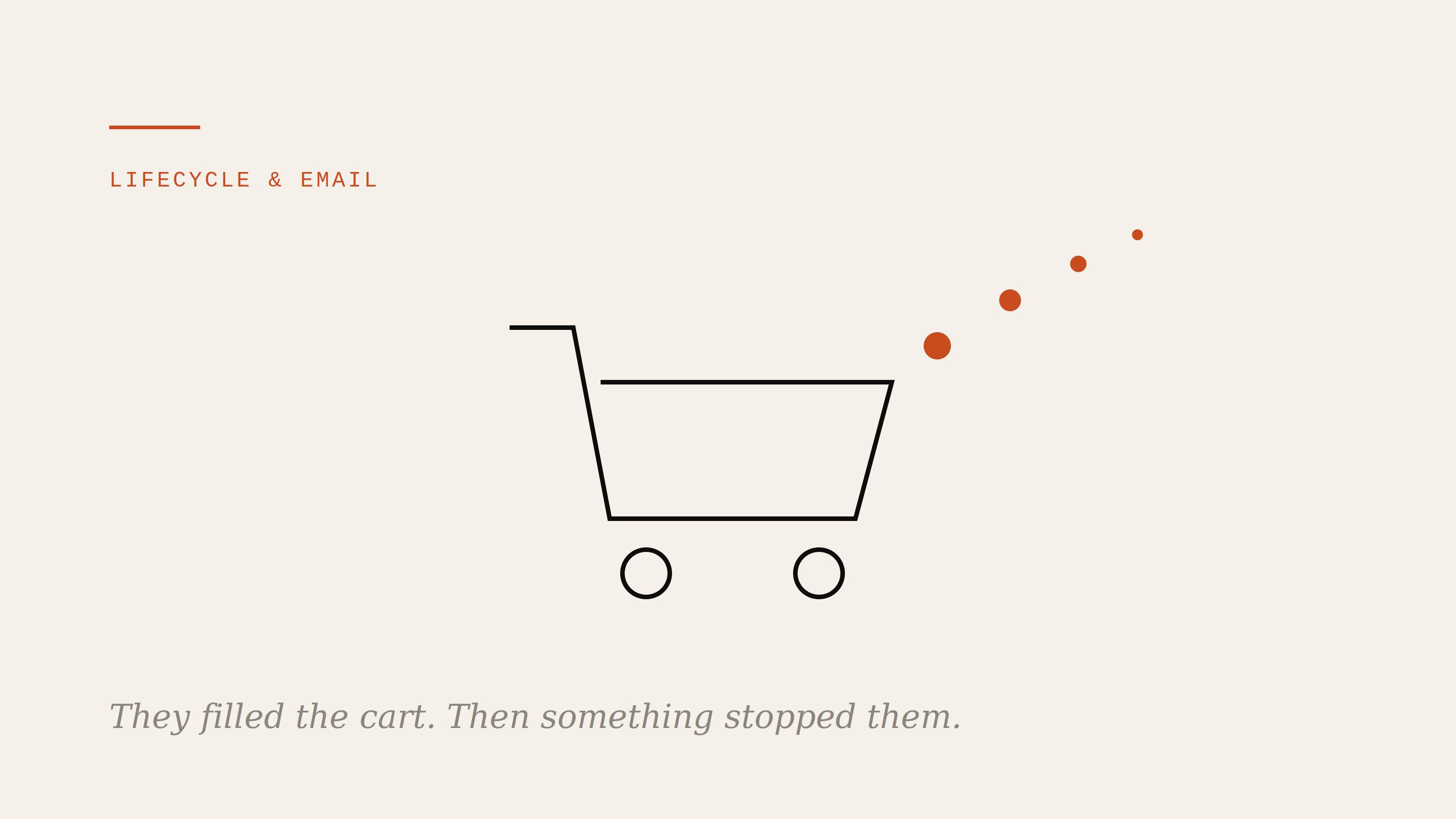
Carts get abandoned for five distinct reasons – doubt, friction, distraction, trust, and price. A discount only addresses price, and it teaches your best buyers to wait for a code. Resolve the doubt instead of buying the transaction.
The abandoned cart discount is the most overused tactic in ecommerce. It feels like a recovery mechanism. In practice it is training your customers to abandon carts on purpose, because you have taught them that abandoning is how you get a better price.
A cart gets abandoned for a handful of distinct reasons, and they call for completely different responses. Unresolved doubt about the product – a question that was never answered. Friction in the checkout. Distraction, not indecision – the intent was there, the moment passed. A lack of trust in the brand. And, sometimes, a price that does not feel justified yet. Only the last of those is a price problem, and only sometimes – yet the discount addresses exactly one cause and does nothing for the other four.
A customer who came back without a discount is worth more than one who learned to wait for one.
– The Antimony position
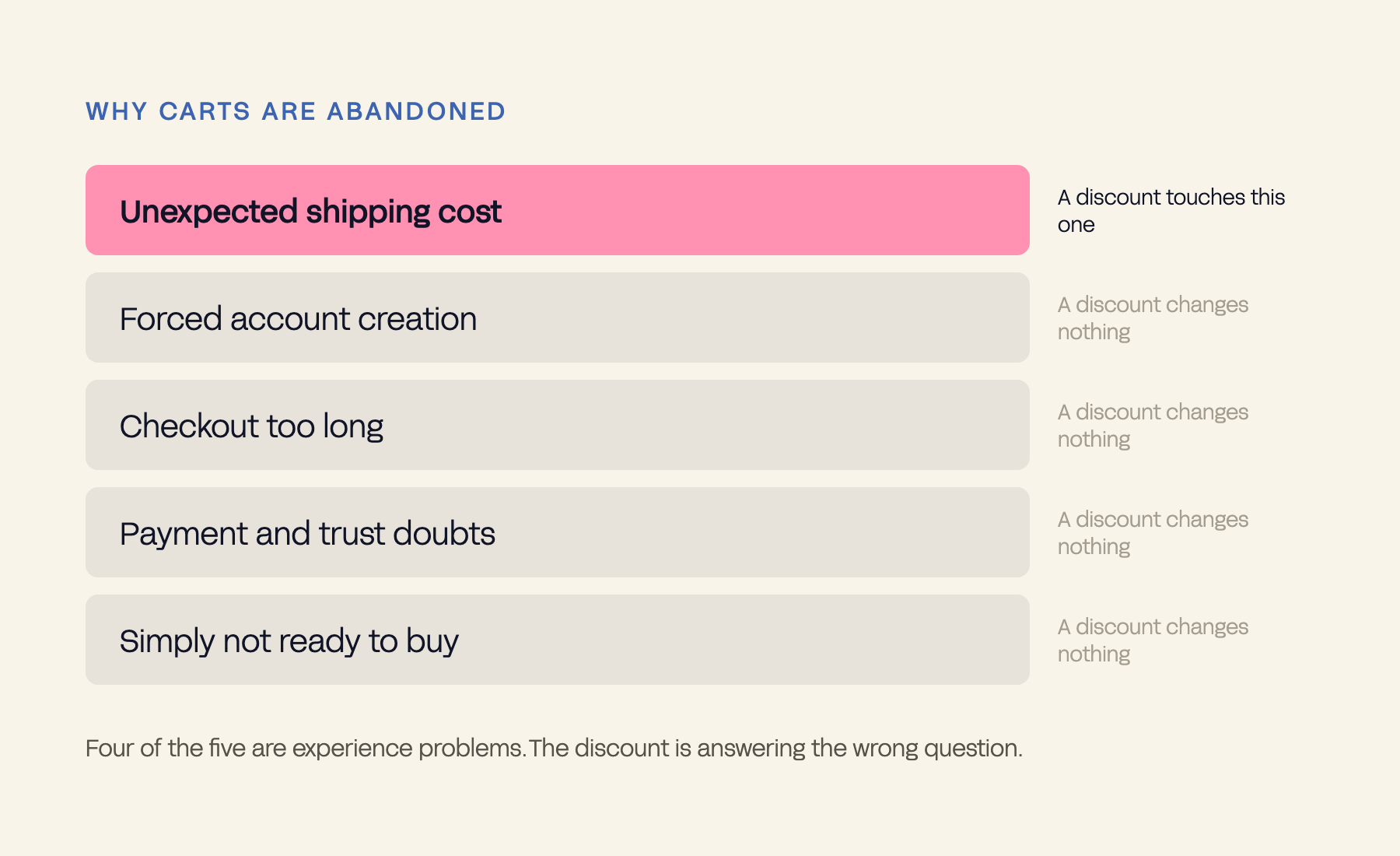

Email 01 reminds. “You left something behind.” No discount, no pressure – a clean, frictionless path back. A significant share of abandonment is distraction, and for those customers a reminder is all that was needed. Email 02 resolves doubt. It answers the question the customer was likely asking before they left – sizing, materials, delivery, returns. Email 03 builds confidence. Social proof, a testimonial from someone with the same hesitation, a guarantee that makes the decision feel safe. A nudge from confidence, not a countdown timer.
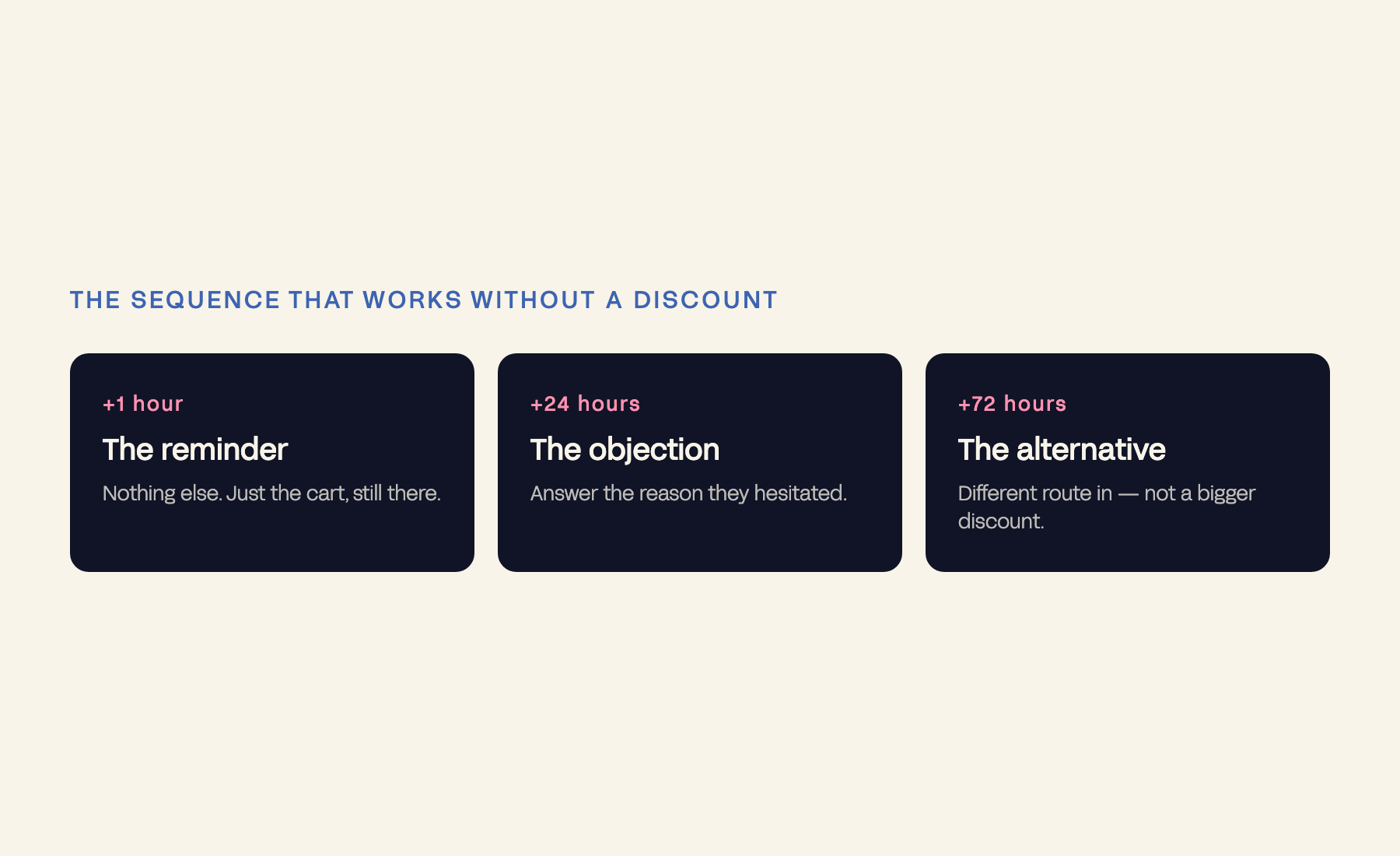
Not, strictly, to recover the sale – to resolve the doubt that prevented it. Fix the doubt and the sale follows naturally. Reach for the discount first and you have fixed nothing: you have bought a single transaction and taught the customer to expect the same discount next time. One approach builds a relationship; the other builds a habit that costs margin on every order. Request the Brand Retention Audit to see whether your flow is discounting doubt away instead of resolving it.
Femme Connection is the clearest evidence we have that flows beat discounts, because the numbers separate cleanly. The Klaviyo program – the automated flows, the abandoned cart sequence among them – is measured on its own.
That last pairing is the argument. A brand that recovers carts by discounting trains its customers to wait for the discount, and the profit line shows it. Femme’s flow revenue grew while profitability improved and sentiment climbed, which only happens when the sequence resolves the actual hesitation rather than buying its way past it.
Read the case study. The same infrastructure logic underpins Ka Ka Wa, where revenue grew 120% in year two on a product range that never competed on price.
Definitions. Cart abandonment: adding to cart without completing checkout. Flow: an automated triggered email sequence.