


Let’s talk

Thank you! Your submission has been received!
Oops! Something went wrong while submitting the form.

B2B buyers complete roughly 70% of their research independently before engaging with a seller. That means the majority of the sale is conducted by whatever they encounter without you: your published material, third-party mentions, and increasingly an AI summary of both. Sales enablement cannot reach that stretch of the journey.
The uncomfortable implication of this statistic is not that buyers are better informed. It is that most of your selling is already being done by material you may never have thought of as sales material.
B2B buyers conduct about 70% of their research independently before engaging with a seller. By the time anyone speaks to you, the shortlist usually exists and the criteria are usually set.
Which means the decisive work happened while you were absent, performed by your published material, third-party mentions of you, and – increasingly – a generated summary of both.
Most of your selling happens while nobody from your company is in the room. The only question is what is doing it.
– The Antimony position
Treating published material as awareness-stage misreads its job. For 70% of the journey it is the sales conversation, which is a different brief: it has to answer the objection, state the price shape, and address the risk a buyer will not raise until much later.
The most useful thing during unaccompanied research is evidence someone comparable succeeded. This is why leaving case studies unlinked is expensive – we had 36 case studies and zero links to them from nineteen articles, which meant the strongest sales asset was unreachable during the stretch of the journey that matters most.
The research is increasingly conducted through systems that summarise. If those cannot describe you confidently, you are absent from the shortlist rather than merely behind on it – the argument in The Entity Problem.
Written content alone is rarely sufficient now; buyers expect the material in the formats they use – video, visual explanation, audio, dynamic documents. And they are looking for a distinct voice, because a brand is increasingly judged on what people understand, repeat and believe rather than what it says.
For a multi-role buying group, consistent visual and verbal codes across decks, dashboards and events measurably improve recognition – the practical argument for the identity systems in Modular Identity Systems.
Future Isles is the clearest version of this working. Three in four inspections arrived pre-qualified, on a programme returning 8:1 on marketing investment across $26.5M transacted – buyers who had already done the work and arrived decided.
Lindsay Ryan shows the vendor-side equivalent: 4.5× qualified vendor enquiries from digital channels, because the brand was answering the judgement question before any conversation happened.

Our published material was doing this job badly in a way that had nothing to do with writing. Articles rendered no author or publish date, so every claim was unattributed and undated. Case studies were linked from nothing.
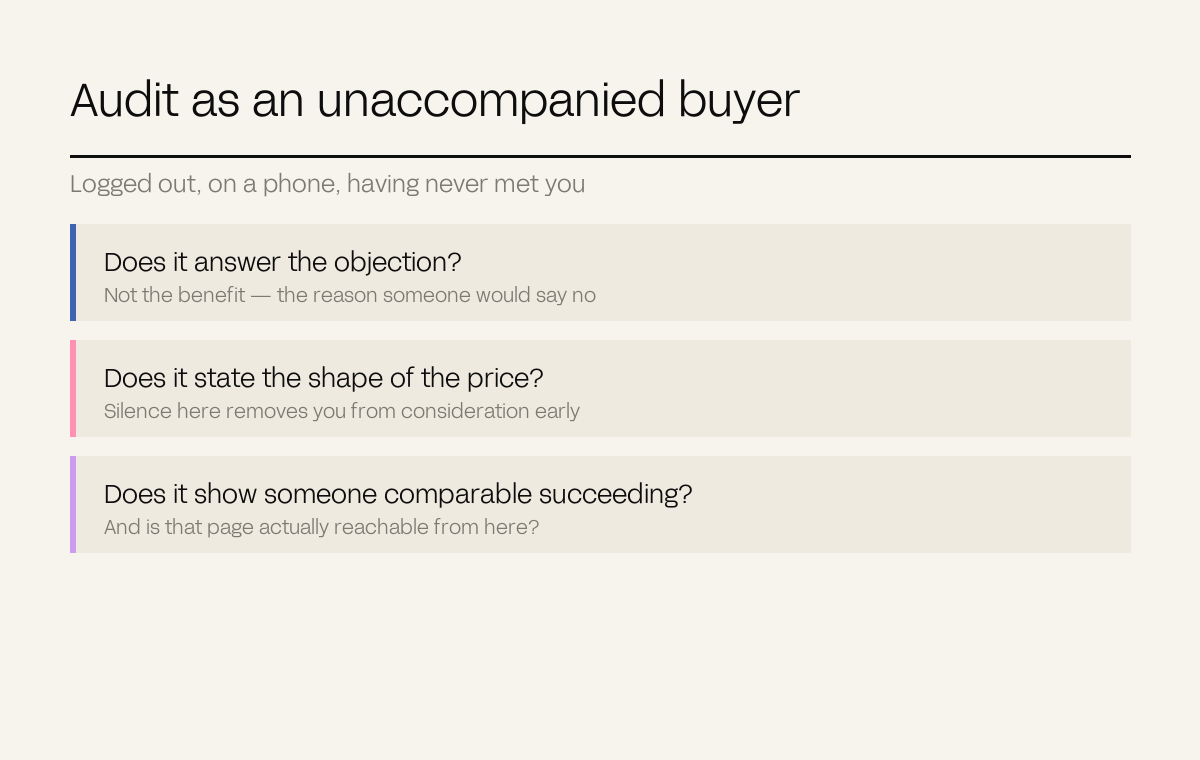
The general rule: audit your material as an unaccompanied buyer, not as a marketer. Open it logged out, on a phone, having never met you, and ask whether it answers the questions someone would need answered before they were willing to make contact. Most of what is missing is provenance and evidence, not persuasion.
Definitions. Buying group: the multiple roles involved in a B2B purchase decision.