


.png)
Let’s talk

Thank you! Your submission has been received!
Oops! Something went wrong while submitting the form.
AI systems recommend entities they can identify confidently. Being crawlable is not the same as being known: a model needs consistent naming, clear organisational facts, and corroboration from third-party sources before it will name you in an answer. Most brands have never tested how they are described, and a significant number find the description is wrong.
There is a test worth running before you spend anything else on visibility. Ask ChatGPT, Gemini and Perplexity who your company is. Then read the answers as though you were a prospect.
Brands are routinely described as the wrong kind of business, located in the wrong city, or confused with a similarly-named company. Some get a confident, entirely fabricated summary. Others get an admission that the system does not know.
A model deciding whether to name you in an answer is making a judgement about confidence. It is not asking whether your site exists. It is asking whether it can say who you are without being wrong.
That confidence is built from agreement across sources. Your own site is one voice, and a self-interested one. What resolves ambiguity is the same facts appearing consistently elsewhere – directories, press, profiles, review platforms, client sites, industry bodies.
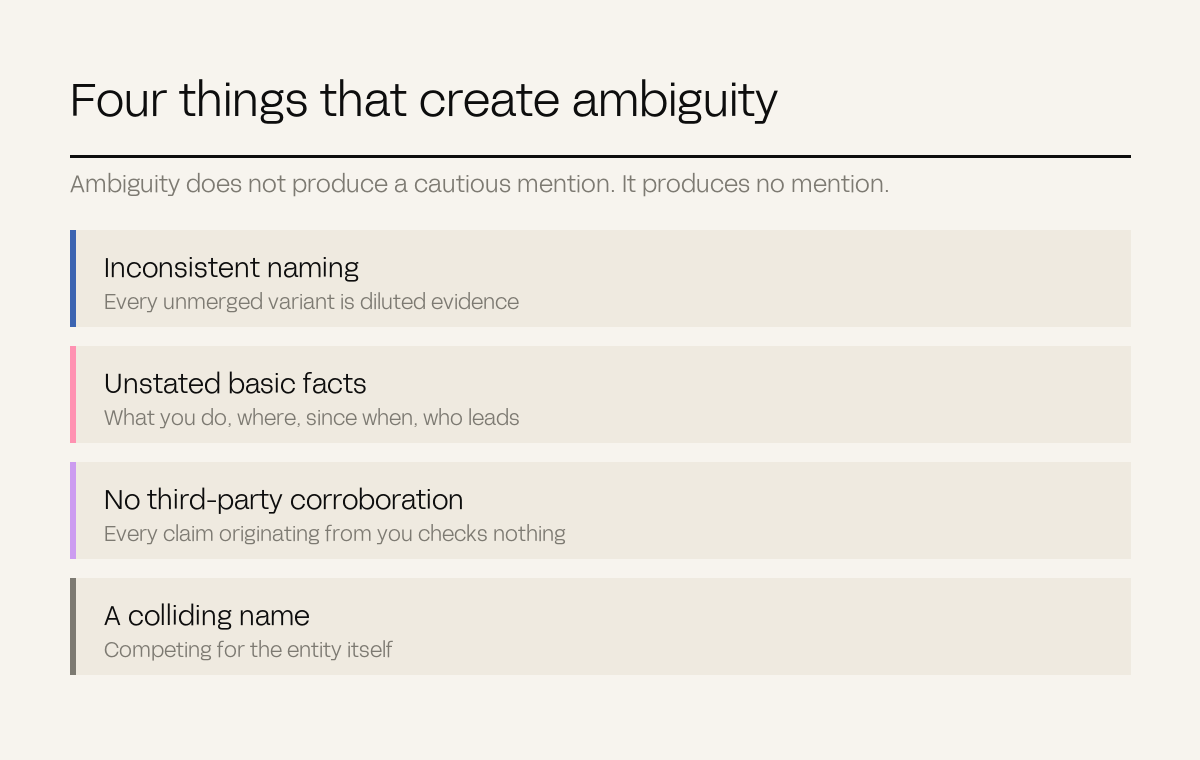
A model will not recommend a brand it cannot confidently describe. Ambiguity does not produce a cautious mention; it produces no mention.
– The Antimony position
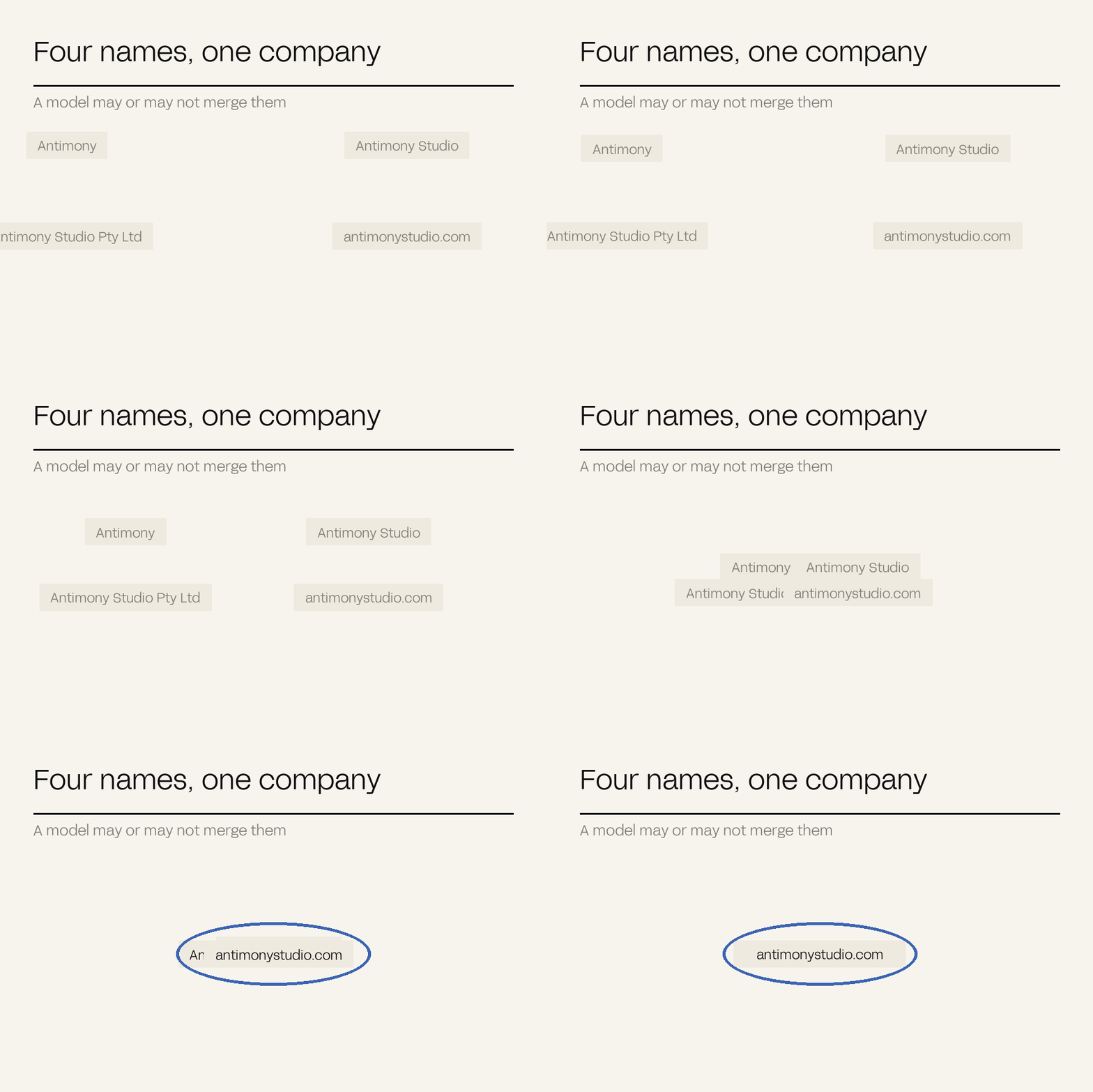
"Antimony", "Antimony Studio", "Antimony Studio Pty Ltd", "antimonystudio.com". A human reads one company. A system building an entity graph may or may not merge them, and every unmerged variant is diluted evidence. Pick one canonical form and use it everywhere, including the places nobody proofreads – footers, directory listings, invoices, social bios.
What the organisation does, where it operates, when it was founded, who leads it. Brands often consider these too dull for the website, or scatter them across an About page in prose. A model needs them stated plainly and, ideally, in structured data.
If every claim about you originates from you, there is nothing to check it against. This is where unlinked brand mentions now matter more than backlinks – the citation model is closer to fact-checking than to link equity.
If you share a name with a chemical element, a town, or a larger company, you are competing for the entity itself. That is a real strategic cost, and it argues for always pairing the name with a disambiguating descriptor in public copy.
Our baseline scored GEO 61, and the diagnosis was not content quality. It was that the facts a model needed were either missing from the page or present in the CMS and never rendered.
Concretely: our journal articles had author and publish-date fields populated and displayed neither, so every article was an unattributed, undated claim. Our own case studies – the third-party-corroborated proof, with named clients and real figures – were not linked from a single article. And the site-wide copyright line misspelled the brand name on every page, which is exactly the kind of small inconsistency that fragments an entity.
None of that was a content problem. All of it was an identity-legibility problem, and it is the cheaper of the two to fix.
The general rule: audit the boilerplate before you audit the content. Footers, copyright lines, directory entries, email signatures and social bios are written once, proofread never, and repeated on every page – which makes them the highest-multiplier errors on a site. Ours misspelled the company name on every single page for an unknown length of time.
The corroboration problem has the same character. Our strongest third-party evidence – named clients with real numbers, like Femme Connection's $1.5M in email flow revenue or Lindsay Ryan's 4.5× lift in qualified vendor enquiries – was already published and simply disconnected from everything that made the argument.
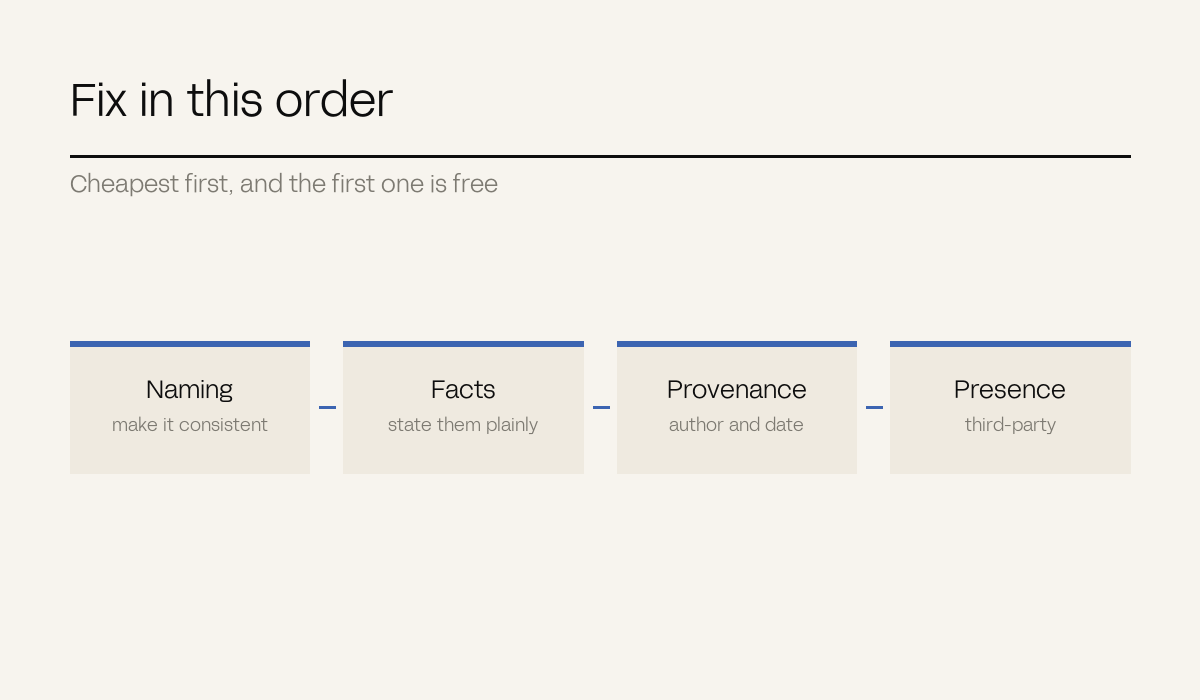
Fix naming consistency everywhere first, because it is free. Then state the basic organisational facts plainly on the site and in Organization schema. Then render provenance – author, date, source – on everything you publish. Then work on third-party presence: directories, review platforms, genuine coverage. Then re-run the test at the top of this article and see whether the description has changed.
Definitions. Entity: a distinct thing a system can identify and hold facts about. Entity graph: the network of entities and relationships a system reasons over. Corroboration: independent sources agreeing on a fact.