


.png)
Let’s talk

Thank you! Your submission has been received!
Oops! Something went wrong while submitting the form.
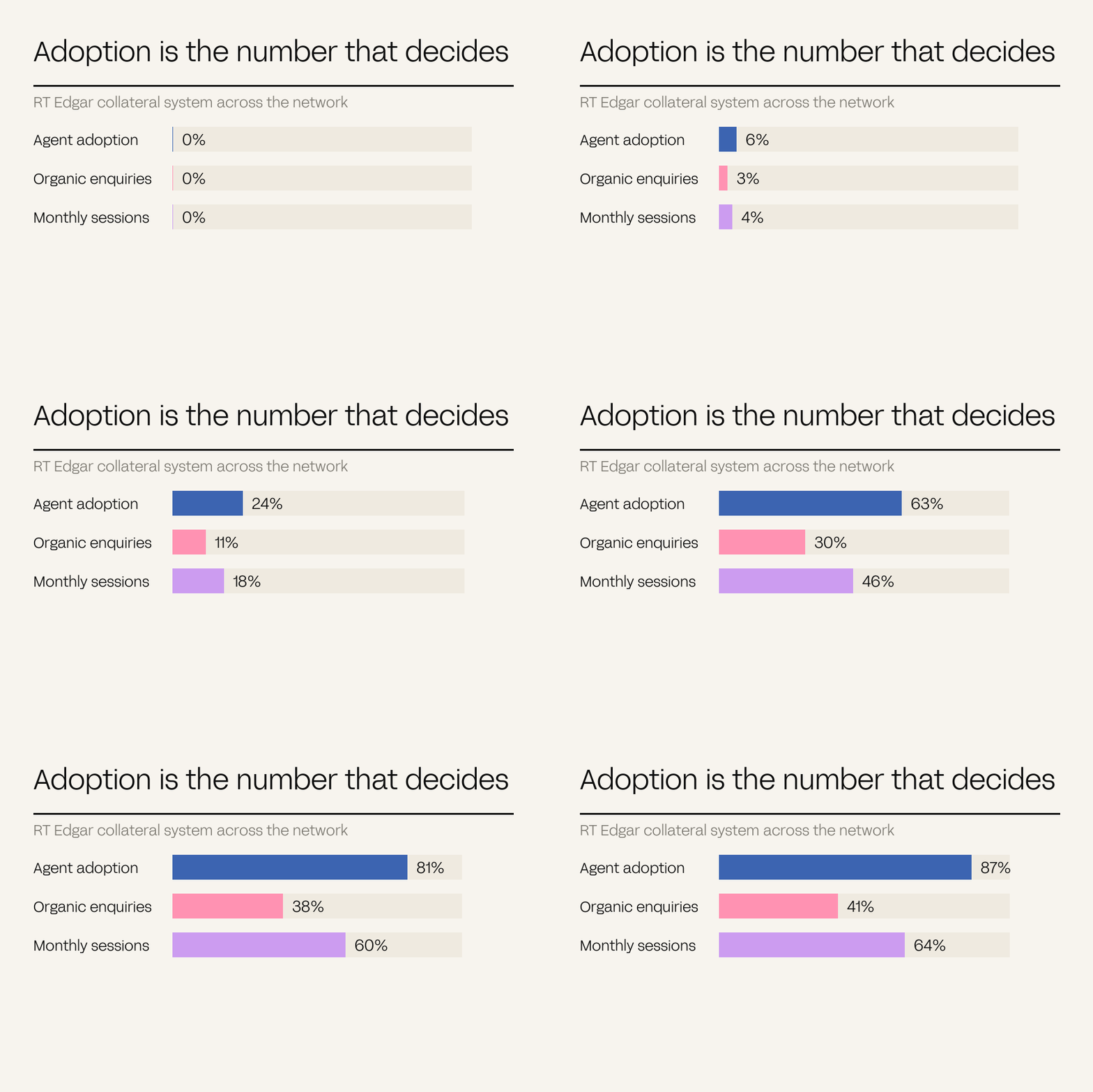
Publishing cadence has outgrown the studio bottleneck: a brand shipping daily cannot have a designer approve every asset, so the identity has to be a system non-designers can run correctly. The number that decides whether a system works is adoption. RT Edgar's collateral system reached 87% adoption across its network, and the enquiry lift followed from that.
Most identity systems are designed for a world where a designer touches everything. That world ended for any brand publishing more than weekly.
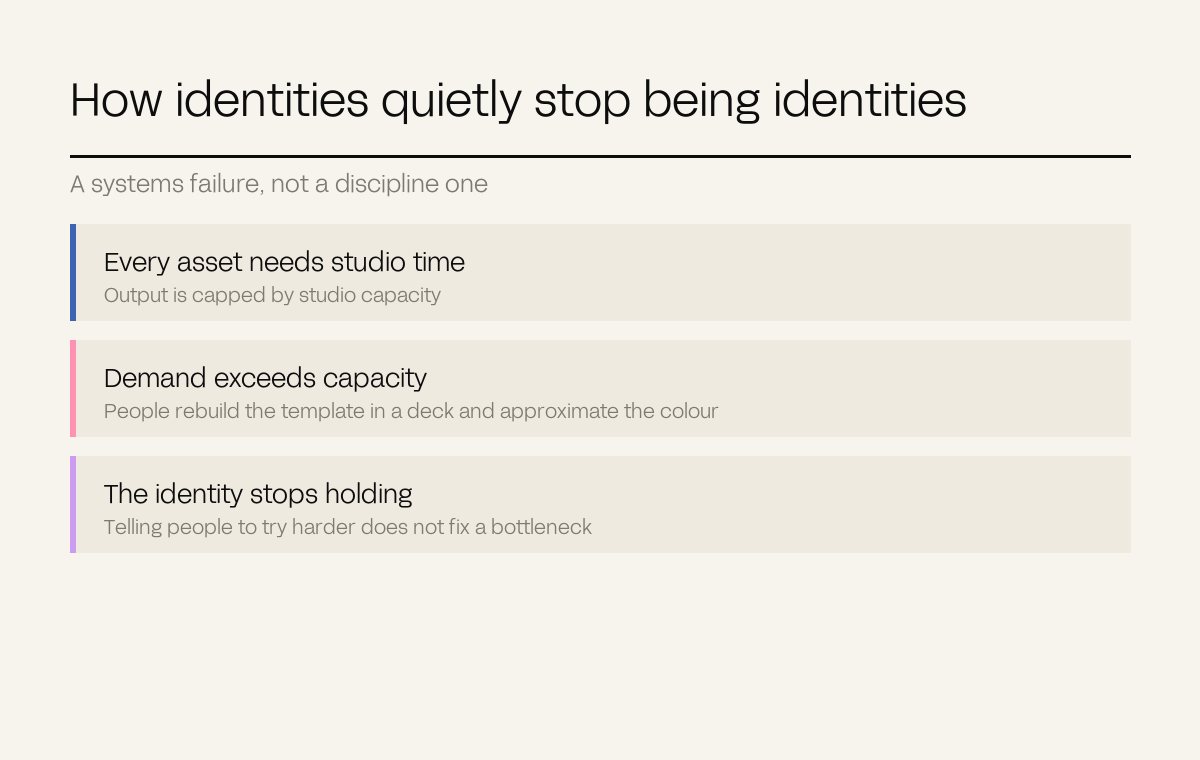
If every asset needs studio time, output is capped by studio capacity – and the moment demand exceeds it, people improvise. They rebuild the template in a deck, approximate the colour, substitute a system font. The identity does not hold and then quietly stops being an identity.
The failure is predictable, and it is a systems failure rather than a discipline one. Telling people to try harder does not fix a bottleneck.
An identity used by a third of your organisation is not an identity. It is a preference some people have.
– The Antimony position
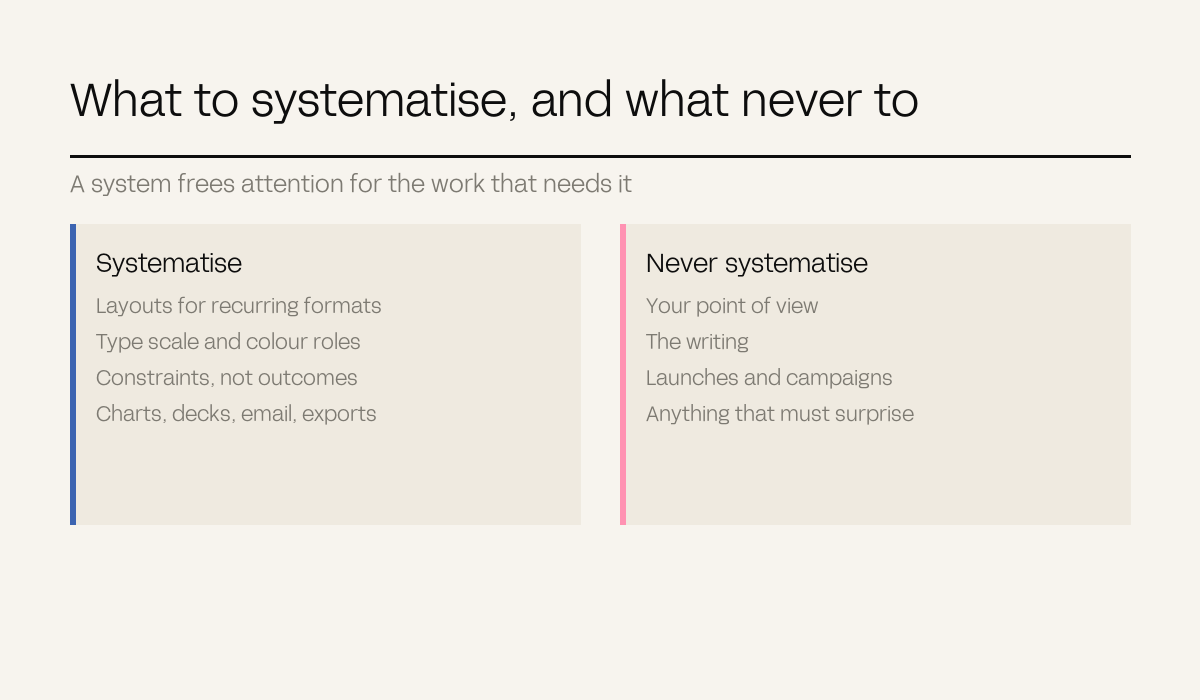
Layouts for recurring formats, the type scale, the colour roles, spacing, and the rules for images. Anyone should be able to produce a correct asset for a known format without judgement.
A good system says what cannot happen – never these two colours together, never this typeface below this size, never a headline over an image without this treatment. Constraints permit variety while preventing drift; rigid templates get abandoned the moment reality does not fit.
Charts, decks, exports, email, automated social. These are frequently the highest-volume surfaces a brand has and almost always the least governed. Every figure in this series is generated programmatically from a shared module holding the palette and typeface – which is the only reason fifty-odd diagrams look like one brand.
The brand's point of view, the writing, and any moment that carries real weight – a launch, a campaign, an apology. Systems produce consistency, which is exactly what you do not want when the job is to be surprising or to sound like a person.
A system exists so that the routine work does not consume the attention the exceptional work needs.
RT Edgar had genuine market authority and no way to express it consistently across a network of agents each producing their own material – the classic distributed-identity problem.
We built a collateral system agents could run themselves, in the field, on any listing. The number that proves it worked is not aesthetic:
Had adoption been 30%, none of the rest would have followed. A system nobody uses changes nothing, however well designed. Read the case study.
We published nineteen articles in nineteen days from a template that rendered no author and no publish date, because the CMS held both and the template never output them. One template gap, reproduced nineteen times before anyone noticed.
The general rule: a systematised error scales exactly as fast as a systematised standard. Before increasing cadence, audit the template itself – because at speed you are no longer producing pages, you are producing copies of whatever the template already gets wrong.
Definitions. Modular identity: an identity expressed as reusable components and rules rather than fixed artefacts.