


Let’s talk

Thank you! Your submission has been received!
Oops! Something went wrong while submitting the form.
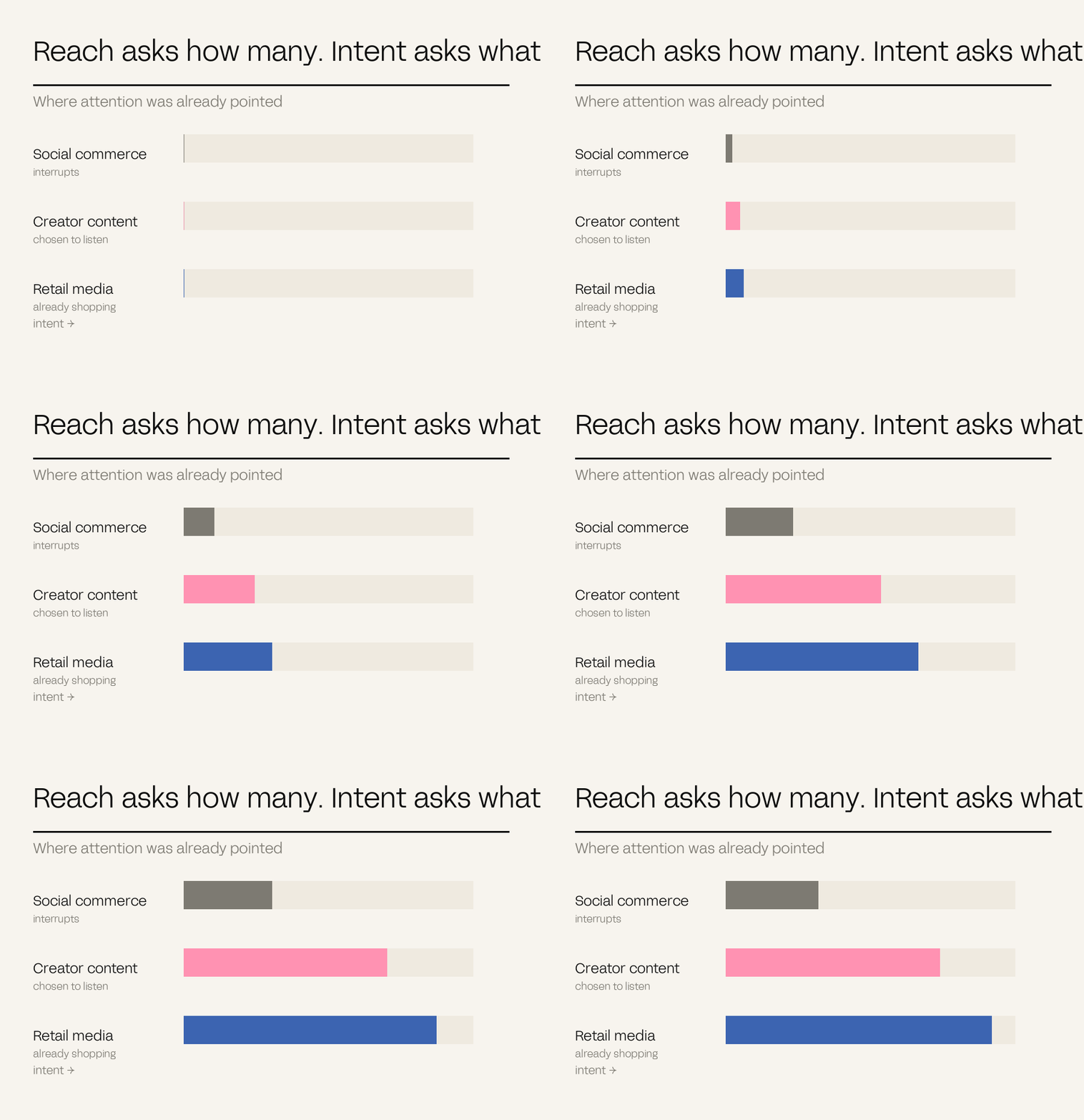
Influencer marketing and retail media are overtaking social commerce as high-intent channels. Retail media reaches people already shopping; creator content reaches people who chose to listen to someone they trust. For a brand with a modest budget the implication is to follow intent rather than reach, and to treat the marketplace listing as a brand surface.
The channel that worked three years ago is not necessarily the channel that works now, and the current reordering is worth understanding before renewing a media plan.
Influencer marketing and retail media are overtaking social commerce as high-intent channels. The distinction is intent: retail media reaches someone already in a shopping context, and creator content reaches someone who actively chose to listen to a person they trust.
Social commerce interrupts. The other two arrive where attention was already pointed.
Reach asks how many people saw it. Intent asks what they were doing when they did.
– The Antimony position
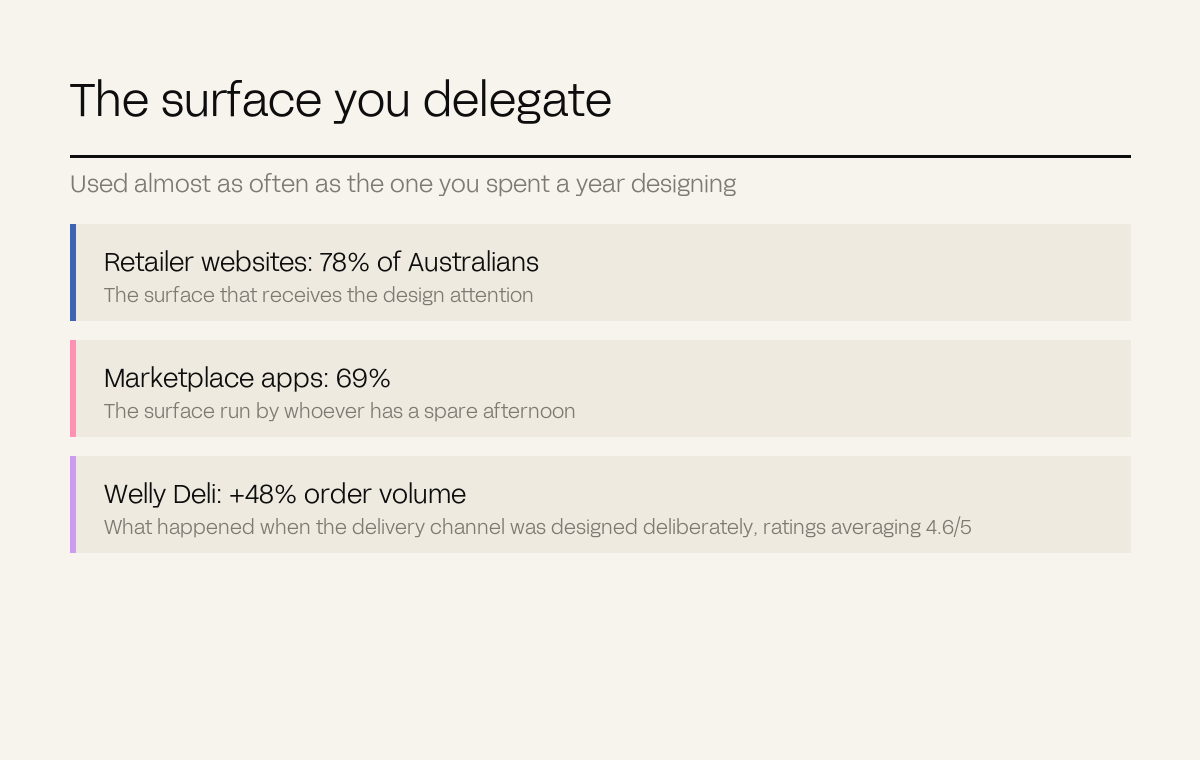
Marketplace and delivery-platform placement now sits close to the point of purchase, and in Australia the surface is nearly as common as your own site: marketplace apps at 69% against retailer websites at 78%.
Most operators treat that surface as a directory entry. Welly Deli treated it as design work – deliberate Uber Eats channel design, packaging and photography direction as part of one system – and order volume rose 48% with ratings averaging 4.6 out of 5. Revenue rose 28% overall.
We covered the full argument in Hospitality, Retail and DTC Are One Channel Now.
The failure mode is buying reach – an account with a large following paid to mention you, producing content the audience discounts immediately.
What works is people who already use the product. SADA MEN built a 286-strong ambassador program from customers, and it became the selling engine for a brand that had to earn permission before revenue in a category men were not yet convinced was for them.
Isadora Nim connected creator-adjacent activity – trunk shows, activations, events – back to bookings, with 27% of Meta leads converting to booked consultations and content engagement up 78% year on year.
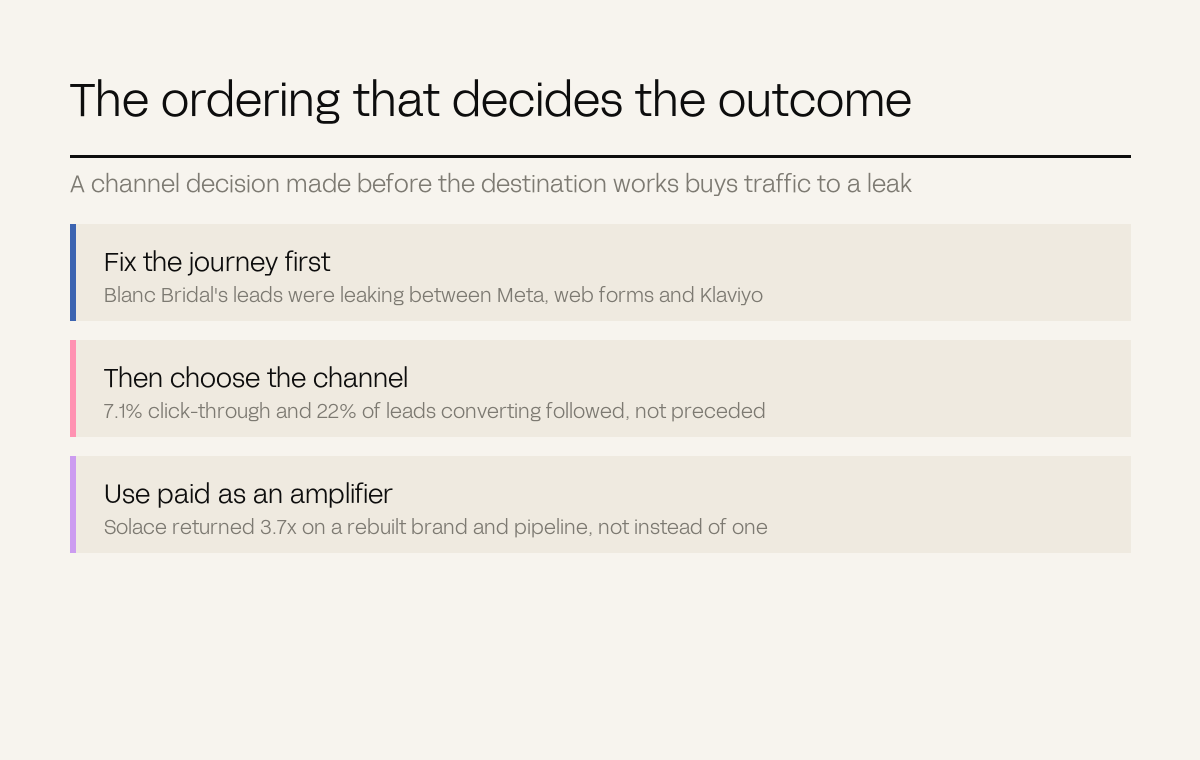
As an amplifier on something already working. Solace returned 3.7× on paid media with qualified inbound up 210%, reaching four states – on the back of a rebuilt brand and pipeline, not instead of one.
Blanc Bridal ran a 7.1% click-through rate with 22% of Meta leads converting to consultations, because the journey behind the ad had been joined up first.
Every one of those numbers came after the brand and the journey were fixed, not before. Blanc's leads had been leaking between Meta, web forms and Klaviyo; spending more on the ad would have sent more people into the same gap.
The general rule: a channel decision made before the destination works is a decision to buy traffic to a leak. Audit what happens after the click before reallocating budget between channels – the channel is rarely the constraint.
Definitions. Retail media: advertising placed within retail and marketplace environments. Social commerce: buying within a social platform.