


Let’s talk

Thank you! Your submission has been received!
Oops! Something went wrong while submitting the form.
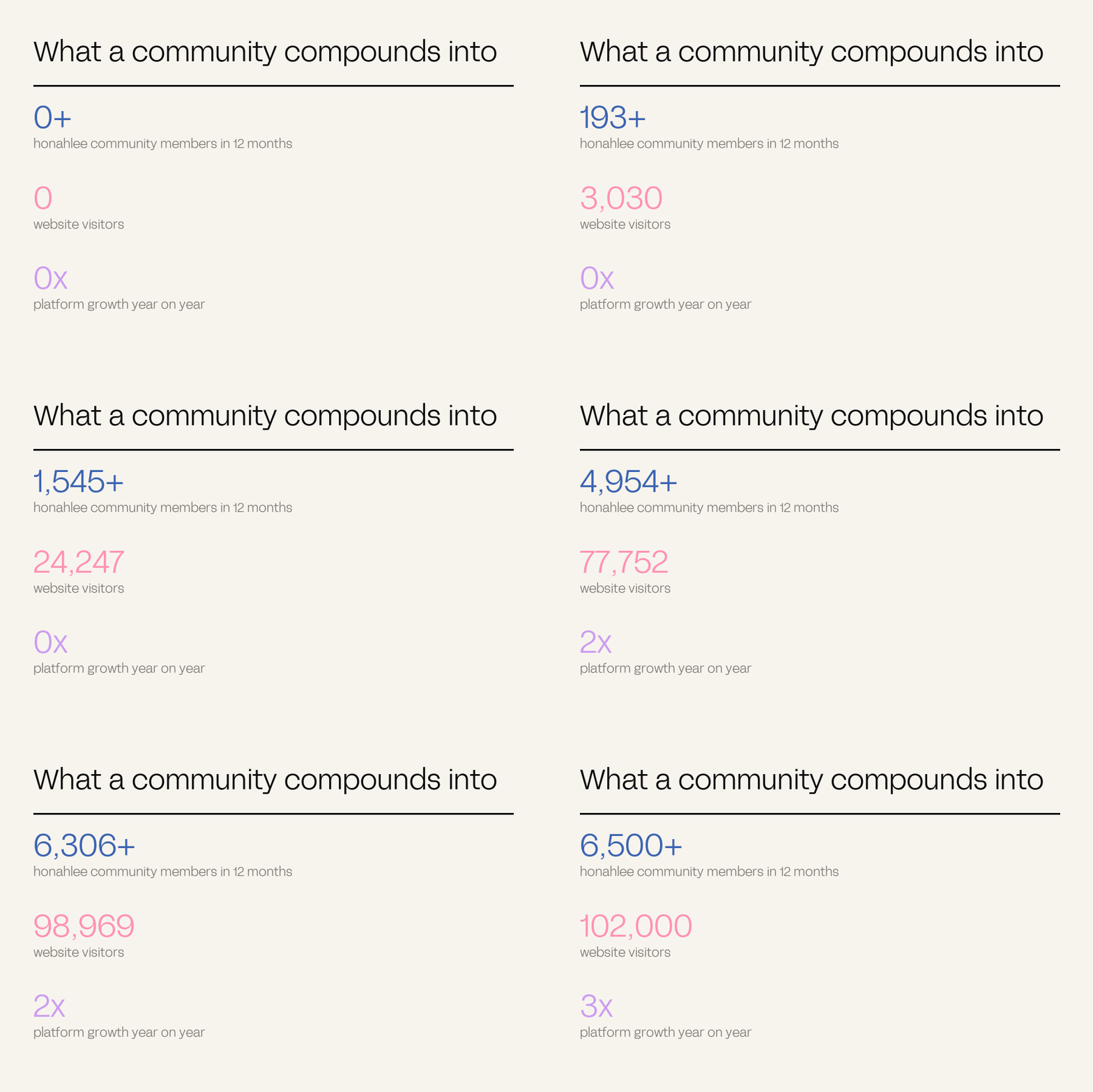
Community commerce works when membership has value independent of the brand's marketing – a reason to return that survives you going quiet. It compounds where paid does not, because members recruit members. honahlee reached 6,500+ members and 102,000 visitors in twelve months with 3x platform growth year on year.
Most brand communities are mailing lists with a friendlier name. The distinction that matters is whether the group has any reason to exist when the brand stops posting.
An audience is people who receive what you send. A community is people who get value from each other, with the brand as host rather than broadcaster.
The test is simple: if you went quiet for a month, would anything still happen? For most brand communities the honest answer is no, which means what exists is a distribution list with a Discord attached.
If nothing happens when you stop posting, you do not have a community. You have an audience with a nicer name.
– The Antimony position
Paid acquisition is linear: you get roughly what you pay for, and it stops the day you stop. A functioning community recruits on your behalf, produces content you would otherwise commission, and retains members through the relationships between them rather than the one with you.
It is also the pillar most consistently named in current DTC strategy – alongside content, retention infrastructure and advocacy, with paid used as an amplifier rather than the primary driver.
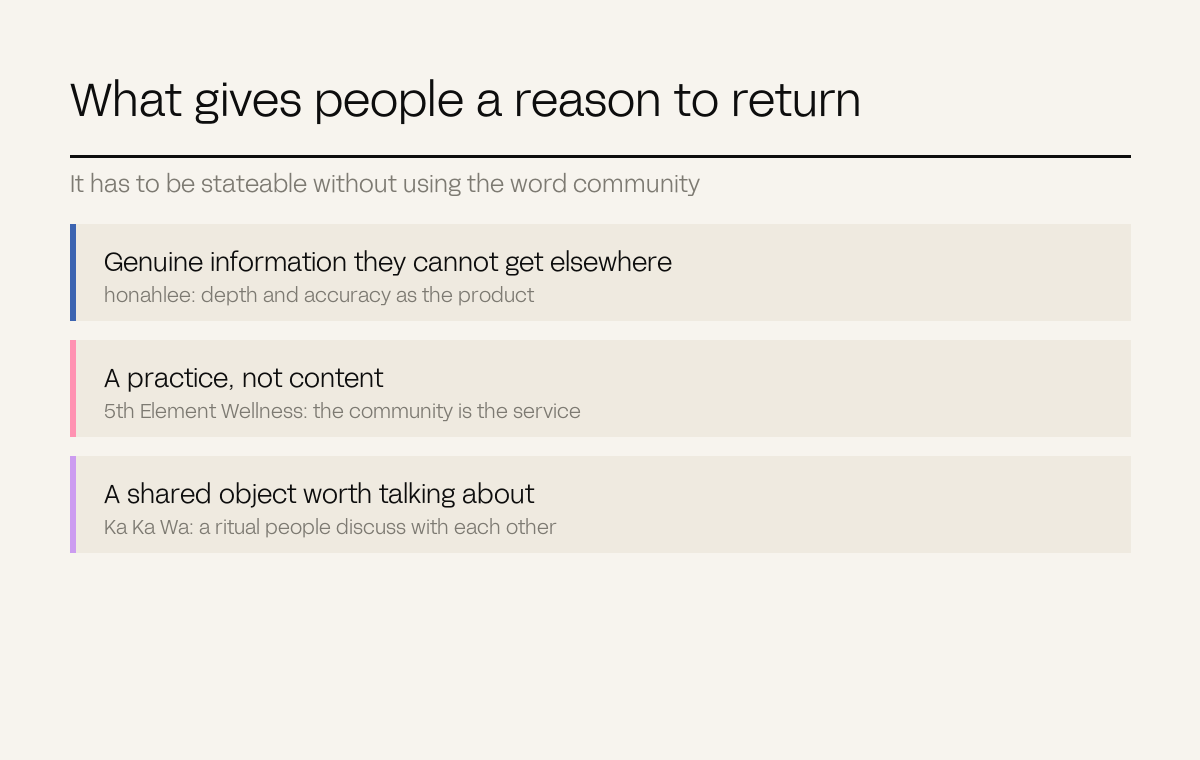
honahlee was built as a trust engine in a category where accurate information is scarce and everyone is selling something. Depth and accuracy were the product, and the numbers followed: 6,500+ community members and 102,000 website visitors within twelve months, with 3× platform growth year on year.
5th Element Wellness added 10,000+ customers to its database in 24 months across a seven-year partnership, with a full business restructure creating three new revenue streams. In a membership business the community is the service, which makes the reason to return structural rather than editorial.
Ka Ka Wa acquired 6,500+ community members and customers within 24 months, revenue up 120% in year two, around a ceremonial product with a genuine practice attached. The ritual gives people something to discuss with each other rather than with the brand.
Carefully, and late. A community that becomes a sales channel too aggressively stops being one – the members feel the shift immediately, and the thing that made it valuable was that it did not feel like marketing.
What works is commerce that follows the community's own behaviour: the product members already asked for, the format they already use, the stockist they already wanted. Byron Bay Bone Broth built a membership program, ambassador engine and structured UGC pipeline as one self-reinforcing loop rather than bolting a shop onto a following.

Brands build the community infrastructure – the platform, the tiers, the badges – before establishing why anyone would join. The infrastructure is visible and satisfying to build; the reason to join is neither.
The general rule: the reason has to exist before the platform, and it has to be specific enough to state in one sentence without using the word community. Full Moon Reset built 1,400+ subscribers around a defined ritual, not around an invitation to be part of something.
Definitions. Community commerce: revenue generated through a community that has value independent of the brand's marketing.