


Let’s talk

Thank you! Your submission has been received!
Oops! Something went wrong while submitting the form.
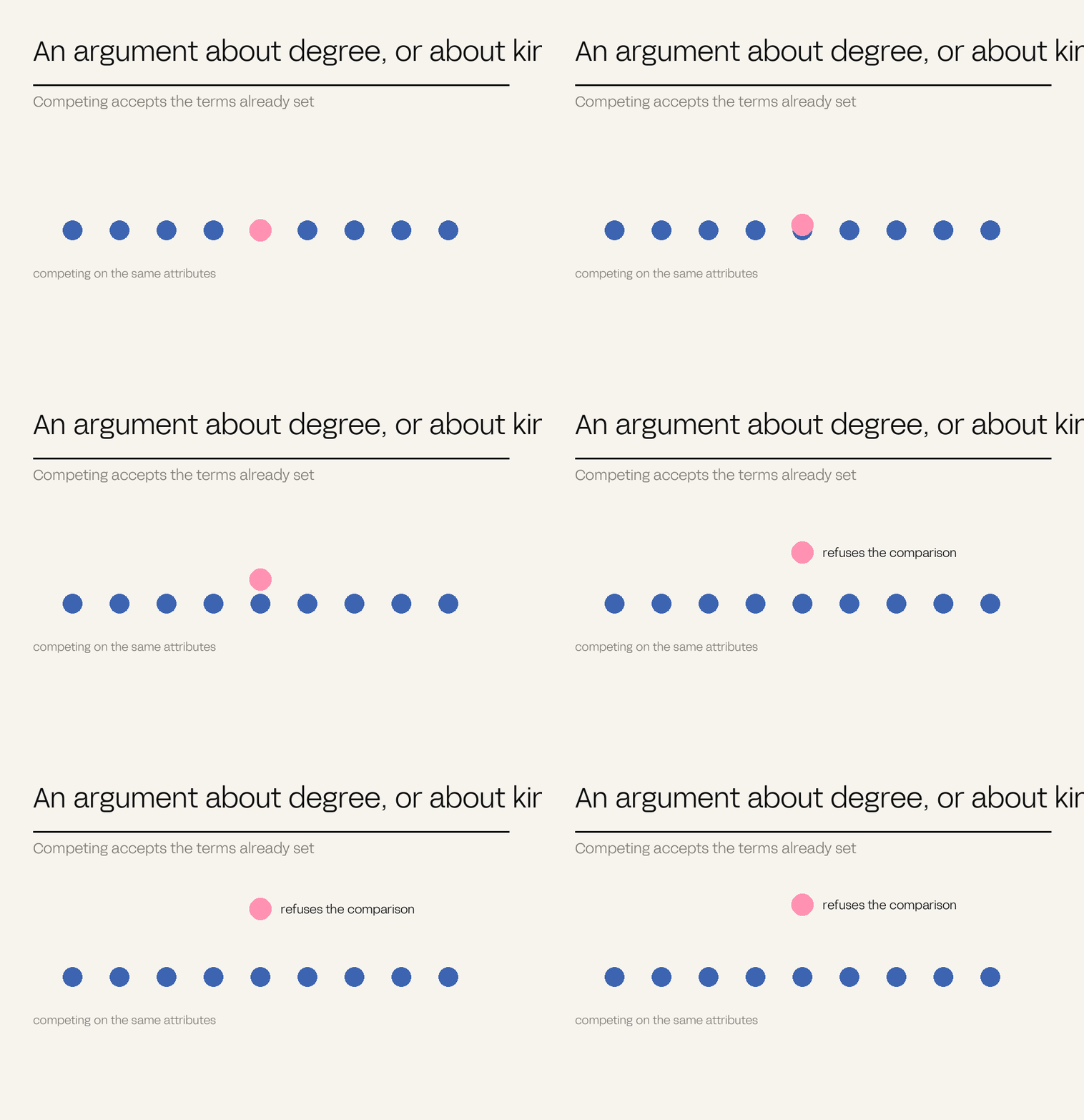
Competing means accepting the terms of comparison your category already set, on attributes your competitors also claim. Category design changes what you are being compared against, which is the only reliable way out of a price argument. The decision is strategic and available early; the execution is a separate problem covered elsewhere in this series.
There is a decision most brands make by default and few make deliberately: whether to be a better version of what already exists, or something the existing comparison does not fit.
Competing accepts inherited terms. The category has already decided which attributes matter, and those are attributes your competitors also claim – which means you are arguing about degree on ground where everyone sounds identical.
The endpoint of that argument is price, because when two things are described in the same words the only remaining difference is cost. And the audit evidence says this is the normal state: across 300+ brand assets from 59 brands in six major B2B categories, most had no distinctive assets at all.
Competing is an argument about degree. Category design is an argument about kind, and only one of them ends somewhere other than price.
– The Antimony position
Category design sounds like something only well-funded companies attempt. In practice the decisive move is usually a refusal – declining to be measured on the attribute the category assumes.
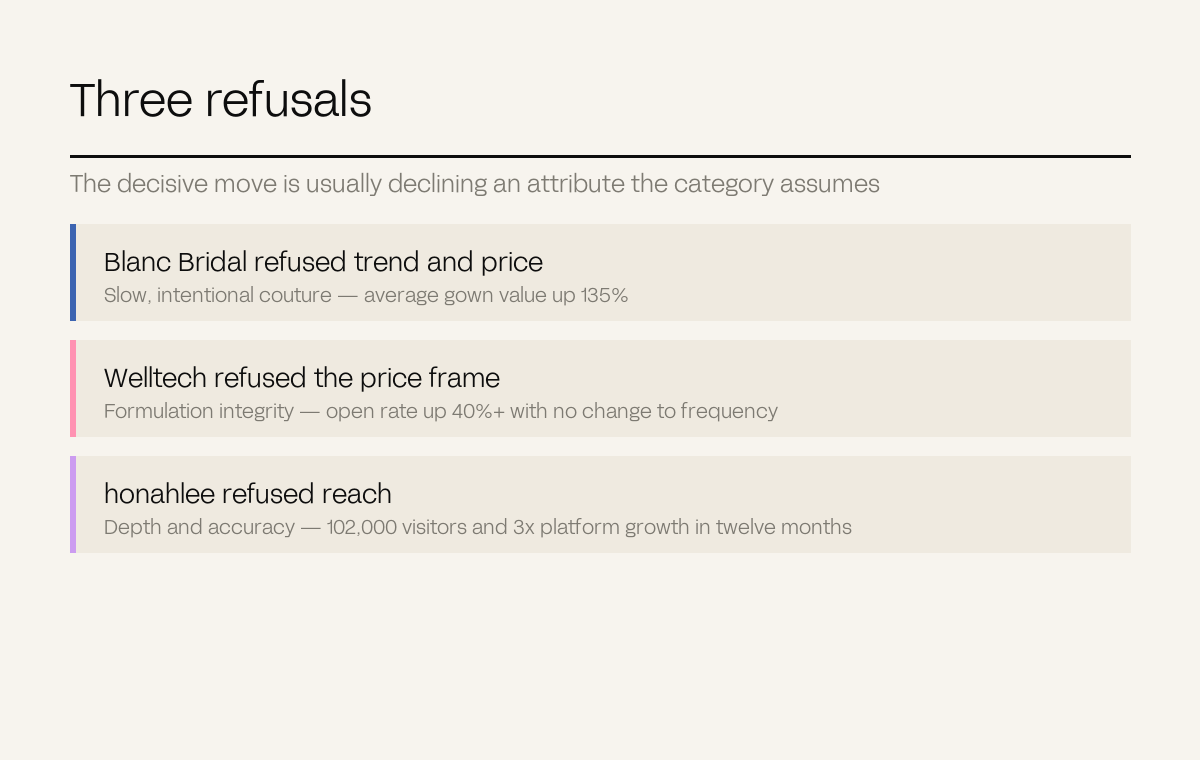
Bridal is loud and largely undifferentiated, with most brands competing on trend and price. Blanc sat in the opposite corner – slow, intentional couture for a considered buyer – and the brand had simply never said so.
Saying it produced average gown value up 135% and consultation bookings up 58%. Not a new category exactly, but a refusal to be compared on the category's terms. Read the case study.
Welltech competed on price and volume in sports and lifestyle nutrition. Moving the argument to formulation integrity produced a 40%+ lift in email open rates with no change to send frequency and 3× growth in retail partnership enquiries. Same list, same channels, different terms. Read the case study.
In cannabis education the obvious play is reach, because the audience is curious and the formats travel. honahlee was built for depth and accuracy instead, and reached 102,000 visitors and 6,500+ community members in twelve months with 3× platform growth. The reach arrived as a consequence of the trust. Read the case study.
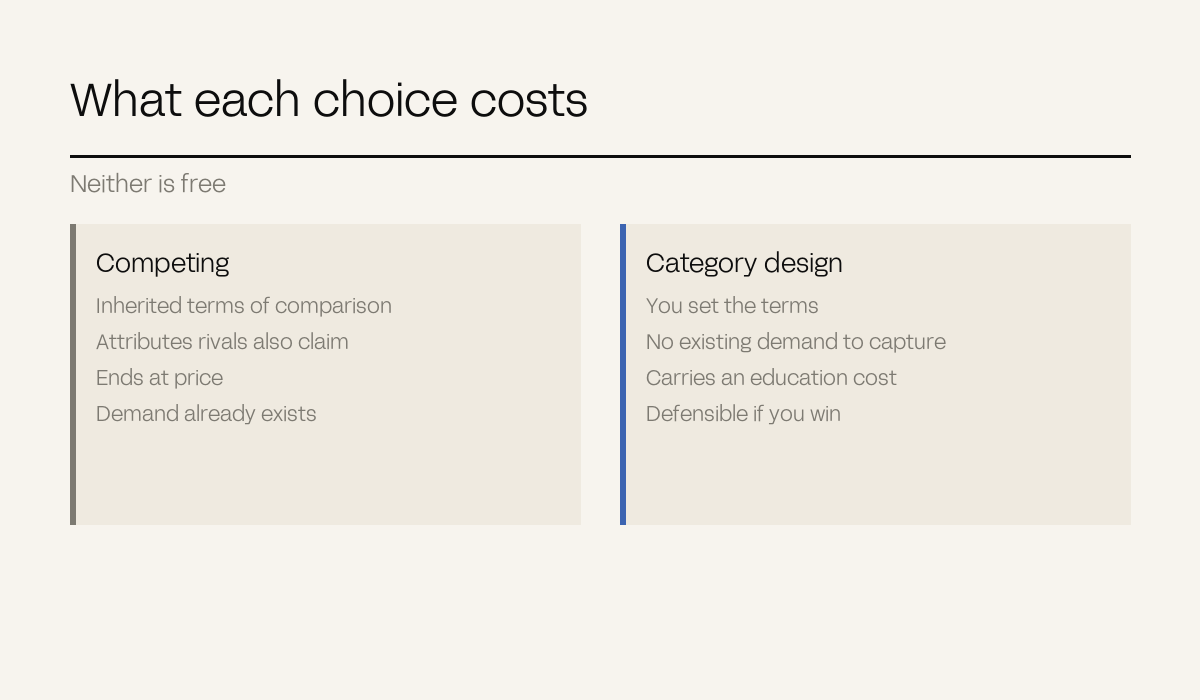
Category design is not free, and pretending otherwise is how it gets attempted badly. You give up the demand that already exists – nobody is searching for a category with no name – and you carry an education cost that a competing brand does not.
The mechanics of paying that cost are a separate problem, covered in How to Launch a Brand in a Category That Doesn't Exist Yet.
The test we use is whether a competitor could publish your positioning statement unchanged. If they could, you are competing, whatever the deck says.
The general rule: run that test on the sentence rather than the strategy. Most brands that believe they are differentiated have a positioning statement their three nearest rivals could adopt verbatim – and the sentence is where the honesty lives, because it is the part customers actually encounter.
Definitions. Category design: defining a new market category rather than positioning within an existing one.