


.png)
Let’s talk

Thank you! Your submission has been received!
Oops! Something went wrong while submitting the form.
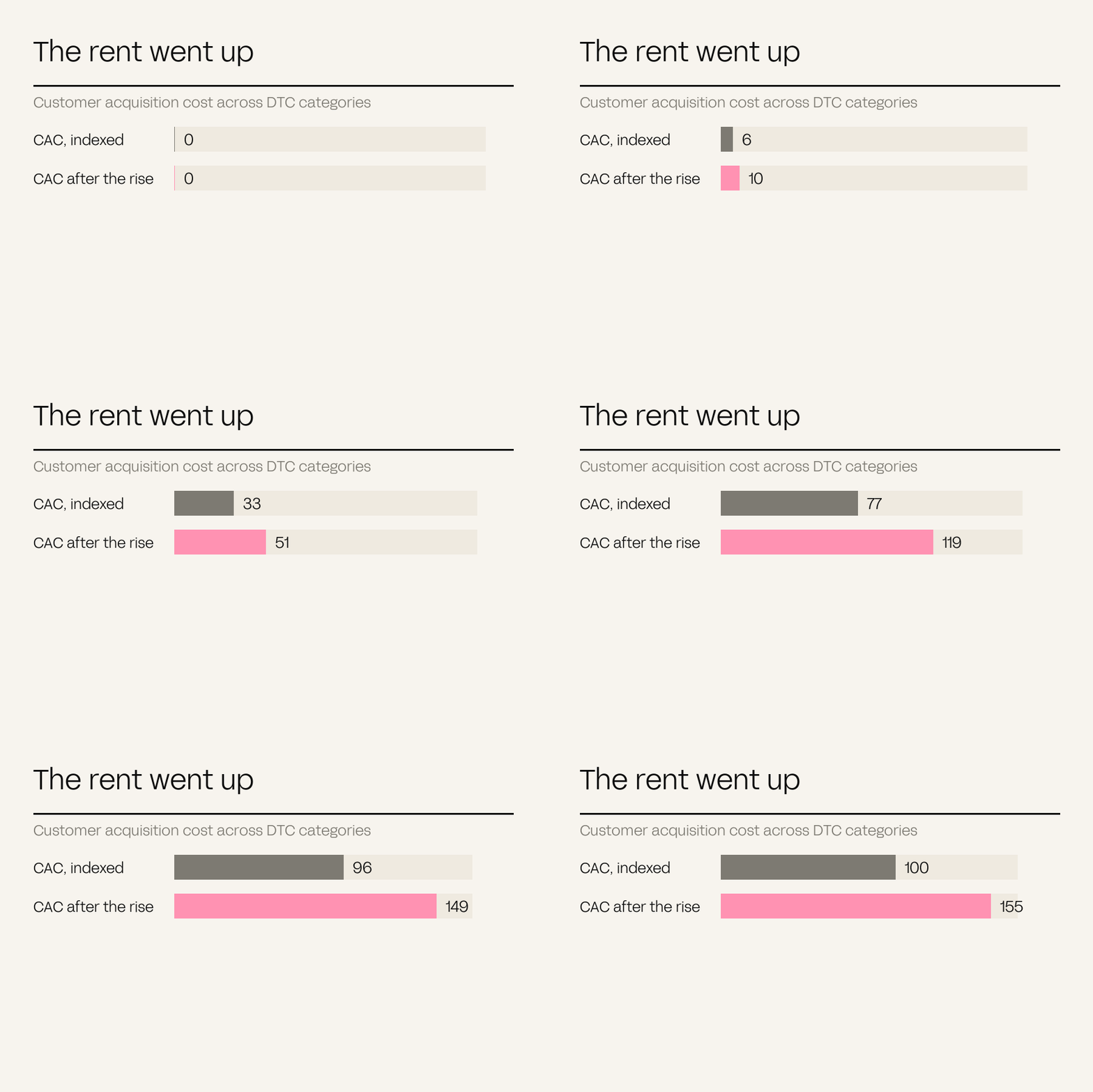
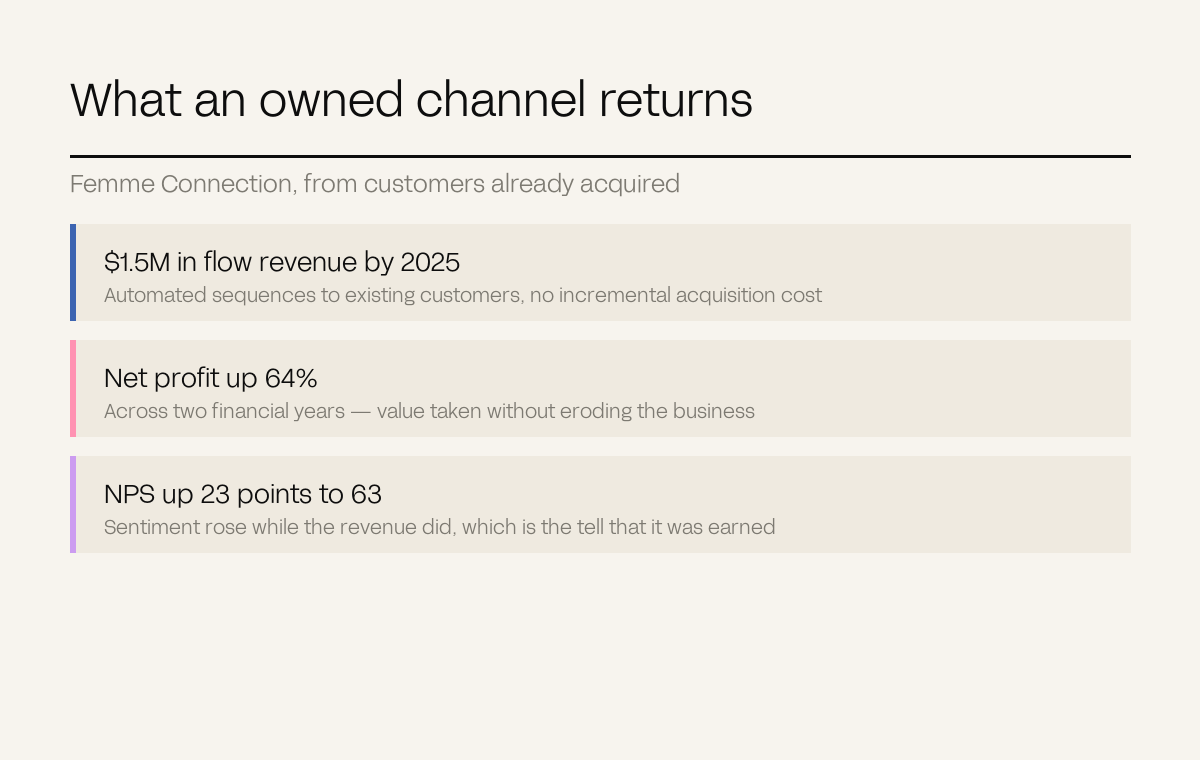
Customer acquisition costs have risen 40–60% across direct-to-consumer categories, and privacy changes have degraded targeting precision at the same time. The brands still growing profitably built owned channels alongside paid acquisition. Femme Connection's email program alone generated $1.5M in flow revenue – from customers already acquired.
Two things happened at once to paid acquisition, and together they changed the arithmetic of building a consumer brand.
Customer acquisition cost has risen 40 to 60% across DTC categories. Simultaneously, targeting precision declined following privacy regulation changes – so you are paying substantially more for audiences defined less accurately.
Neither trend is cyclical. Neither reverses because you optimise a campaign better.
A brand whose growth is rented has no defence when the rent goes up. And the rent went up 40 to 60%.
– The Antimony position
The standard playbook assumed acquisition cost stays roughly flat while lifetime value rises with scale, so you can buy growth now and earn it back later. If acquisition costs rise faster than lifetime value, that loop inverts – and every additional customer bought at the new price makes the position worse rather than better.
The brands that noticed early did not find a cheaper channel. They reduced how much of their growth depended on buying attention at all.
Not "channels we post on". A channel is owned if you can reach the audience without paying a third party for permission, and if the audience does not disappear when a platform changes its rules.
That is a short list: your email list, your customer database, your site, and any community you host rather than rent.
Femme Connection's Klaviyo program alone generated $1.5M in flow revenue by 2025 – automated sequences to customers already acquired, with no incremental acquisition cost. Over the same period net profit rose 64% across two financial years.
That is what a hedge looks like on a P&L. Not a channel that grows faster, a channel whose cost does not rise when the auction does.
Full Moon Reset built 1,400+ subscribers alongside its launch rather than after it, and sold 180+ units within 90 days from 4,600+ sessions. Isadora Nim grew its database 3,200+ in six months with nurture sequences opening at 49%.
Both were built while acquisition was still working. That is the only comfortable time to do it.
The current consensus for DTC is a set of pillars where paid channels amplify rather than drive: content that earns organic traffic, community commerce, retention infrastructure, and advocacy programs that reduce paid creative costs.
Solace shows the amplifier working properly – paid media returned 3.7× and qualified inbound rose 210%, but on the back of a rebuilt brand and pipeline infrastructure rather than instead of one.

Our own audit found the same principle failing in a different medium. We had thirty-six case studies and nineteen articles with zero links between them – the owned asset existed and nothing routed anyone to it.
The general rule: owned channels fail quietly through neglect rather than loudly through cost. A list nobody mails, a site whose best pages nothing links to, a community with no reason to return – these cost nothing per month and return nothing either, which is why they survive unexamined on a budget line while paid gets scrutinised weekly.
Definitions. CAC: customer acquisition cost. Flow revenue: revenue from automated sequences rather than campaigns.