


Let’s talk

Thank you! Your submission has been received!
Oops! Something went wrong while submitting the form.
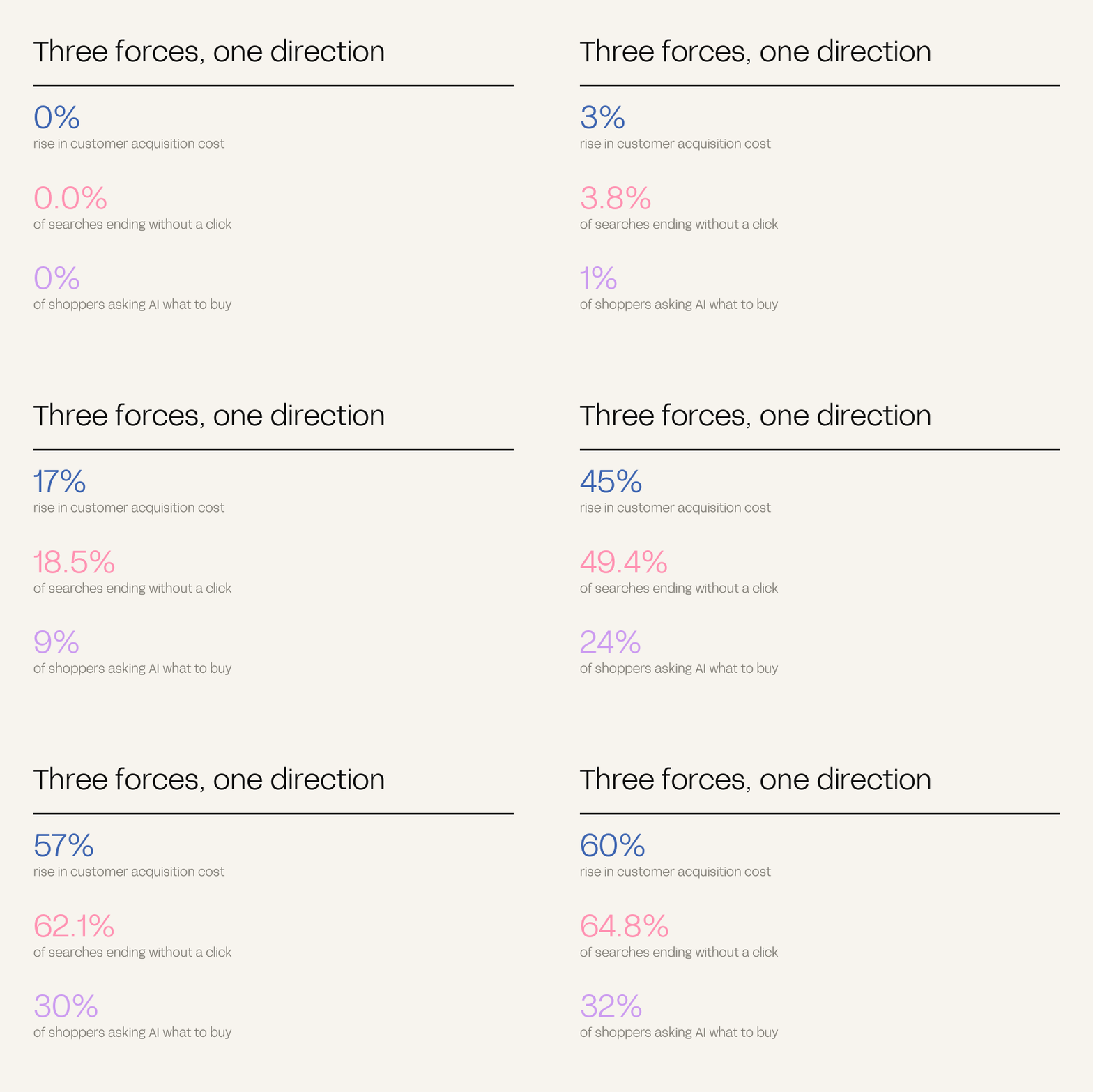
Three forces have converged: acquisition costs up 40–60%, two thirds of searches ending without a click, and a third of shoppers asking an assistant what to buy. Each independently reduces the value of rented attention and increases the value of being known. Brand has stopped being the thing that makes distribution work better and become distribution itself.
This is the last article in a series of fifty-two, and it is the argument the other fifty-one were assembling.
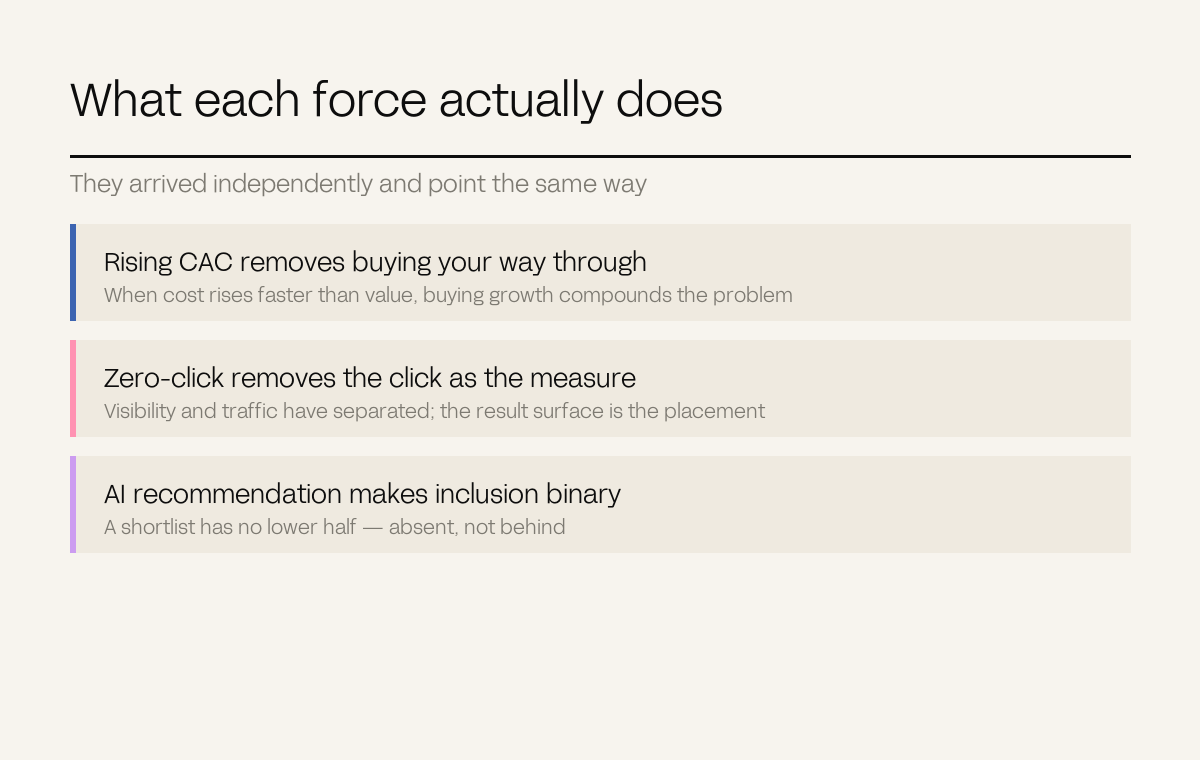
They arrived independently and point the same way. Renting attention costs more and delivers less; being known costs the same as it always did and now delivers more.
Brand used to make distribution work better. It has become the distribution.
– The Antimony position
When acquisition cost rises faster than customer value, buying growth compounds the problem rather than solving it. The hedge is owned audience – Femme Connection's $1.5M in flow revenue came from customers already acquired, with net profit up 64%.
If two thirds of searches end in the result surface, visibility and traffic have separated. Being the answer – and being named while being it – is the placement.
A shortlist has no lower half. A brand a model cannot describe confidently is absent rather than behind, which converts brand legibility into a distribution question.
The work that produces distribution now is unglamorous and mostly already sitting in your organisation: making what you publish state its answer plainly, attributing claims, connecting arguments to evidence, keeping your name consistent, and owning something distinctive enough to be recognised without a logo.
Almost none of that is a campaign. It is the accumulated result of decisions about how a brand presents itself, repeated until they compound.
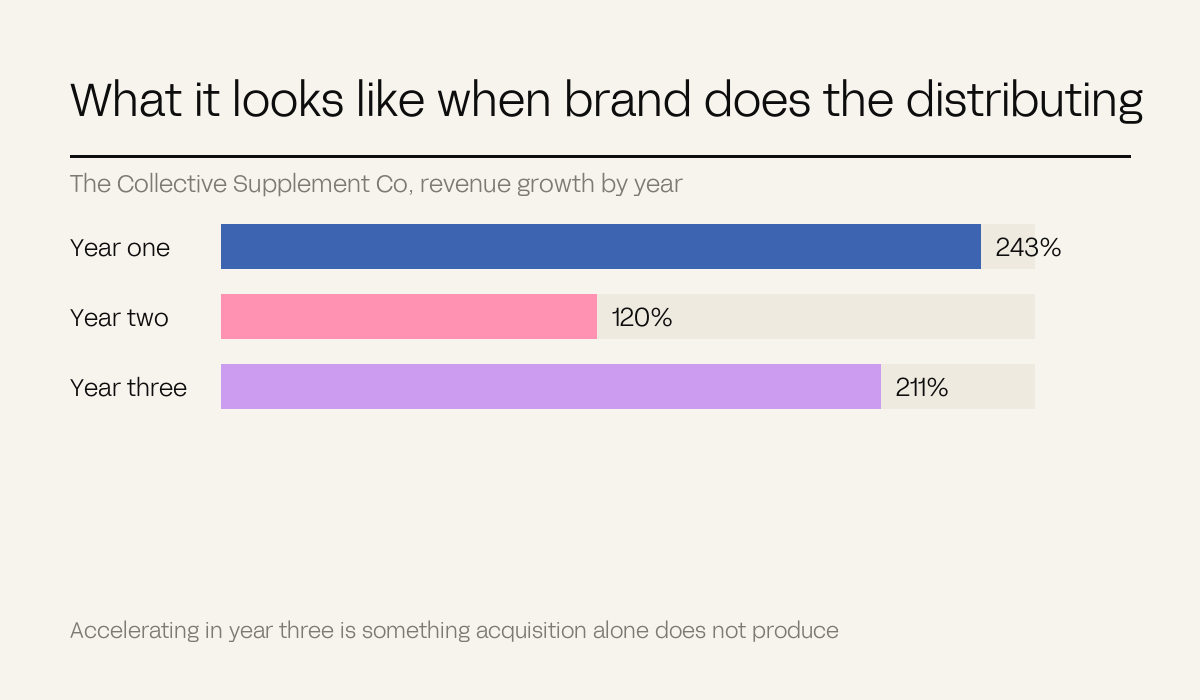
The Collective Supplement Co grew 243%, then 120%, then 211% across three years – accelerating in year three, which acquisition alone does not produce.
Future Isles returned 8:1 on marketing investment across $26.5M transacted, with three in four inspections pre-qualified.
5th Element Wellness passed $1M in revenue within five years across a seven-year partnership, with 10,000+ customers added in 24 months.
Each is a brand doing its own distribution.
We began this series by auditing ourselves and scoring SEO 74, GEO 61, AEO 52. What we found was not a content problem: articles with no author or date, thirty-six case studies linked from nothing, six category pages rendering no tiles, an internal build marker in public title tags, and our own name misspelled site-wide.
The general rule, and the one this series keeps arriving at: most brands do not need to become more visible. They need to become more legible – to state plainly what they already know, attribute what they already proved, and connect what they already published. That work is cheaper than a campaign and it is the thing that now does the distributing.
Definitions. Distribution: the mechanism by which a product reaches the people who might buy it.