


.png)
Let’s talk

Thank you! Your submission has been received!
Oops! Something went wrong while submitting the form.
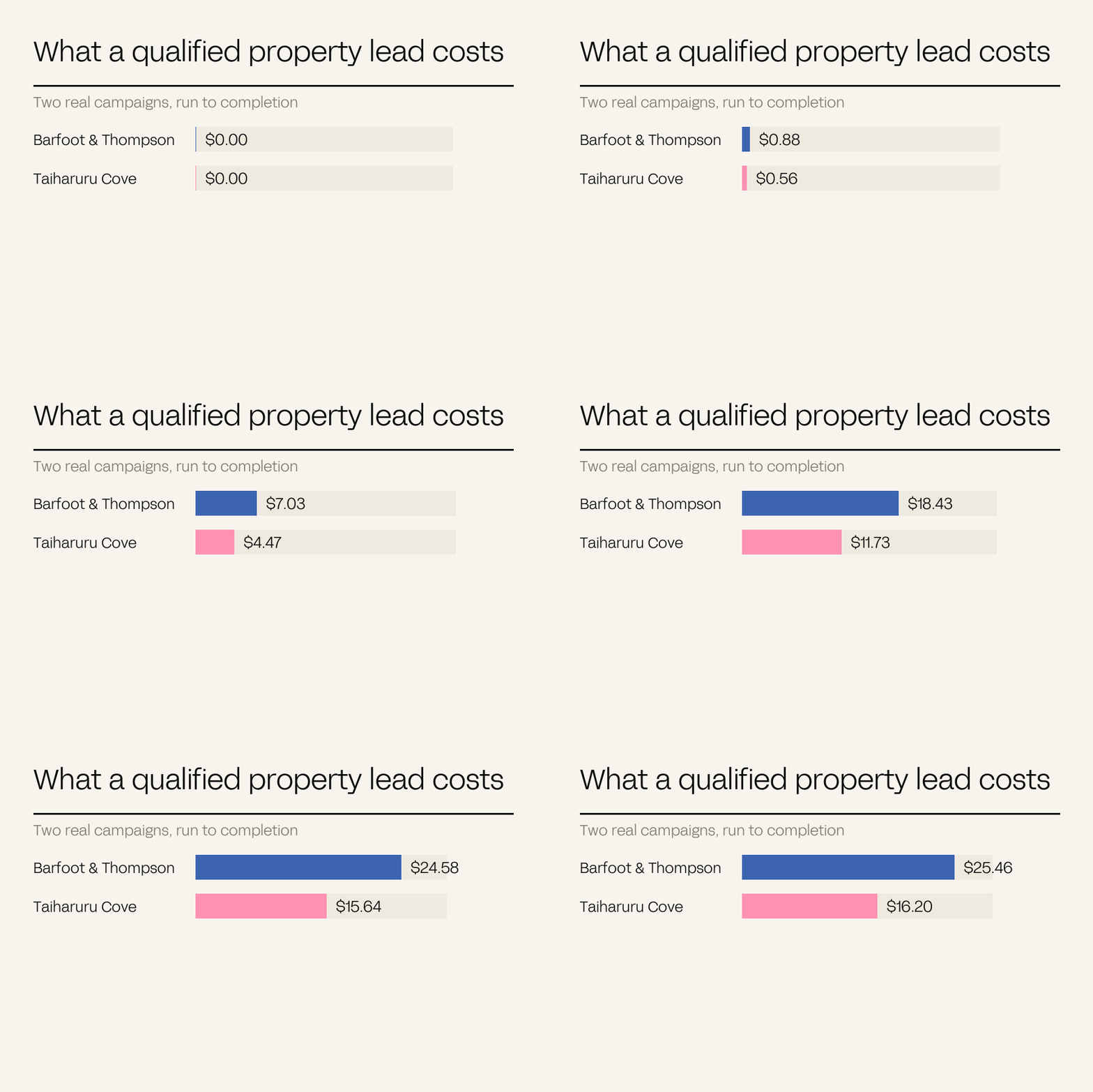
Across two premium property campaigns we ran, qualified leads cost $25.46 and $16.20 each. The difference was not budget or platform but how much qualifying the landing page did before a lead was counted. A cheap lead that an agent must qualify by phone is not cheaper than an expensive one that arrives ready, and most reported cost-per-lead figures are not comparing the same thing.
Almost nobody publishes this number, which is why it is worth publishing. Here are two, from campaigns that ran to completion, with the conditions attached.
Both are real, both are qualified rather than raw, and the gap between them is instructive.
A lead is only cheap if it arrives ready. Otherwise you have moved the cost from the media budget to the agent's afternoon.
– The Antimony position
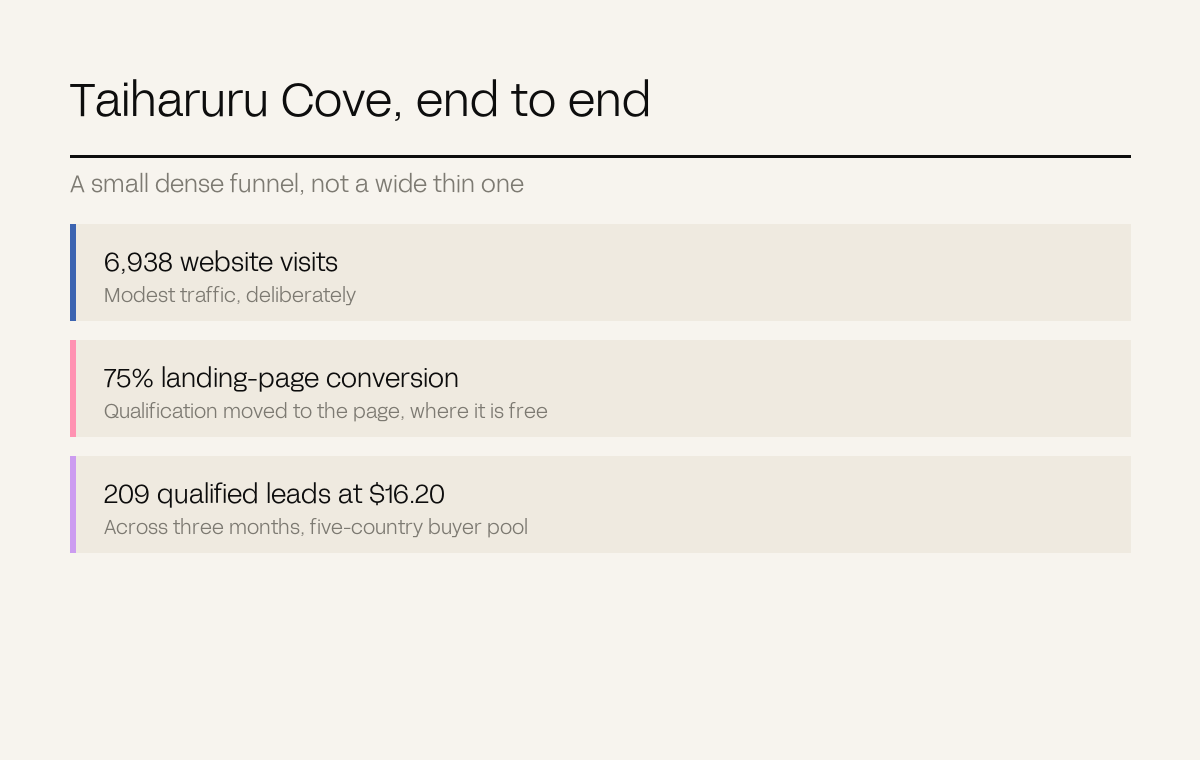
Taiharuru's landing page converted at 75%. That is not a traffic achievement, it is a filtering one – the page did enough work that the people who enquired had already self-selected hard. Qualification moved from the phone call to the page, where it costs nothing per unit.
Barfoot's programme ran across a portfolio at 3.29 million reach. Broader targeting reaches further from the ideal buyer, which raises the cost of getting each qualified one – and 2,604 qualified leads is a volume no single-listing campaign produces.
This is where most published figures fall apart. A cost-per-lead is meaningless without the definition attached. Ours count leads that met a stated qualification bar, not everyone who filled in a form. Any number quoted without that definition is not comparable to anything.
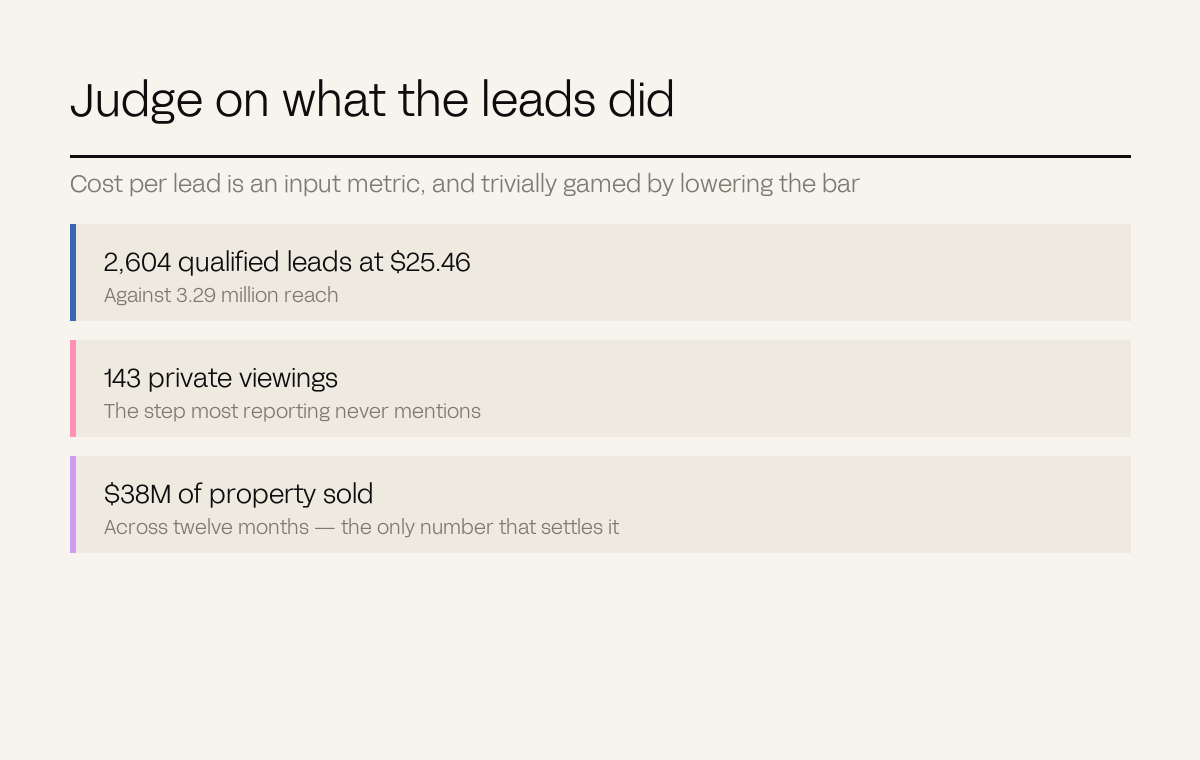
Cost per lead is an input metric and it can be gamed trivially by lowering the qualification bar. The output metric is what those leads did.
Barfoot's 2,604 leads produced 143 private viewings and $38M in sales inside twelve months. Future Isles is the clearest version of this: three in four inspections arrived pre-qualified, on a programme returning 8:1 on marketing investment across $26.5M of prestige property transacted.
An agency reporting only cost per lead is reporting the metric it controls. The one worth asking for is what proportion of those leads an agent would call a real buyer.
Use them as a reference range, not a target. If your qualified leads cost dramatically less than $16, check what you are counting – you may be counting form fills. If they cost dramatically more than $25 on a premium listing, the likely cause is a landing page doing no qualifying, so the media is paying for filtering that a page should be doing for free.
And measure the thing after the lead. Cost per qualified lead multiplied by an unknown conversion rate is not a business case.
Premium property marketing is a qualification problem wearing a lead-generation costume. The campaigns that look expensive per lead and cheap per sale are the ones doing the qualifying properly, and the ones that look cheap per lead usually pushed that work onto the agent, where it costs more and gets measured less.
Definitions. Qualified lead: an enquiry meeting a stated buyer-intent bar, not a raw form fill. ROMI: return on marketing investment.