


.png)
Let’s talk

Thank you! Your submission has been received!
Oops! Something went wrong while submitting the form.
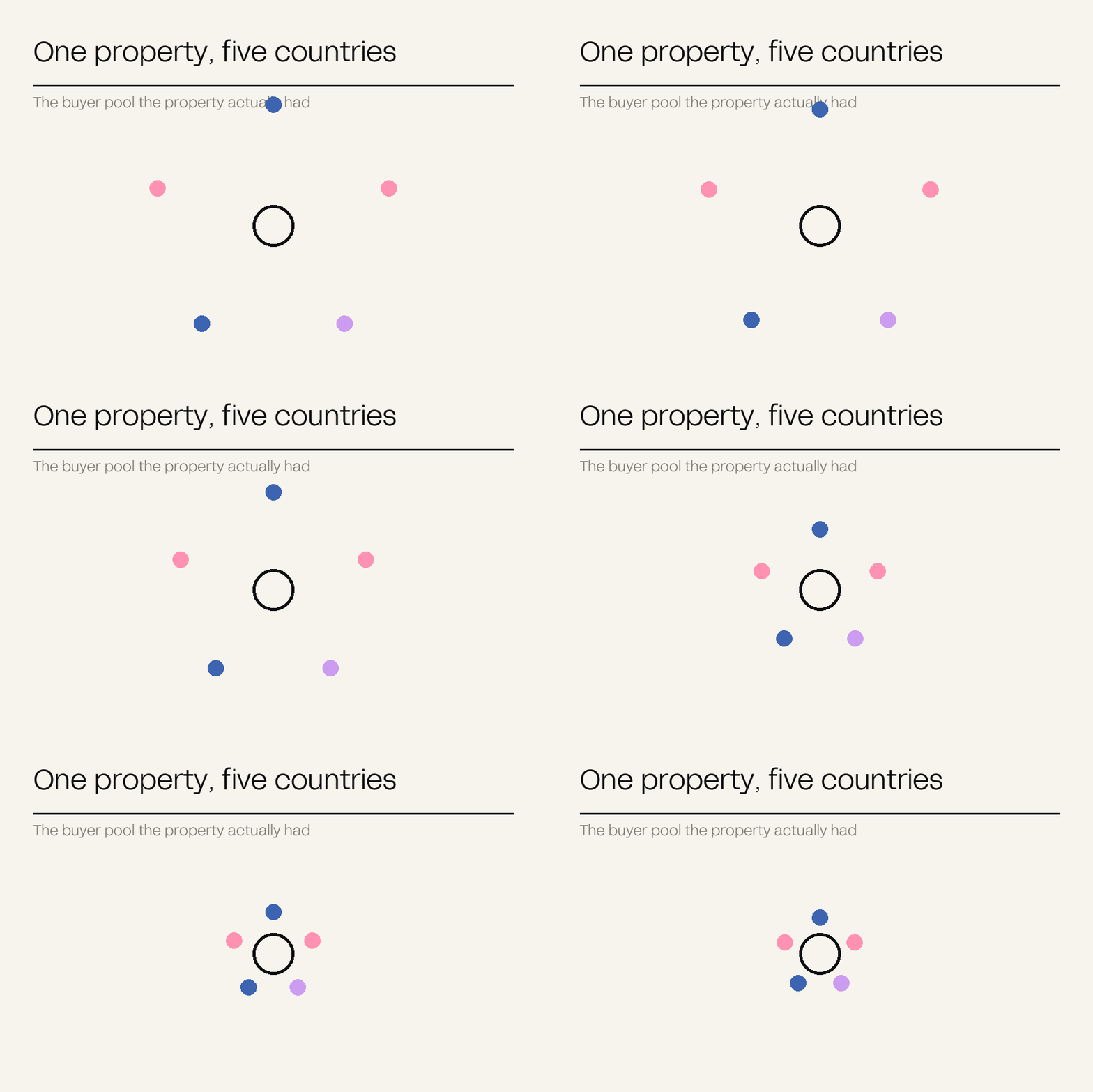
A remote premium property sold to an international buyer inverts the usual sequence: the digital experience does the work an inspection normally does, and it must qualify hard rather than attract widely. Taiharuru Cove converted its landing page at 75%, turning 6,938 visits into 209 qualified leads at $16.20, from a buyer pool spanning five countries.
A domestic buyer can drive out on a Saturday and decide how a place feels. An offshore buyer cannot, and everything about how the property must be marketed follows from that single fact.
In an ordinary campaign the marketing creates interest and the inspection creates conviction. Remove the inspection and the digital experience has to do both – and it has to do the harder one, because conviction about a place is normally built by standing in it.
This is why remote premium listings are so often marketed badly. They get treated as an ordinary listing with better photography, when they are a fundamentally different job.
When the buyer cannot visit, the landing page is not advertising the property. It is standing in for it.
– The Antimony position
The instinct with an expensive, unusual property is to widen the net. It is the wrong instinct. A buyer pool for a secluded coastal estate is small, specific and geographically scattered, and the job is to find those people and convince them – not to be seen by everyone.
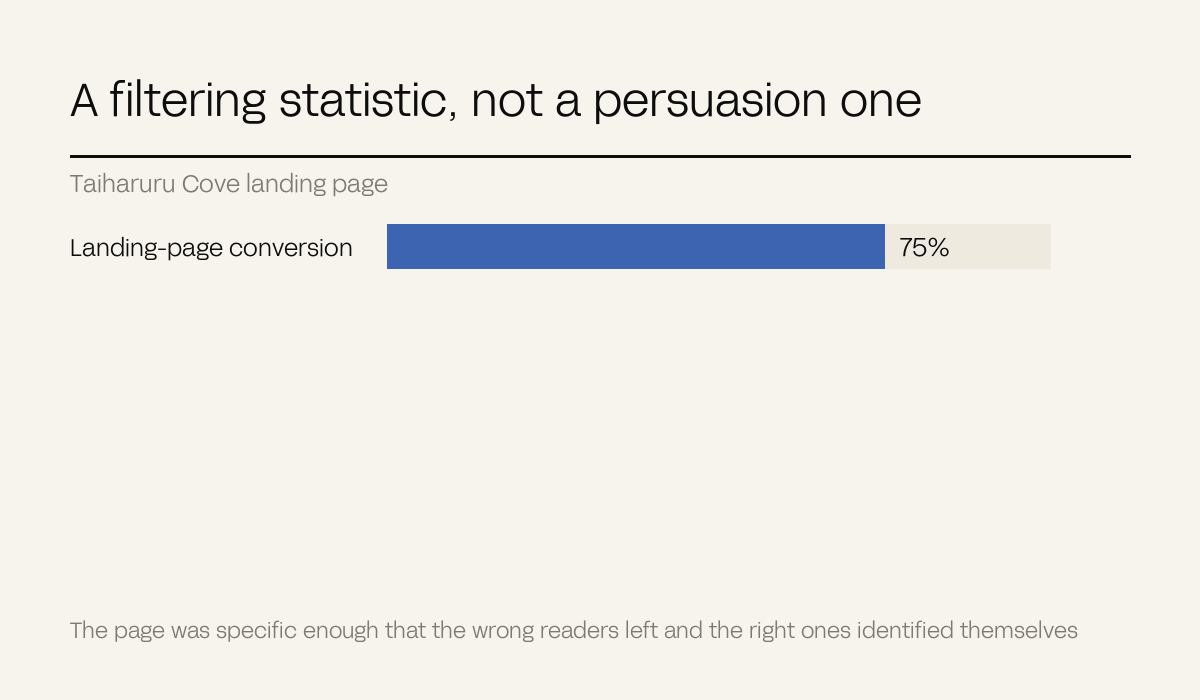
Taiharuru Cove converted its landing page at 75%. Read that as a filtering statistic rather than a persuasion one: the page told people plainly enough what this place was that the wrong ones left and the right ones identified themselves.
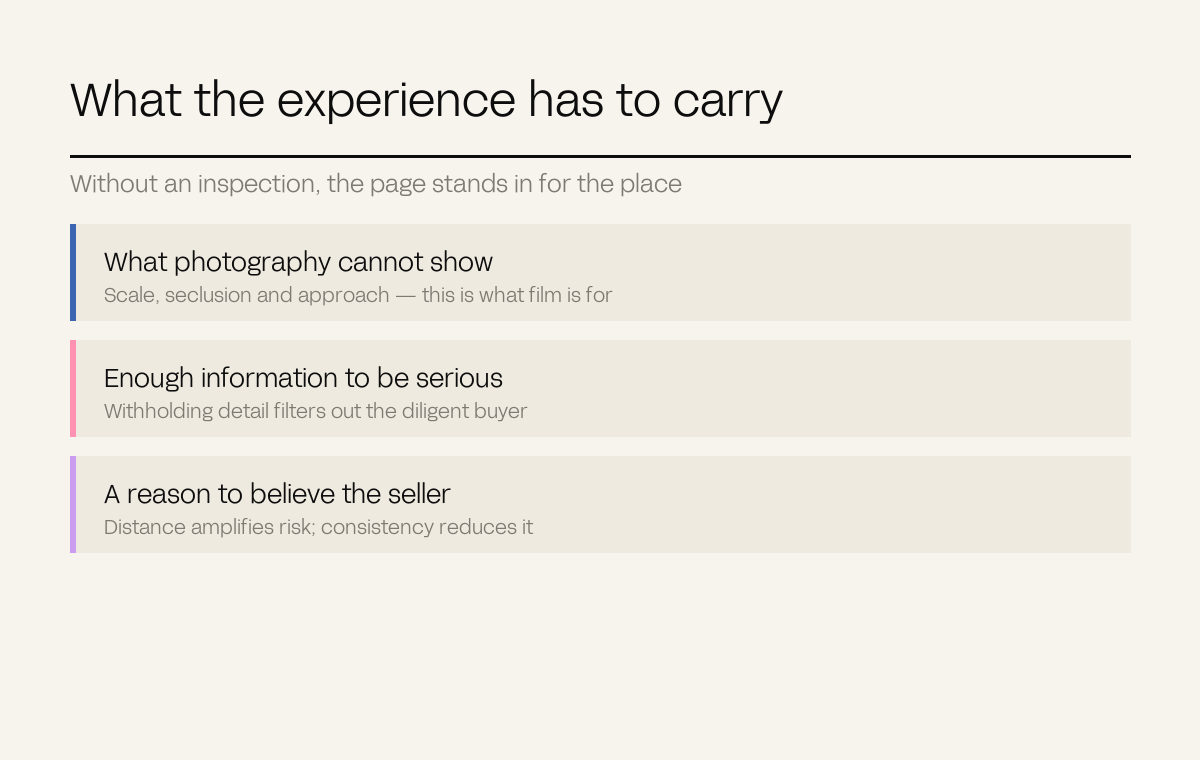
Scale, seclusion and approach are what a remote estate is actually selling, and they are exactly what still images flatten. Film does this work – the Barfoot programme ran distinct films across its listings for this reason, including walkthrough and mobile-first cuts for buyers encountering the property on a phone in another timezone.
An offshore buyer at this level is doing diligence, not browsing. Withholding detail to force an enquiry works against you – it filters out the serious buyer, who has no patience for it, and retains the casual one.
Distance amplifies risk. The credibility of the agency, the quality of the material and the consistency of the presentation are all doing risk-reduction work, whether or not anyone names it.
Taiharuru did not run alone. It sat inside the Barfoot & Thompson coastal programme – 2,604 qualified leads at $25.46, 143 private viewings, $38M of property sold across twelve months – which is what made a repeatable model out of what is usually a bespoke effort per listing.
That repeatability is the real asset. Future Isles shows where it goes over three years: $26.5M transacted, offshore enquiry up 3.1× across Australia, Asia and Europe, 4,600+ high-net-worth contacts, and three in four inspections arriving pre-qualified.
Remote premium property rewards narrow, deep and honest marketing over broad and aspirational. The buyer is rare, sophisticated and far away, and the only way to reach them economically is to be unmistakably specific about what the place is – so that the few people it is for recognise it immediately, and everyone else stops reading.
Definitions. Qualified lead: an enquiry meeting a stated buyer-intent bar. Buyer pool: the identified set of plausible purchasers.