


.png)
Let’s talk

Thank you! Your submission has been received!
Oops! Something went wrong while submitting the form.
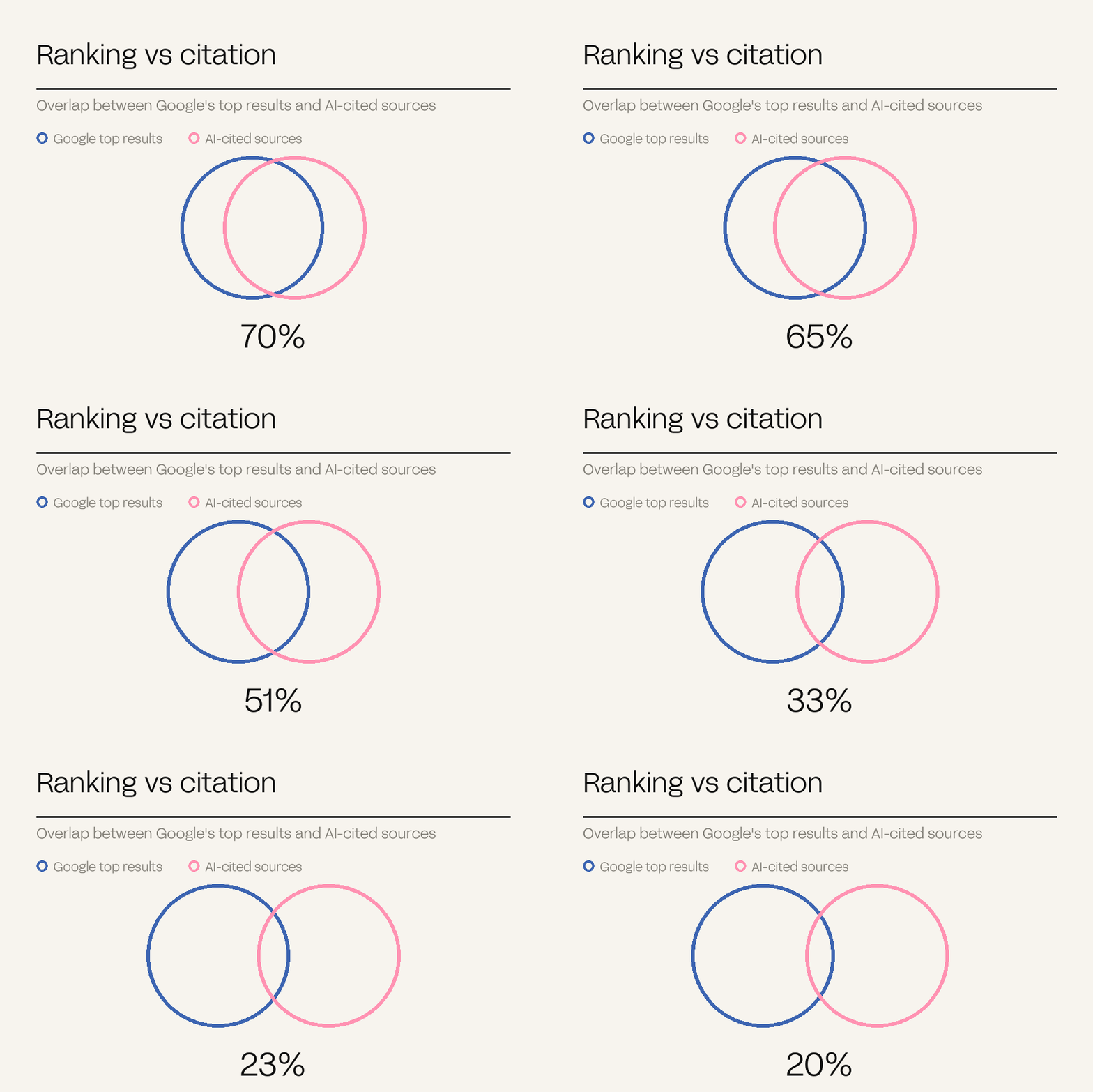
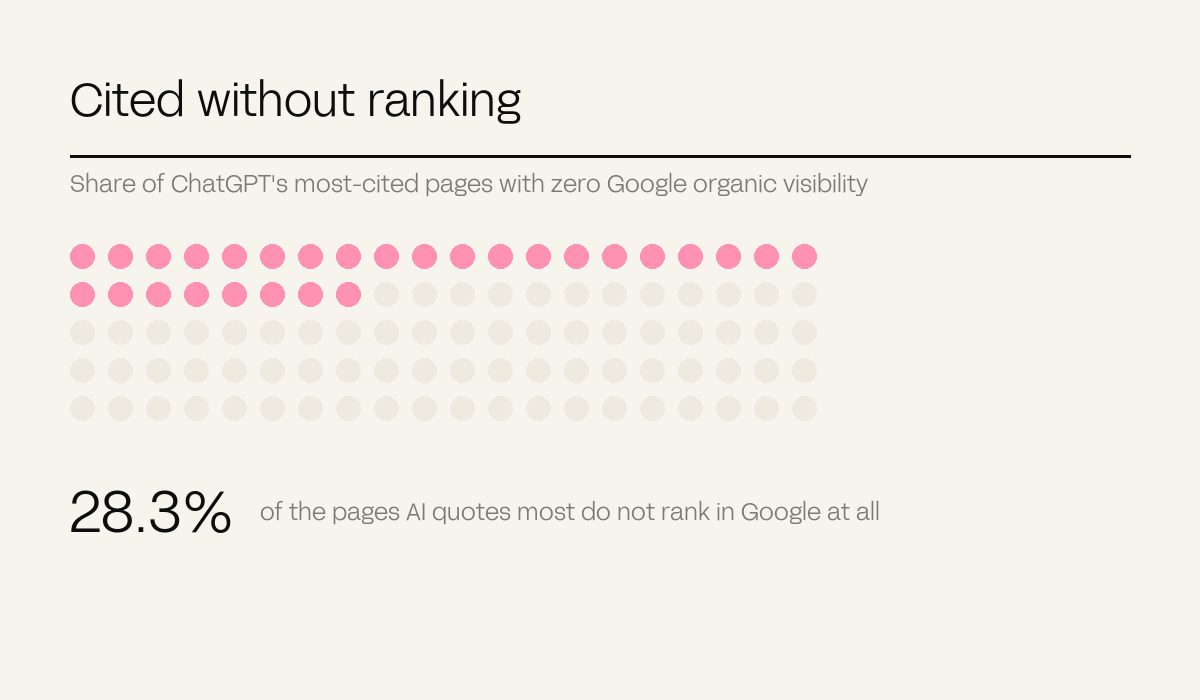
Ranking well in Google no longer means being cited by AI. The overlap between top Google links and AI-cited sources has fallen from around 70% to under 20%, and 28.3% of ChatGPT's most-cited pages have no organic Google visibility at all. These are now two separate disciplines with two separate briefs, and most brands are only resourcing one of them.
For twenty years, one number stood in for findability. If you ranked, you were found. That assumption is quietly breaking, and most marketing plans have not caught up.
The overlap between the top links Google returns and the sources AI systems actually cite has fallen from roughly 70% to under 20% – and it is still falling as each system develops its own preferences about what is worth quoting.
Sit with what that means. Four in five of the sources shaping how buyers understand your market are not the pages you fought to rank. Your rank tracker can be green across the board while you are absent from the answers a customer is actually reading.
Ranking and being cited used to be the same achievement. They are now two different jobs, and most brands are only doing one of them.
– The Antimony position
That third figure is the one that ends the argument. If fewer than one in ten cited sources ranks in the top ten for the same question, then citation is not a reward for ranking. It is a separate outcome with separate causes.
Google ranks pages. It asks which document best satisfies a query and orders a list. An AI system does something different: it retrieves candidate material, breaks it into passages, and assembles an answer from the passages it trusts. It is not choosing a destination. It is choosing evidence.
Evidence has different qualities from a destination. A page can rank on authority, freshness and link equity while offering nothing quotable – no specific figure, no clean definition, no passage that survives being lifted out of context. That page ranks and is never cited. Meanwhile a page nobody has linked to, on a domain with modest authority, gets quoted constantly because it states a number plainly and attributes it.
Specificity above all: real figures, named entities, dates, and claims a model can attribute with confidence. Self-contained passages that make sense when extracted. Direct answers positioned early rather than withheld for engagement. And corroboration – the same claim appearing across credible third-party sources, which is closer to how a fact-checker works than how a link-building campaign does.
Rank tracking is not wrong, it is simply incomplete. The missing measurement is whether your brand appears in generated answers to the questions your buyers ask, and whether it is named when it appears.
That means running your real buying questions through ChatGPT, Gemini, Perplexity and Google's AI surfaces, and recording three things: whether you are mentioned, whether you are cited with a link, and whether the description of you is the one you would write. The third is the one most brands have never checked, and it is frequently wrong.
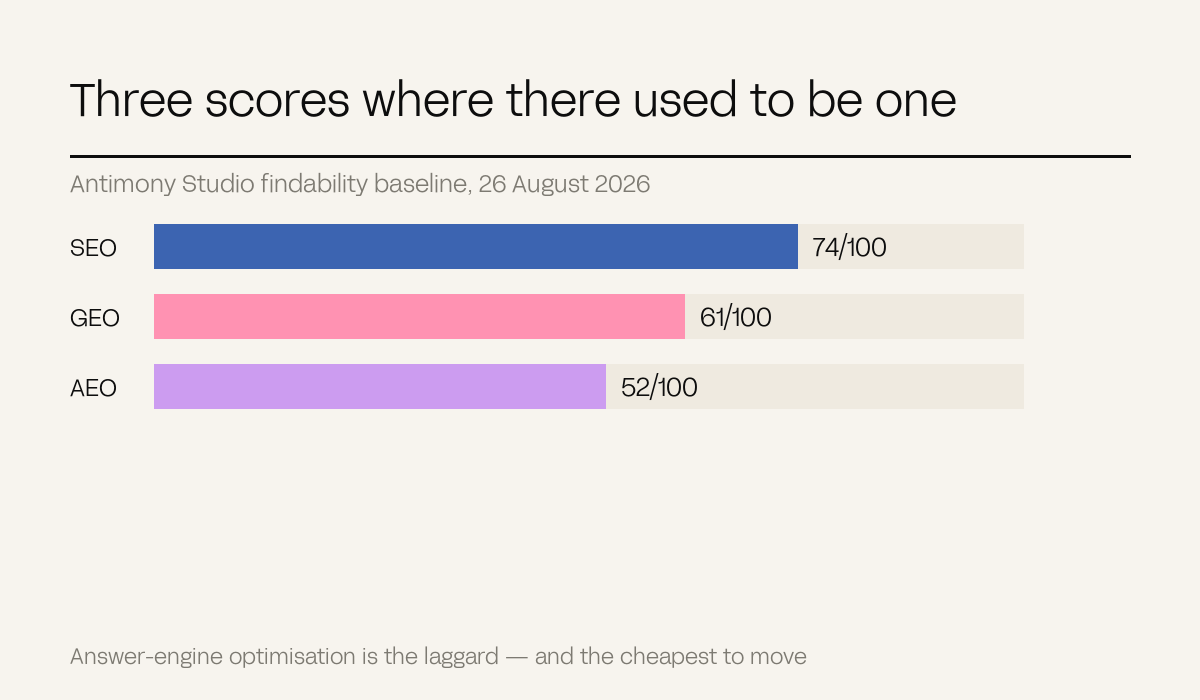
We ran this on ourselves before recommending it to anyone. Antimony's own findability baseline scored SEO 74, GEO 61, AEO 52 – three different numbers for what used to be one.
The SEO score was comfortable. The answer-engine score was barely half marks. The gap was not weak content – it was content written to be read rather than to be extracted, on a site where the proof lived on pages the articles never linked to.
The general rule this points at: most findability gaps are not content-production problems, they are legibility problems in content that already exists. Before commissioning anything new, check whether what you have already published states its claims plainly, attributes them, and links to the evidence behind them. That is a cheaper fix and usually a bigger one.
In our case the evidence was sitting in the case studies the whole time – Future Isles at 8:1 return on marketing investment, Taiharuru Cove converting a landing page at 75%, The Collective Supplement Co compounding 243%, 120% then 211% across three years. Named clients, real figures, dates. Exactly the material an AI system prefers to cite, on pages nothing pointed to.
Treat findability as three disciplines, not one. Classic SEO still earns the click when a click happens. Generative optimisation earns the mention. Answer optimisation earns the quote. They share research and voice but they do not share a brief, and a plan that resources only the first is now optimising for a shrinking share of how people actually find things.
Definitions. GEO: generative engine optimisation, being present in AI-generated answers. AEO: answer engine optimisation, being the quoted answer. Citation: an AI system attributing a claim to your page.