


.png)
Let’s talk

Thank you! Your submission has been received!
Oops! Something went wrong while submitting the form.
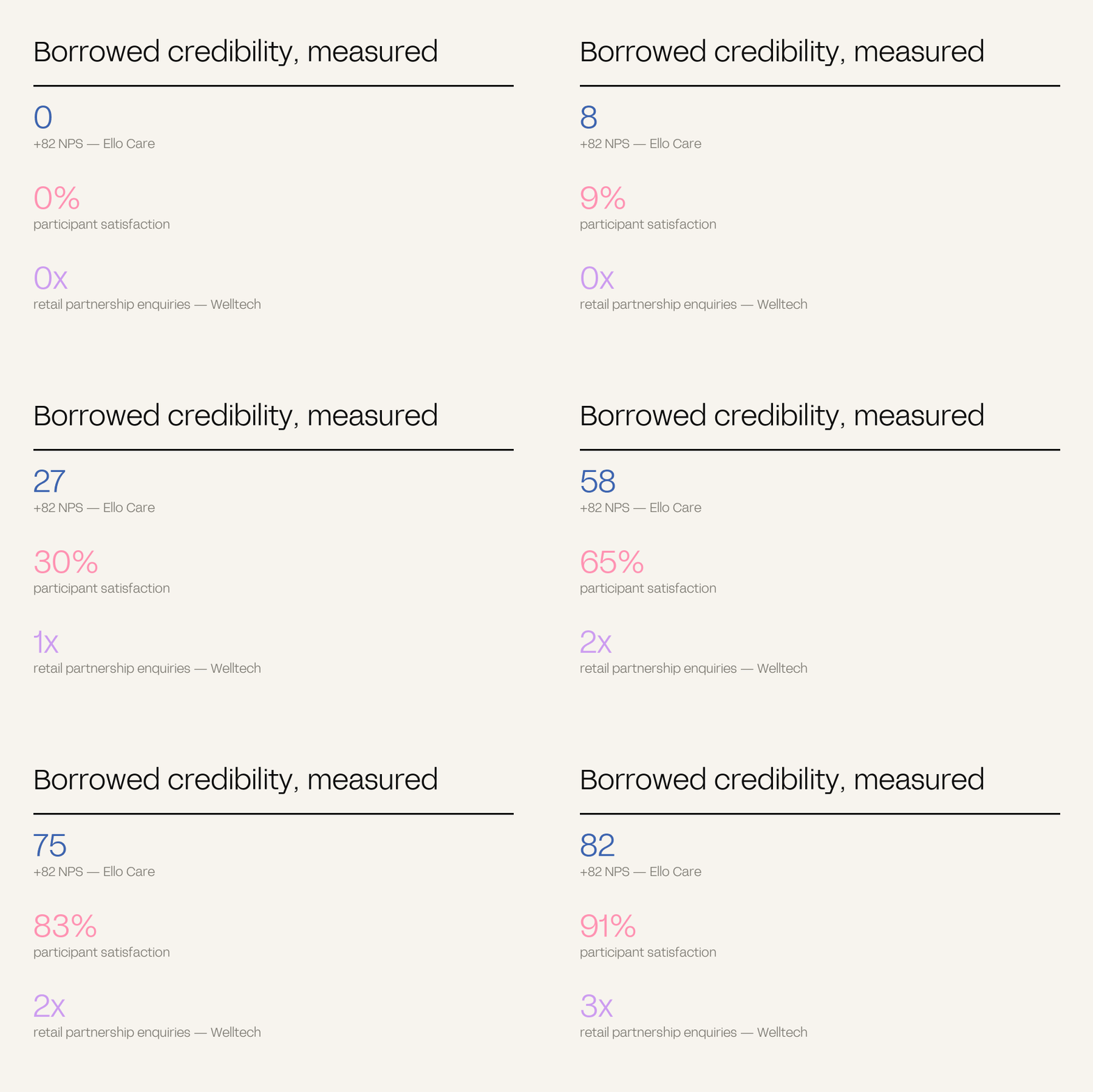
Wellness sells on assertion, so consumers discount claims made by brands about themselves. Credibility borrowed from practitioners – the people who already recommend you – converts far better than paid reach, because it is the one signal a competitor cannot simply copy into their own ad. Byron Bay Bone Broth had twelve years of that credibility sitting in wholesale relationships and no consumer relationship at all.
The default DTC launch plan is to buy attention until the product finds its people. In wellness that plan is unusually expensive, because attention is not the constraint. Belief is.
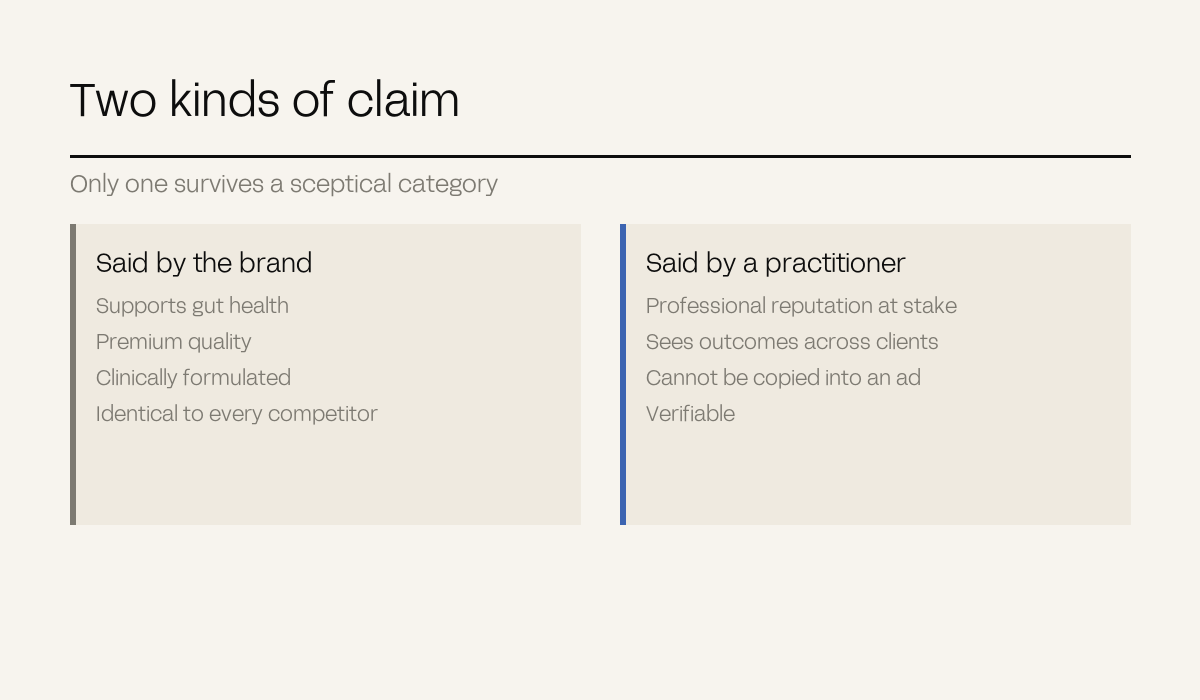
Functional food and supplements are a category built on claims. Every product on the shelf says it supports gut health, energy, recovery, sleep. The honest brand and the exaggerating one use identical language, and the consumer has no way to tell them apart from the packaging alone.
The rational consumer response is to discount everything a brand says about itself. Which means the marketing lever most brands reach for – saying it louder, to more people – is the one lever the category has trained its buyers to ignore.
In a category where everyone claims the same benefit, the only claim worth anything is the one somebody else makes on your behalf.
– The Antimony position
Practitioners – naturopaths, nutritionists, physios, GPs, clinic owners – occupy a position no brand can buy into. They have professional reputations at stake, they see outcomes across many clients, and their recommendation carries the weight of that accountability.
Most established wellness brands already have relationships like these and treat them as a sales channel rather than a marketing asset. That is the mistake. A wholesale account is a distribution relationship. A practitioner who recommends you is a credibility relationship, and it compounds in a way a media buy does not.
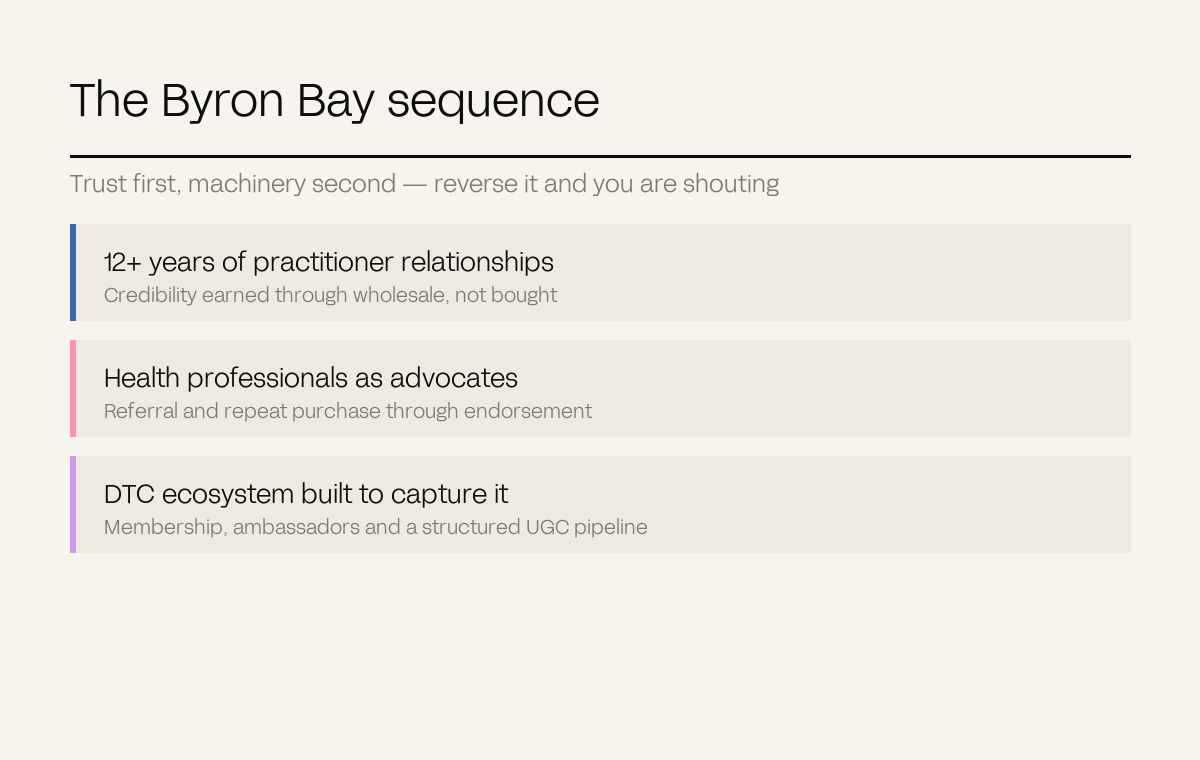
Byron Bay Bone Broth had something most DTC brands spend years trying to manufacture: twelve years in market and genuine product credibility earned through wholesale and manufacturing relationships nationwide. The product was proven. What it did not have was a relationship with the person actually eating it.
The obvious move would have been to launch a consumer brand and buy traffic to it. We did the opposite – we treated a decade of practitioner trust as the growth engine and built the consumer brand on top of it.
The sequence matters. The trust existed first; the direct-to-consumer machinery was built to capture it. Reverse the order and you are a new brand shouting in a category that has stopped listening. Read the case study.
You may not have twelve years of wholesale history. The principle still holds, because the question is not how long you have been going – it is whether anyone with a professional reputation will stake it on you.
Find the practitioners already recommending you and ask why. Make it easy for them to explain you accurately, which usually means giving them the formulation detail and the evidence rather than the marketing copy. And resist the urge to convert them into an affiliate scheme; the moment a recommendation is visibly paid for, the thing that made it valuable is gone.
Wellness brands do not have an awareness problem. They have a believability problem, and awareness spending makes it worse by adding another voice making claims. Start from whoever already vouches for you, build the machinery to carry that vouching to consumers, and buy attention afterwards – when there is something credible for the attention to land on.
Definitions. DTC: direct-to-consumer. UGC: user-generated content. NPS: net promoter score.