


.png)
Let’s talk

Thank you! Your submission has been received!
Oops! Something went wrong while submitting the form.
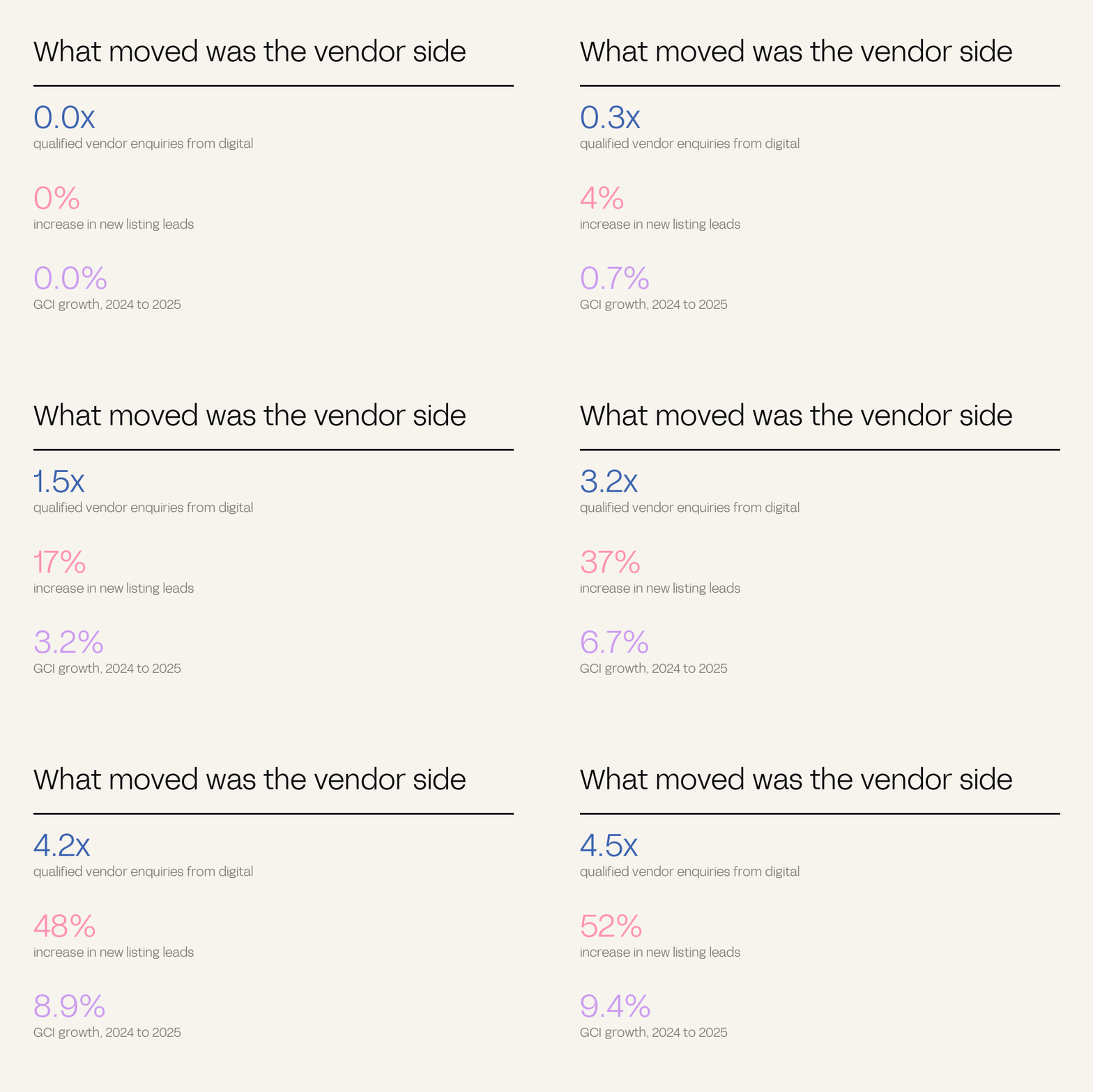
Every listing campaign an agent runs builds equity in a property that will be sold and gone. The agent's own brand, which is the asset that wins the next instruction, usually gets whatever attention is left. Fixing that asymmetry produced a 4.5x lift in qualified vendor enquiries and a 52% increase in new listing leads for Lindsay Ryan.
There is a strange asymmetry in real estate marketing. Enormous care goes into presenting each property, and almost none into presenting the person selling it – even though the property leaves and the person stays.
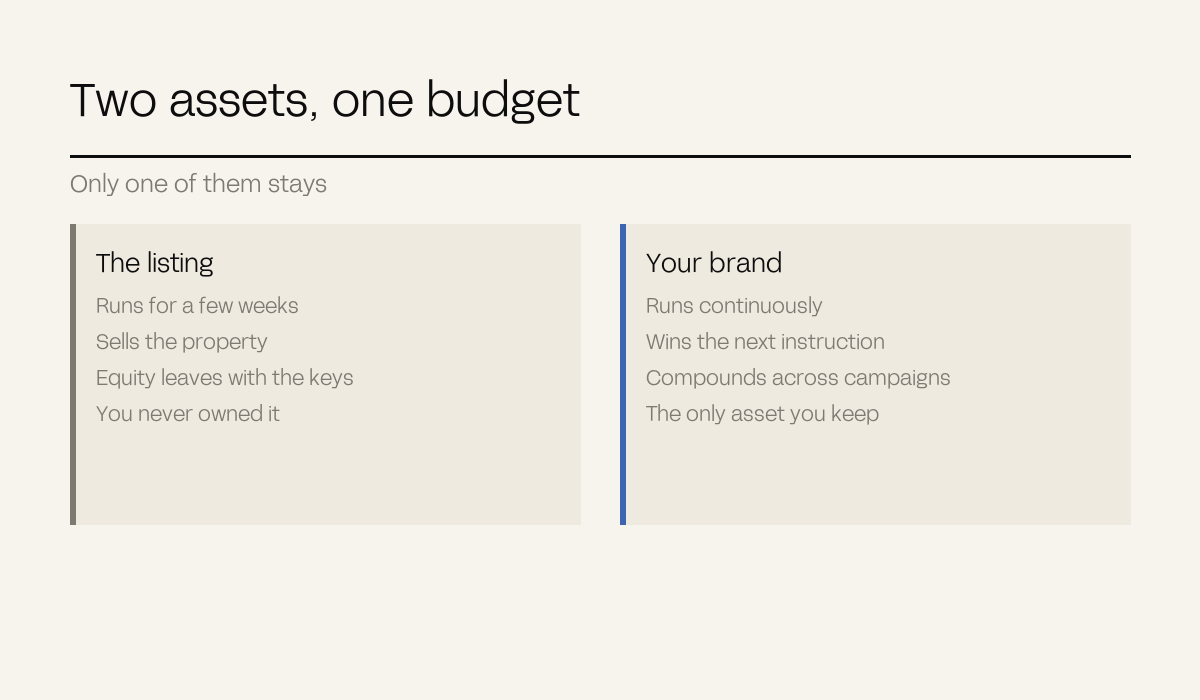
A listing campaign builds equity in an asset the agent does not own and will not own. It runs for a few weeks, sells the property, and the equity leaves with the keys.
The agent's brand is the thing that determines whether the next vendor calls them or the competitor down the street. It compounds across every campaign – if anyone is building it. Usually nobody is, because the listing has a budget and a deadline and the personal brand has neither.
Every listing campaign builds an asset you are about to give away. The only one you keep is the reason the next vendor calls you.
– The Antimony position
By the time a vendor is choosing between agents, they have usually seen all of them present competently. Photography is a commodity at this level, the comparative market analysis says roughly the same thing, and the fee is negotiable.
What they are really assessing is judgement and trustworthiness – whether this person will handle the largest transaction of their life well. Almost nothing in a standard agent's marketing addresses that, because it is all about properties.
Lindsay Ryan was doing the work at a high standard and the brand was not keeping up with it. We rebuilt it so the agent, not just the listings, was properly presented – and the shift showed up on the vendor side of the business, which is where an agent's future actually lives.
Note which number moved. Not buyer enquiries – vendor enquiries. The brand work changed who was asking Lindsay to sell their home, which is the compounding asset. Read the case study.
At agency scale it becomes a consistency problem. RT Edgar had the market authority and no system for expressing it uniformly across a network of agents each producing their own material.
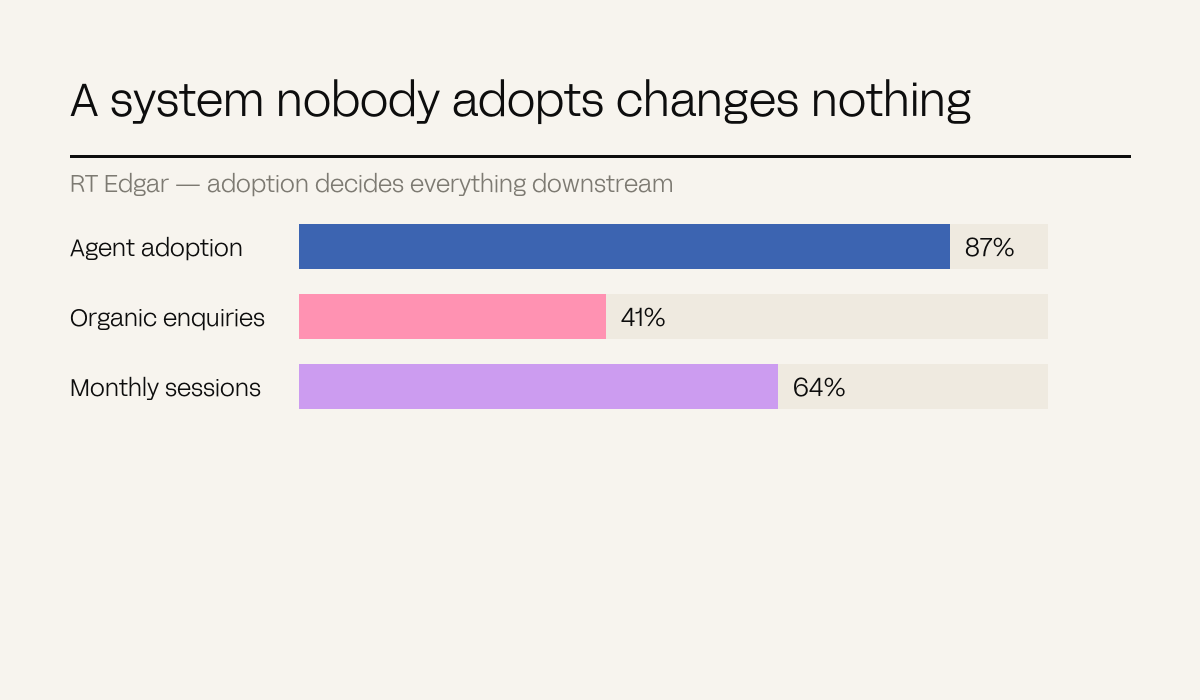
The fix was a collateral system agents could actually run themselves, and the number that proves it worked is the adoption one: 87% of agents adopted it. That is what produced the 41% lift in organic property enquiries, the 64% increase in monthly sessions and the 3.2× improvement in time-on-page. A system nobody adopts changes nothing, however well designed.
Start with the thing a vendor is deciding: evidence of judgement. Results with numbers attached, and the reasoning behind decisions rather than only the outcomes.
Then consistency, which is mostly discipline – the same person, the same tone, the same visual treatment across every listing, so twenty campaigns accumulate into one impression instead of twenty unrelated ones.
Then a home for it that you own. Aaron McKenzie is the outside-industry proof: thirty years of craft living under other people's brands, with no way to be found, pitched or booked – and 3,800 sessions plus six new commissions within 90 days of having somewhere to send people.
Treat a share of every listing budget as investment in the asset you keep. An agent who has run two hundred campaigns and built no personal brand has spent two hundred budgets improving someone else's outcome, and starts each new pitch from close to zero.
Definitions. GCI: gross commission income. Vendor: the seller instructing the agent.