


Let’s talk

Thank you! Your submission has been received!
Oops! Something went wrong while submitting the form.
A repeatable audit for whether your brand is distinguishable from its category: the logo-off test, the swap test, the colour map, the summary test, the evidence-reachability check, and the boilerplate check. Each takes under an hour and none needs a budget. Published in full because utility content is the kind that earns citation.
Here is the audit, in full, with nothing held back for a sales conversation. It takes about a day and needs no budget.
Remove your logo from ten recent pieces. Show them to twenty people in your market and ask one question: whose is this?
Then test each element separately – colour, typeface, illustration style, layout, tone – and identify which one alone produced a correct answer. That element is your only real distinctive asset. Most brands find they have none, which is consistent with an audit of 300+ assets across 59 brands that found the same.
Take your three nearest competitors' websites and put your logo on their homepage copy. Then put theirs on yours.
If nothing breaks, you are competing on the category's terms. This is the fastest and most uncomfortable test in the audit, which is why it is second – do it before enthusiasm wears off.
Put your fifteen nearest competitors' primary colours on one page. The gaps are the available territory, and they are usually obvious and usually uncomfortable, which is why they are still open.
Check any candidate at thumbnail size, in a dark interface, on cheap stock, and behind small text at accessible contrast. Detail in Owning a Colour Territory.
Ask ChatGPT, Gemini and Perplexity to describe your company in one sentence, then to name the best options in your category.
Record whether you appear unprompted, whether the description is accurate, and who appears if you do not. Method in Positioning That Survives an AI Summary.
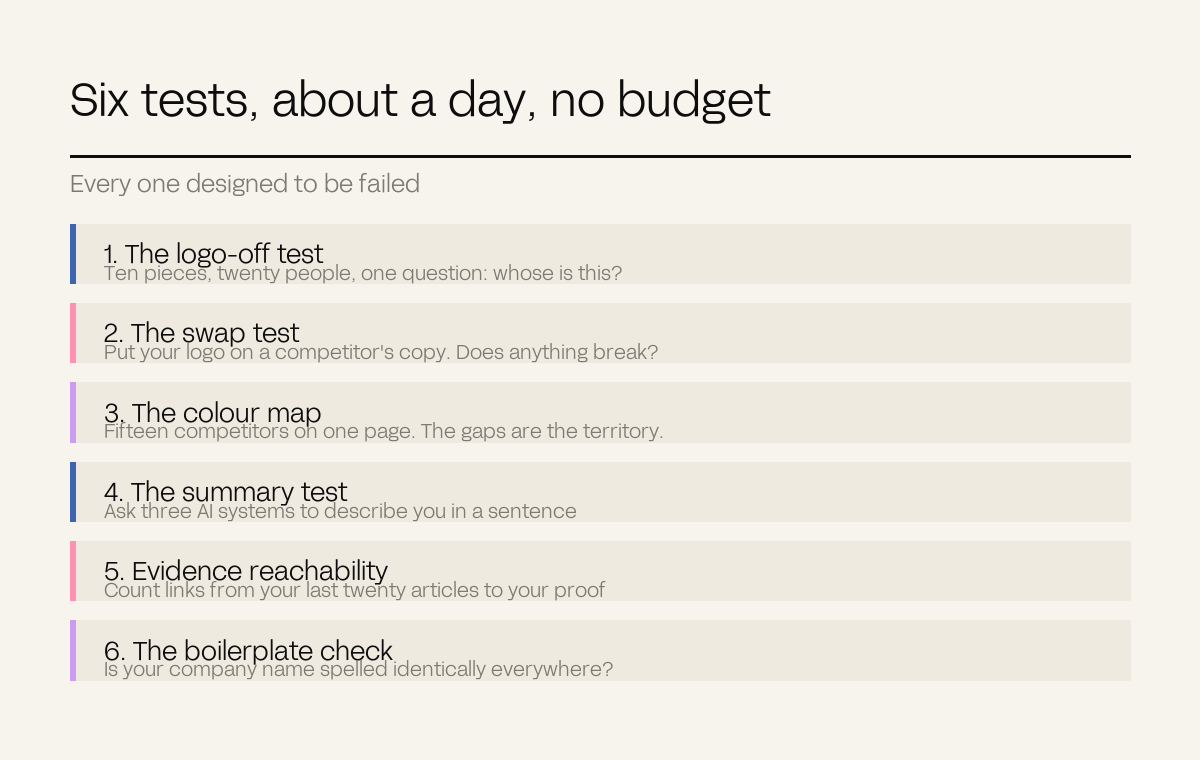
Count the links from your last twenty articles to your case studies, results or documentation.
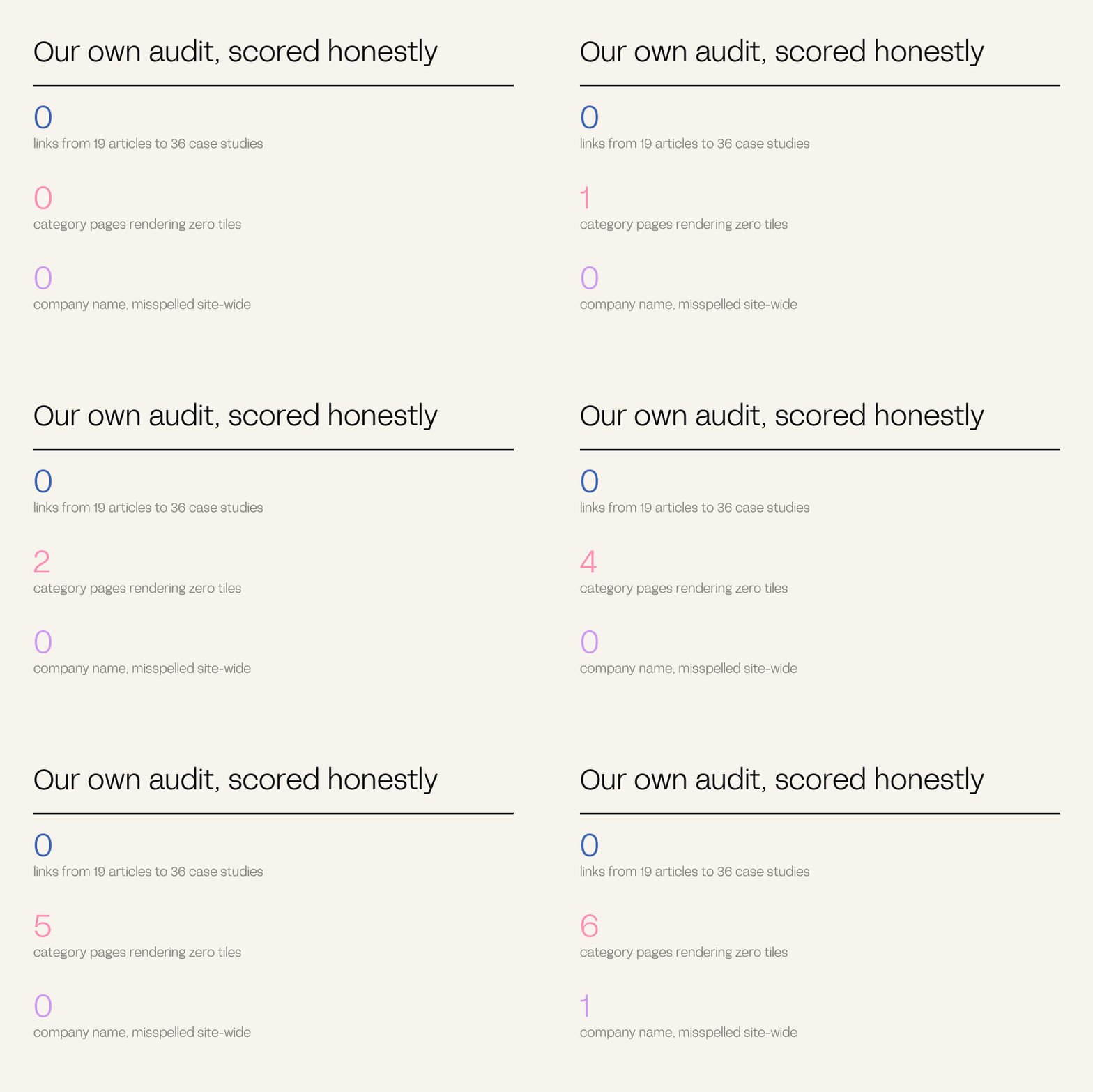
We ran this on ourselves and found zero links across nineteen articles to thirty-six case studies. If your number is low, your best sales asset is unreachable during the ~70% of the buying journey that happens without you.
Read your footer, copyright line, directory entries, email signatures and social bios. Check the company name is spelled identically in all of them.
This sounds trivial and is not. Ours was misspelled in the site-wide copyright line on every page for an unknown period. Boilerplate is written once, proofread never, and repeated everywhere, which makes it the highest-multiplier error available.
Every test here is designed to be failed. An audit that returns good news mostly proves the questions were too easy.
– The Antimony position
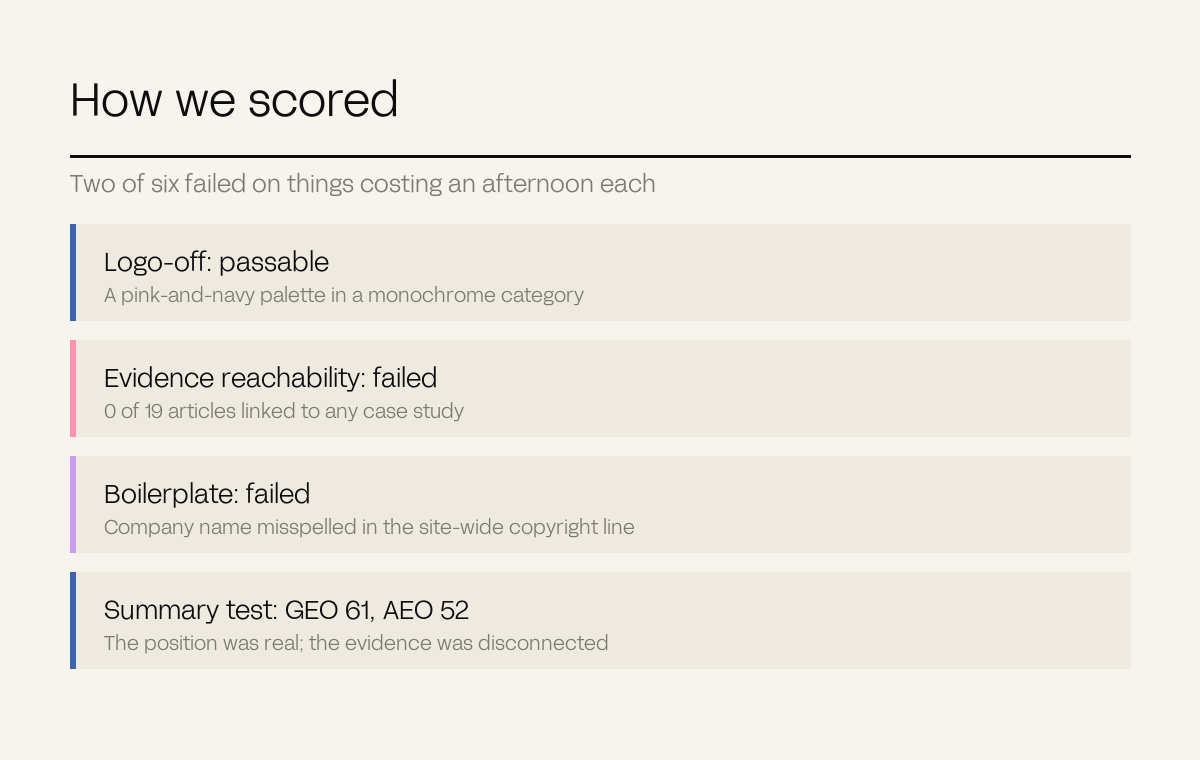
Rank the failures by cost to fix. Boilerplate and internal links are close to free and usually the largest immediate gain. Colour and positioning are expensive and slow, and worth committing to only if you will hold them for years.
Resist fixing everything. A brand that changes its colour, typeface, positioning and tone simultaneously restarts recognition from zero, which is the opposite of what the audit is for.
Two of six failed on things that cost an afternoon each. That ratio is normal.
Definitions. Distinctive asset: a non-verbal element triggering brand recognition without the name.