


Let’s talk

Thank you! Your submission has been received!
Oops! Something went wrong while submitting the form.

A new and unusually honest test for positioning: have an AI system summarise your brand in a sentence. Because the summary is compressed from your published material, it reveals what actually survives compression. Most brands get their category back, which means the positioning existed in the deck and never reached the page.
Positioning has always been hard to audit because everyone grades their own work. There is now a test that grades it for you, and it takes about a minute.
Ask ChatGPT, Gemini and Perplexity to describe your company in one sentence. Then compare what comes back to the positioning statement you believe you have.
What you receive is a compression of everything published about you. If your position survives that compression, it is real. If what comes back is a generic description of your category, it never reached the page.
A summary is positioning with the marketing removed. What is left is what you actually own.
– The Antimony position
Positioning is agreed internally, expressed in a strategy document, and then diluted into safe category language by the time it reaches public copy. The model can only read what is public.
The test that predicts failure: could three competitors publish the same statement unchanged? If so, a summary of your material and a summary of theirs will converge, correctly.
A claim appearing only in your own words is weakly held. Positioning corroborated by client evidence and third-party mention survives compression far better – the mechanism is in Third-Party Mentions Now Beat Backlinks.
Specificity survives. Named clients, real figures, a stated refusal, an unusual constraint. Blanc Bridal as slow, intentional couture in a market competing on trend and price is compressible without becoming generic – the refusal is the position and it is stated plainly.
Adjectives do not survive. Innovative, trusted, end-to-end and premium compress to nothing because every competitor supplies the same words, so the summariser drops them as uninformative.
Our findability baseline scored GEO 61, and the diagnosis was not that we lacked a position – it was that the evidence for it was disconnected from the material stating it. Our case studies carried the specifics, and no article linked to them. Our articles carried no author or date, so the claims were unattributed.
The general rule: your position is only as compressible as its evidence is reachable. Before rewriting a positioning statement, check whether the proof of the current one is linked from the pages that assert it – because a summariser can only use what it can find and attribute.

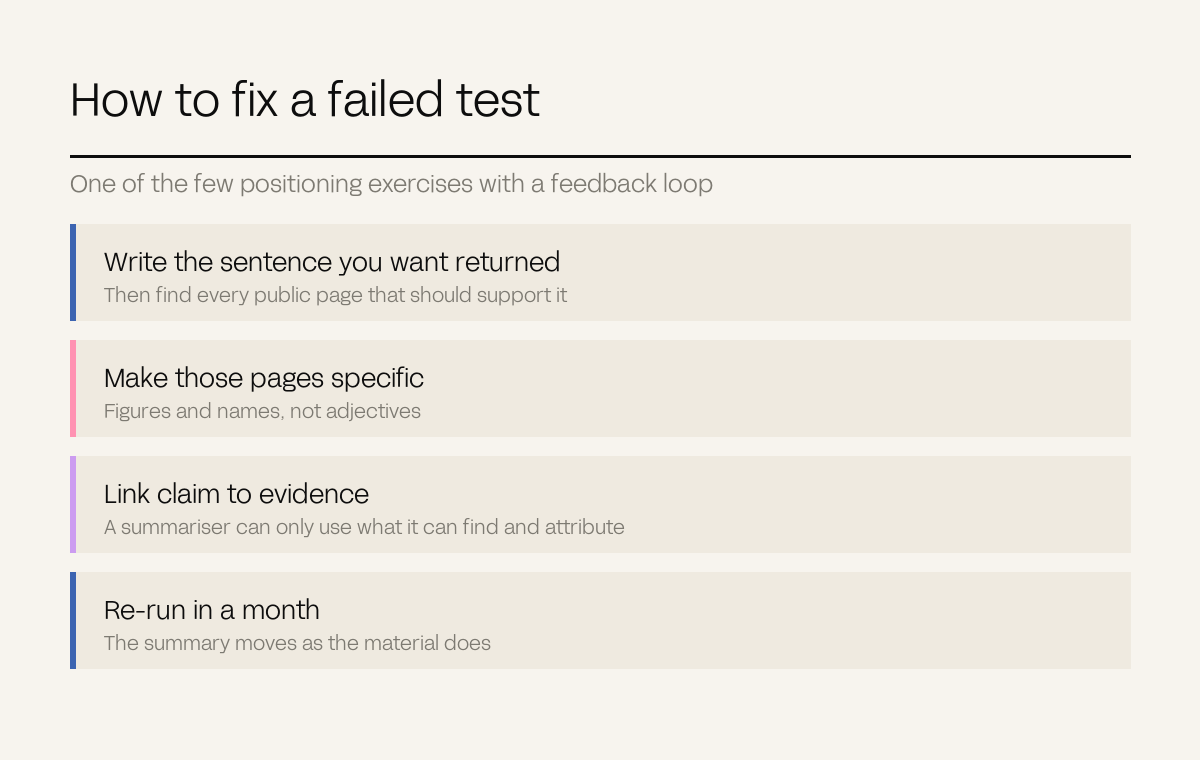
Write the sentence you want returned. Then find every public page that should support it and check that it does – specifically, with figures and names rather than adjectives. Then link those pages to each other so the claim and its evidence sit within reach of one another.
Then re-run the test in a month. The summary changes as the material does, which makes this one of the few positioning exercises with a feedback loop.
Definitions. Compression: the summarisation a model performs when asked to describe an entity briefly.