


.png)
Let’s talk

Thank you! Your submission has been received!
Oops! Something went wrong while submitting the form.
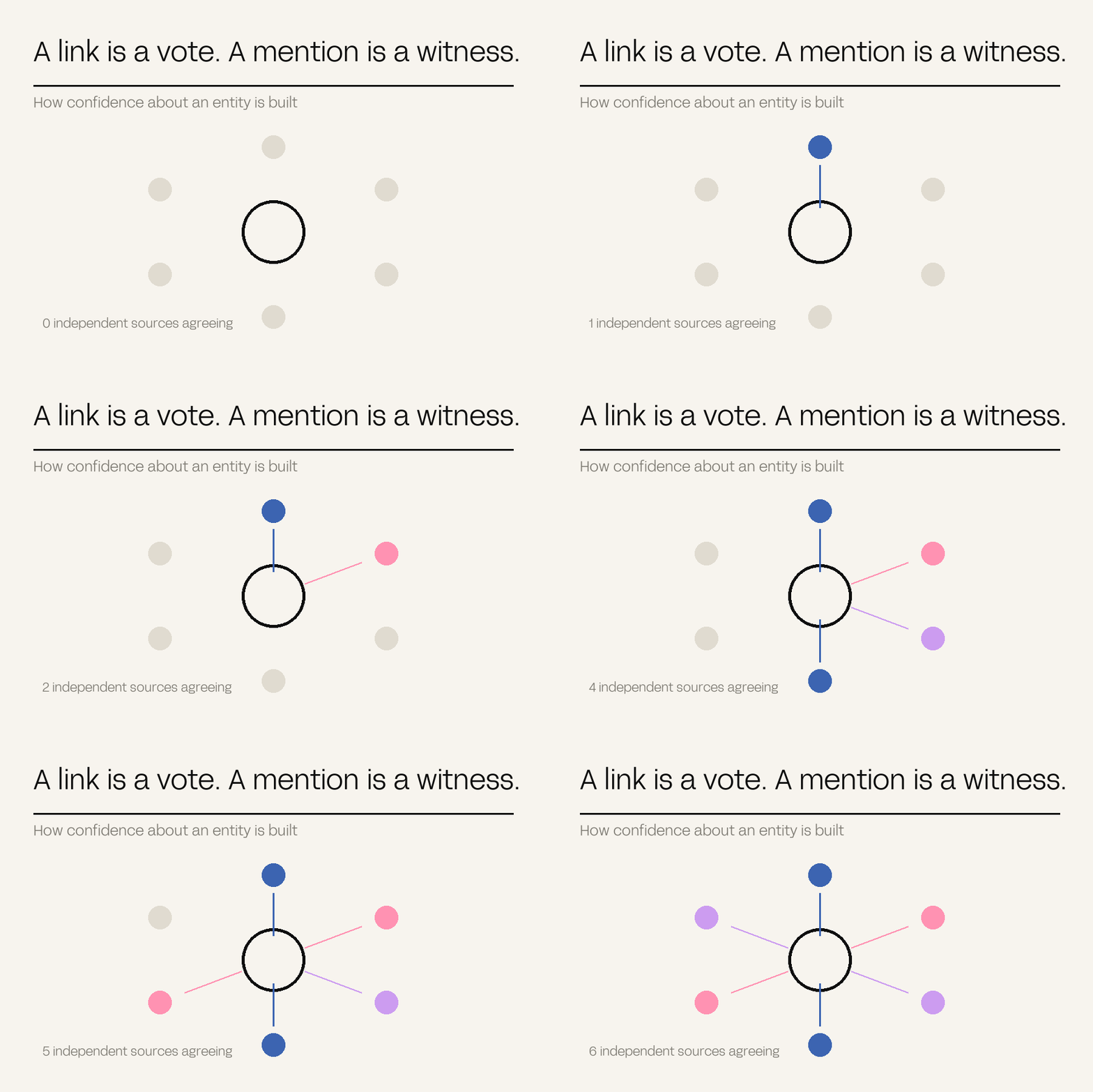
AI systems build confidence about an entity the way a fact-checker does – by looking for the same claim across independent sources. That makes an unlinked mention on a credible site valuable in a way traditional SEO never counted, and makes a purchased link close to worthless. The sites cited most often have strong fundamentals plus genuine third-party coverage.
Link building assumed a model where a link is a vote and votes accumulate into authority. That model still operates in classical search. It describes almost nothing about how a language model decides whether to name you.
A retrieval system assembling an answer is doing something closer to fact-checking than to counting endorsements. It is asking whether a claim appears consistently across sources it has reason to trust.
Under that model an unlinked mention on a credible site – a directory entry, an industry roundup, a client naming you, a review platform – carries real weight, because it corroborates. And a purchased link from a low-quality site carries close to none, because it corroborates nothing and originates from the same interested party as your own claims.
A link is a vote. A mention is a witness. The systems answering questions now care much more about witnesses.
– The Antimony position
The sites appearing most in ChatGPT, Perplexity and Claude answers share three properties: strong traditional SEO foundations, meaningful third-party coverage, and content written to answer the specific questions their audience asks.
Note that third-party coverage sits between the two. It is not a substitute for fundamentals or for good content, and neither of the others substitutes for it.
Link building was procurable. You could budget for it and buy it. Corroboration is largely earned, which makes it slower, less controllable, and considerably more valuable for the same reason.
It also means the work sits outside the marketing team's usual reach: getting named in a client's own case study, appearing in an industry directory that people actually use, having reviews on platforms nobody controls.
Our strongest third-party evidence was already published and disconnected from everything – named clients with real figures, like Femme Connection's $1.5M in flow revenue or Lindsay Ryan's 4.5× lift in qualified vendor enquiries.
Meanwhile the site-wide copyright line misspelled our own company name on every page for an unknown period. That is the opposite of corroboration: a brand publishing two different spellings of itself gives an entity graph a reason to split rather than merge.
The general rule: before pursuing external mentions, make sure your own name is spelled consistently everywhere it appears – footers, directory listings, social bios, email signatures. These are written once, proofread never, repeated on every page, and they are the cheapest corroboration signal you control outright.

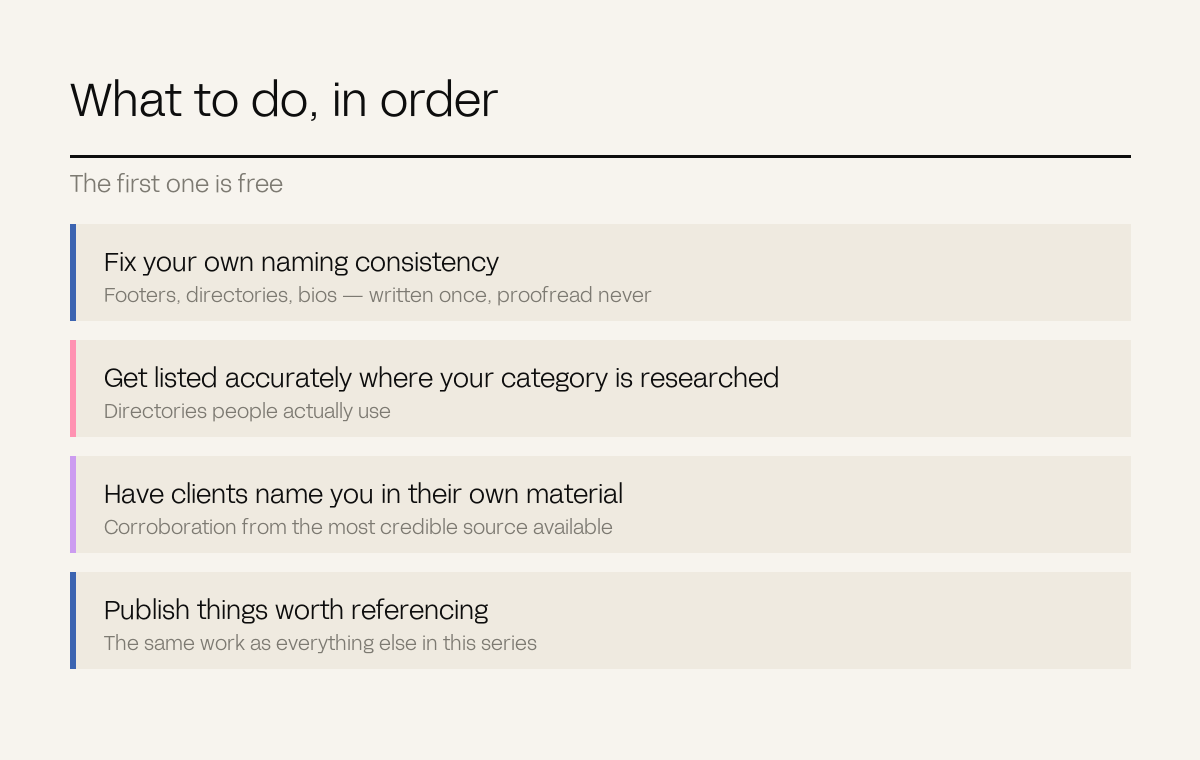
Fix your own naming consistency first, because it is free. Then get listed accurately where your category is genuinely researched. Then ask satisfied clients to name you in their own material, which is corroboration from the most credible possible source. Then earn coverage by publishing things worth referencing – which is the same work as everything else in this series.
What not to do is buy links. It was a declining tactic in search and it contributes nothing to citation.
Definitions. Corroboration: independent sources agreeing on a fact. Entity graph: the network of entities and relationships a system reasons over.