


.png)
Let’s talk

Thank you! Your submission has been received!
Oops! Something went wrong while submitting the form.
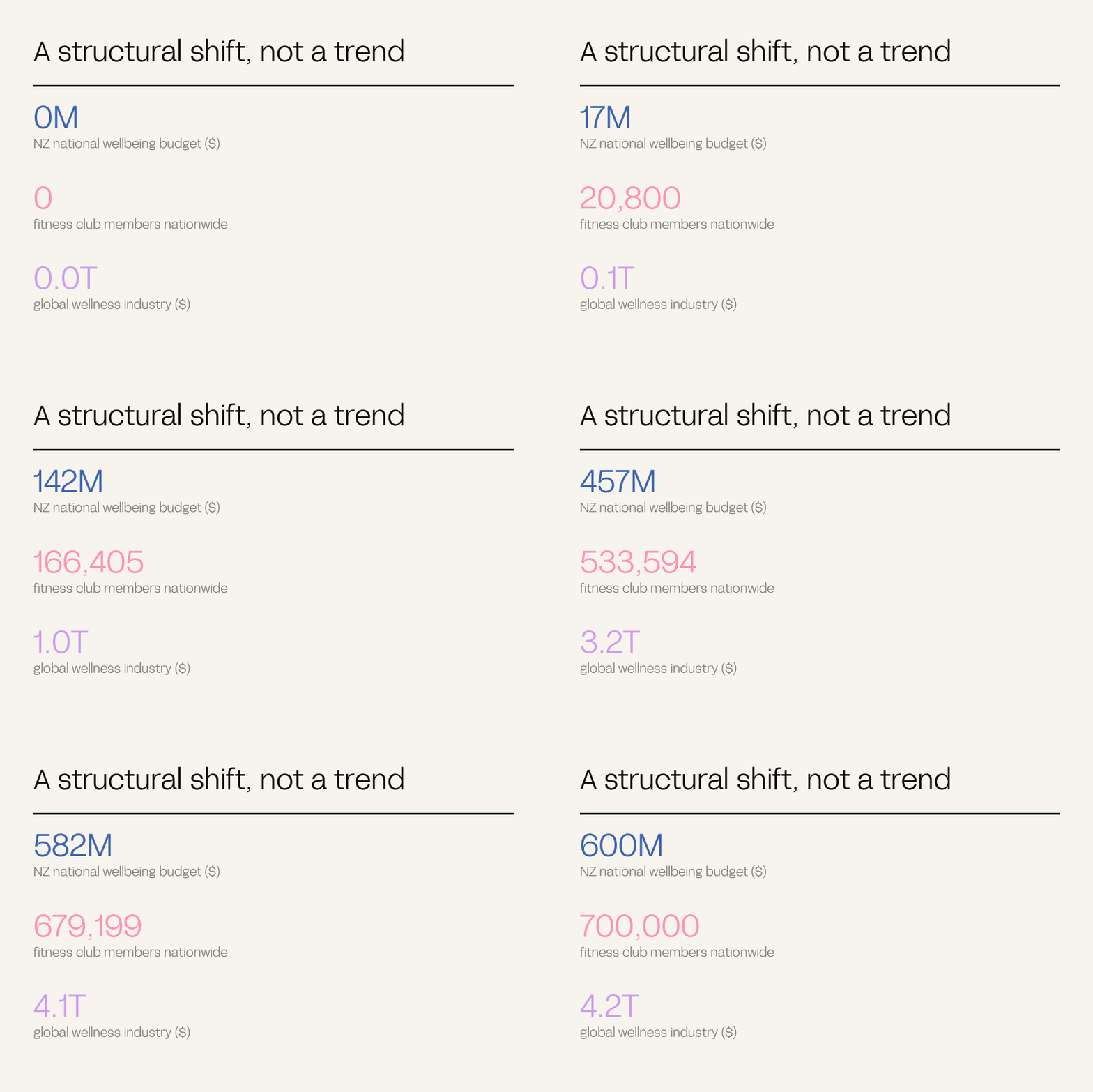
New Zealand committed $600 million to its national wellbeing budget, against 700,000+ fitness club members domestically and a $4.2 trillion global wellness industry. Public investment at that scale reframes wellness from discretionary spending to expected infrastructure, which changes who the customer is, what they expect, and how a brand has to be positioned to meet them.
Most category shifts in wellness are trends: an ingredient, a format, a modality that runs hot and cools. A national government committing $600 million is a different kind of event.
Read together they describe something more durable than demand. Public investment at that scale changes what people expect as normal, and expectations set at a national level do not reverse when a trend cools.
Trends change what people buy. Structural shifts change what people assume they are entitled to.
– The Antimony position
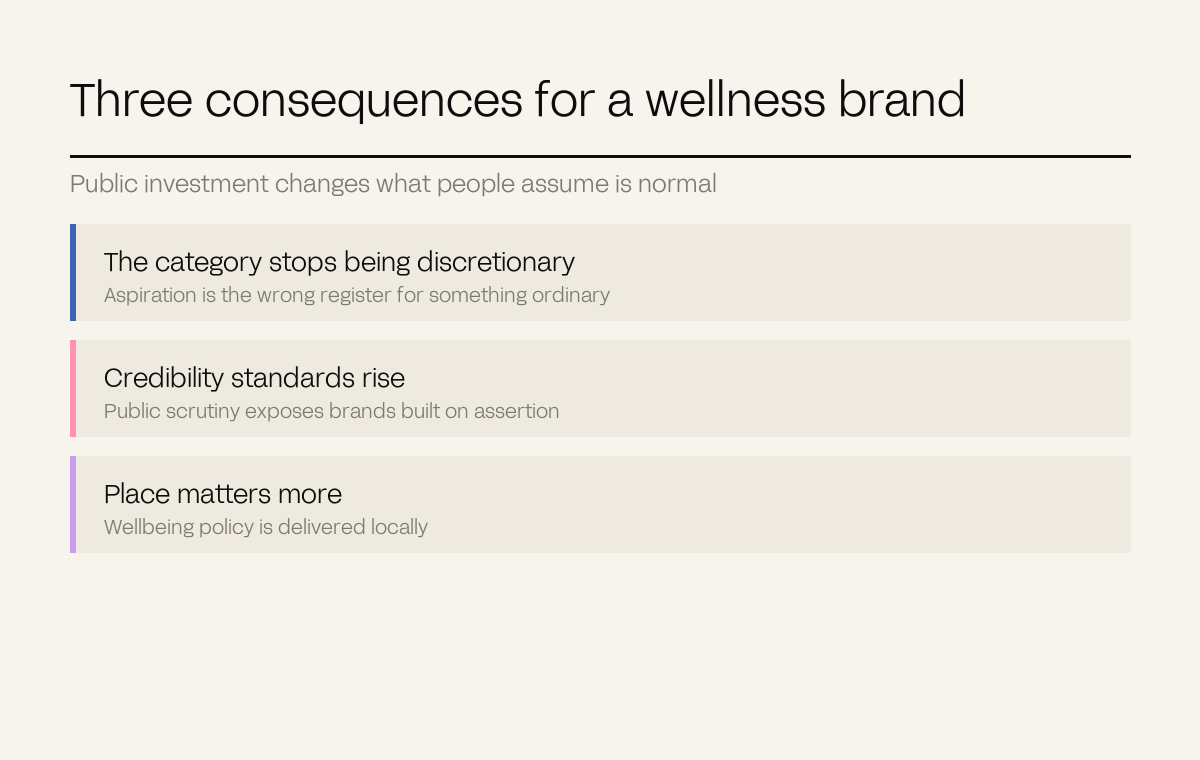
When wellbeing is framed as public infrastructure, private wellness stops being an indulgence and becomes an expected part of ordinary life. That is a positioning change: aspiration was the right register for a discretionary purchase, and it is the wrong one for something people consider normal.
Public investment brings public scrutiny. As government, clinicians and media pay attention, the loose claim that survived in a purely commercial category attracts a different quality of examination. Brands built on assertion get more exposed; brands built on verifiable evidence get more valuable.
National wellbeing policy is delivered locally, and it makes people think about wellbeing as something with a location. A brand that belongs somewhere specific has an advantage over one that could be from anywhere.
Re<>Defined was built for exactly this environment – an integrative wellness proposition in Papamoa, one of New Zealand's fastest-growing areas, entering a market where the structural signals above were the whole opportunity.
The brief was to make holistic health relatable and give it a sense of place. We built the strategy, the identity and the spatial experience as one thing, so the brand worked the moment someone encountered it – online, and standing in the room. The messaging had to land in both, blending traditional values with modern connection.
That integration is the direct answer to the third consequence above. A brand that exists only as a logo and a website cannot express place. One built with the space as part of the identity can. Read the case study.
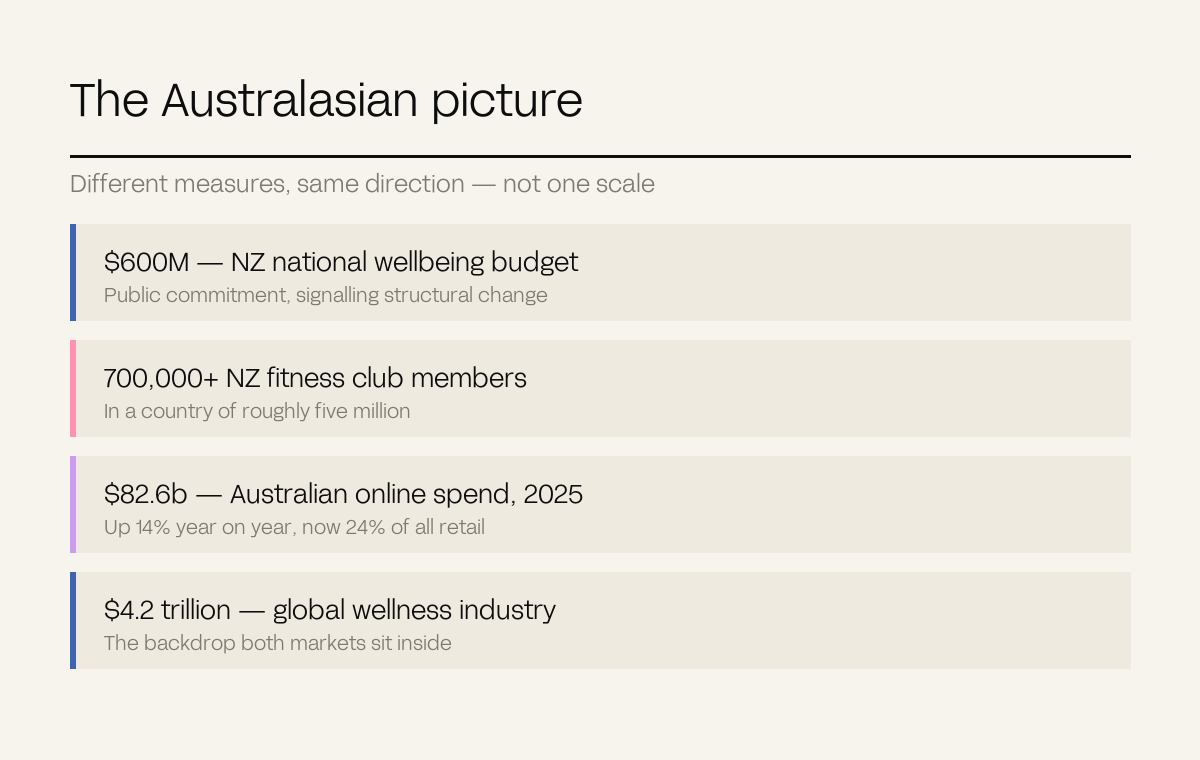
New Zealand is not a smaller version of the Australian market and treating it as an export afterthought is the standard mistake. But the structural direction is shared, and NZ is further along the public-commitment curve – which makes it a useful preview.
The practical implication is that credibility infrastructure – measurement, practitioner relationships, verifiable evidence – is worth building before you need it. Ello Care's +82 NPS and 91% satisfaction, or 5th Element Wellness's consistent 4.8 and 4.9 ratings across three independent platforms, are the kind of asset that takes years and cannot be bought when scrutiny arrives.
Build for the version of the category that exists after the shift, not the one that existed before it. That means evidence over assertion, specificity over aspiration, and a brand that belongs somewhere – because a category that has become normal rewards brands that feel like part of ordinary life rather than an escape from it.
Definitions. Wellbeing budget: New Zealand's framework for allocating public spending against wellbeing outcomes rather than purely economic ones.