

.png)
Let’s talk

Thank you! Your submission has been received!
Oops! Something went wrong while submitting the form.
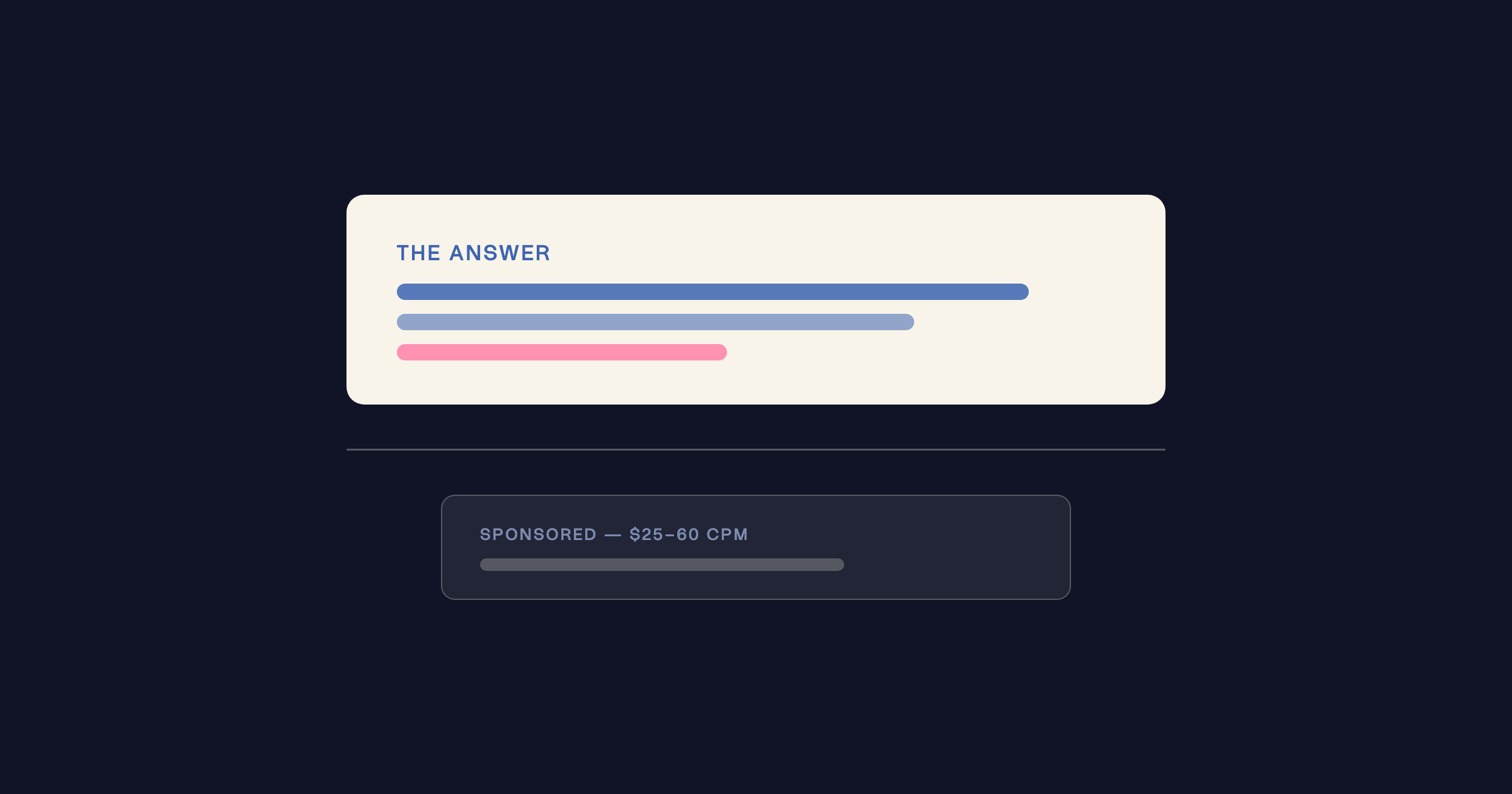
The founder-led growth ceiling is a brand problem, not a marketing problem. A brand system creates authority before the sales call, filters the right clients, converts through belief rather than persuasion, and compounds – where a funnel on a weak brand just adds effort to the same ceiling.
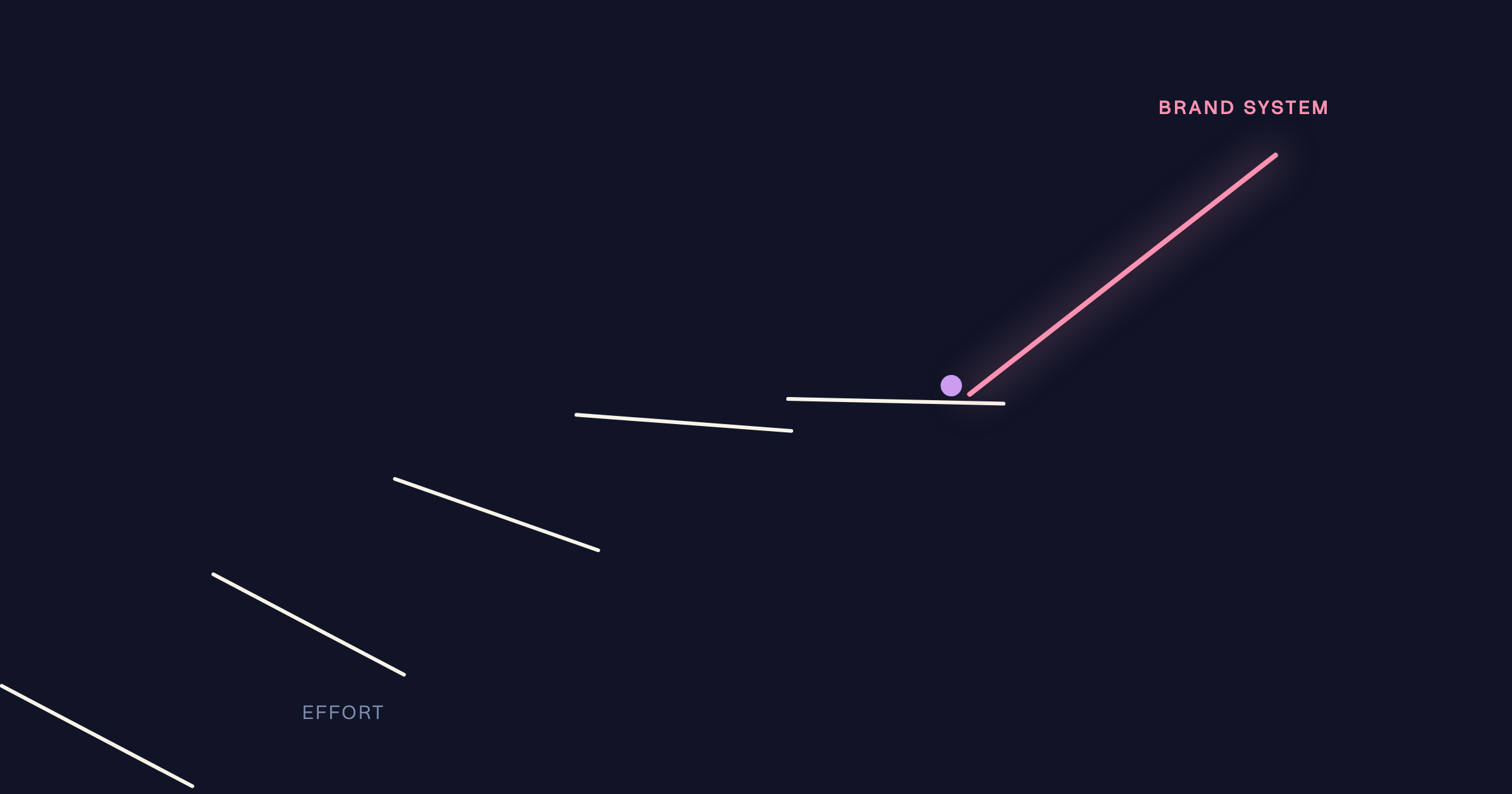
The pattern is always the same. A founder builds a service business to $10K, $30K, $50K per month on personal effort: referrals, outreach, reputation, one-to-one relationships. Revenue grows – and so does the workload. Every new client requires more of the founder's time. The business scales linearly with effort, not exponentially with systems. Eventually the founder asks: do I need a better funnel? The answer is almost always no. They need a better brand.
Most founder-led brands were built organically. The logo was made by a friend. The website was good enough at the time. The messaging evolved by trial and error. That works early, because the founder is the brand. But at a certain scale the founder cannot be in every conversation, and the brand has to communicate authority, trust, and positioning without them in the room. If it cannot, growth stalls.
The service business growth industry runs on traffic-trust-transactions funnel models. They optimise the middle of the funnel – but they assume the brand underneath is strong enough to support it. If positioning is vague, traffic quality suffers. If the brand world is inconsistent, trust takes longer. If website, content, and sales collateral do not work as one system, the sales call has to do all the heavy lifting.
A better funnel on a weak brand is like a bigger engine in a car with no steering.
– The Antimony position

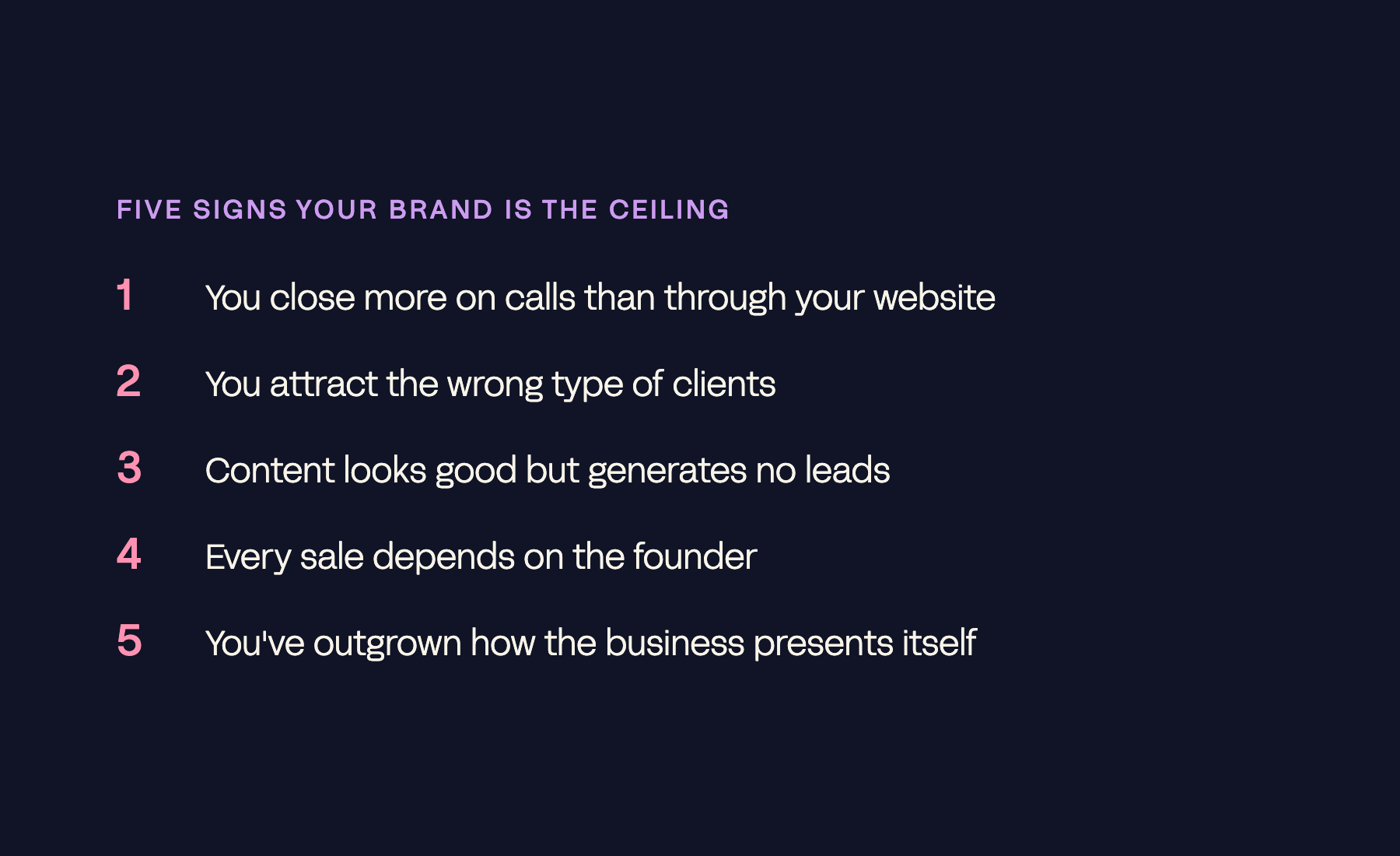
1. You close more deals on calls than through your website. 2. You attract the wrong type of clients – a positioning problem, not a traffic problem. 3. Your content looks good but generates no leads. 4. Every sale depends on the founder's personal credibility. 5. You feel you have outgrown how the business looks, sounds, and presents itself. That last one is instinct, and it is almost always right.
Clarifying positioning. Defining the customer belief system. Rebuilding the visual identity. Aligning the website to the new positioning. Connecting content and lifecycle to the strategy. And launching the evolved brand deliberately. This is the arc behind founder-led work like Elly Sofocli – branding and launching New Zealand's first purpose-built wellbeing destination, where the founder's authority became a brand system that could carry it.
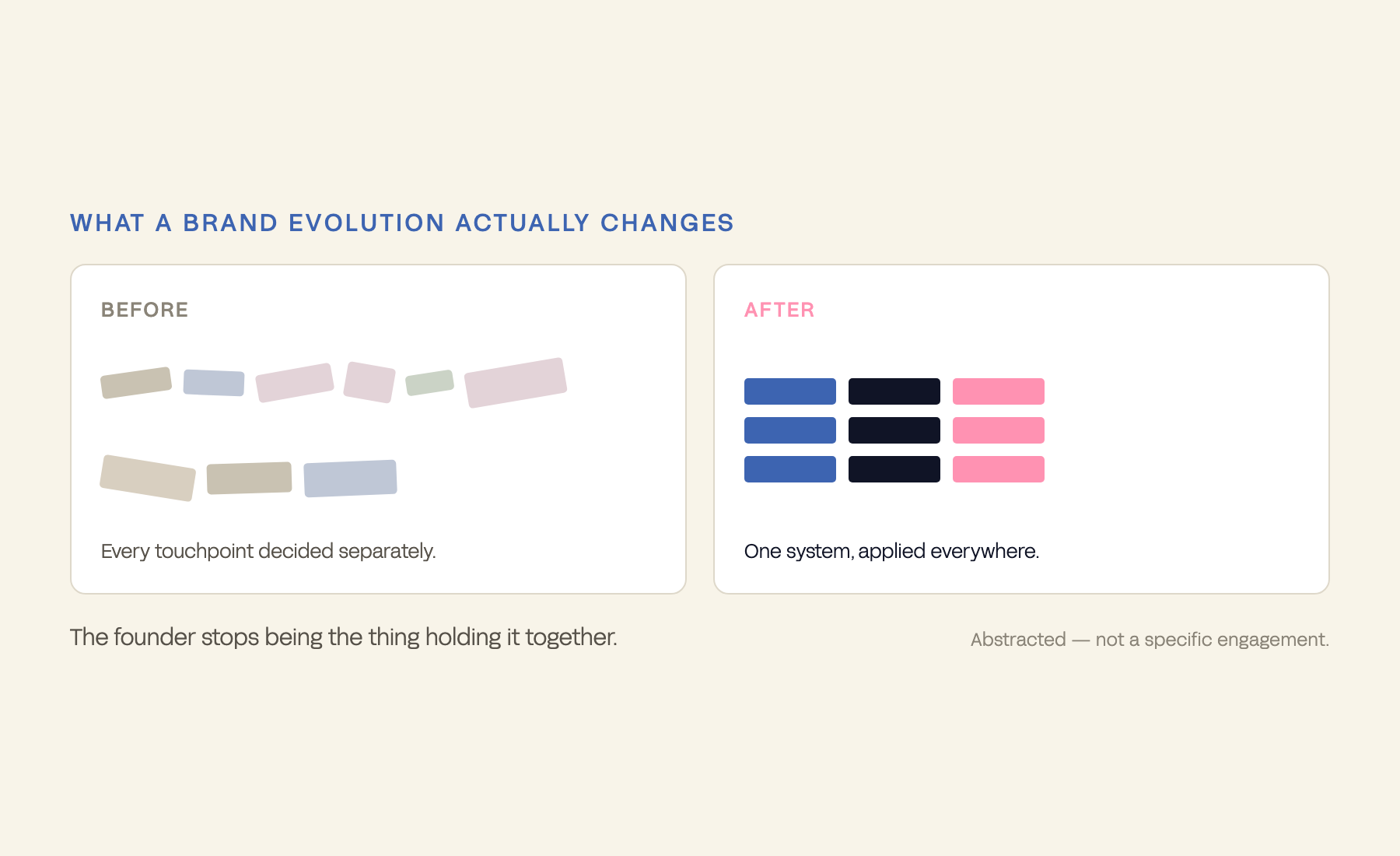
The brand that got you to $30K a month is not the brand that will get you to $100K. Growth requires evolution, not just more effort applied to the same identity. If three or more of the five signs sound familiar, the next move is not a new channel – talk to us about a Brand Evolution Sprint.
Definitions. Brand system: the connected set of positioning, identity, website, content, and lifecycle that communicates authority consistently. Belief system: the set of things a customer must believe before buying.