


.png)
Let’s talk

Thank you! Your submission has been received!
Oops! Something went wrong while submitting the form.
A distinctive brand asset has to score on two axes: fame, meaning how many people recognise it, and uniqueness, meaning how many link it only to you. High fame with low uniqueness is a category cue you are wasting money on. The test is simple enough to run on your own material this afternoon.
The Ehrenberg-Bass framework for distinctive assets is unusually practical for an academic model, because it reduces to two questions you can answer about any element of your identity.
Fame: of the people in your market, how many recognise this element? Uniqueness: of the people who recognise it, how many attribute it to you and only you?
Both are required, and the second is where almost everything fails.
An asset everyone recognises and nobody attributes to you is not your asset. It is the category's, and you are paying to maintain it.
– The Antimony position
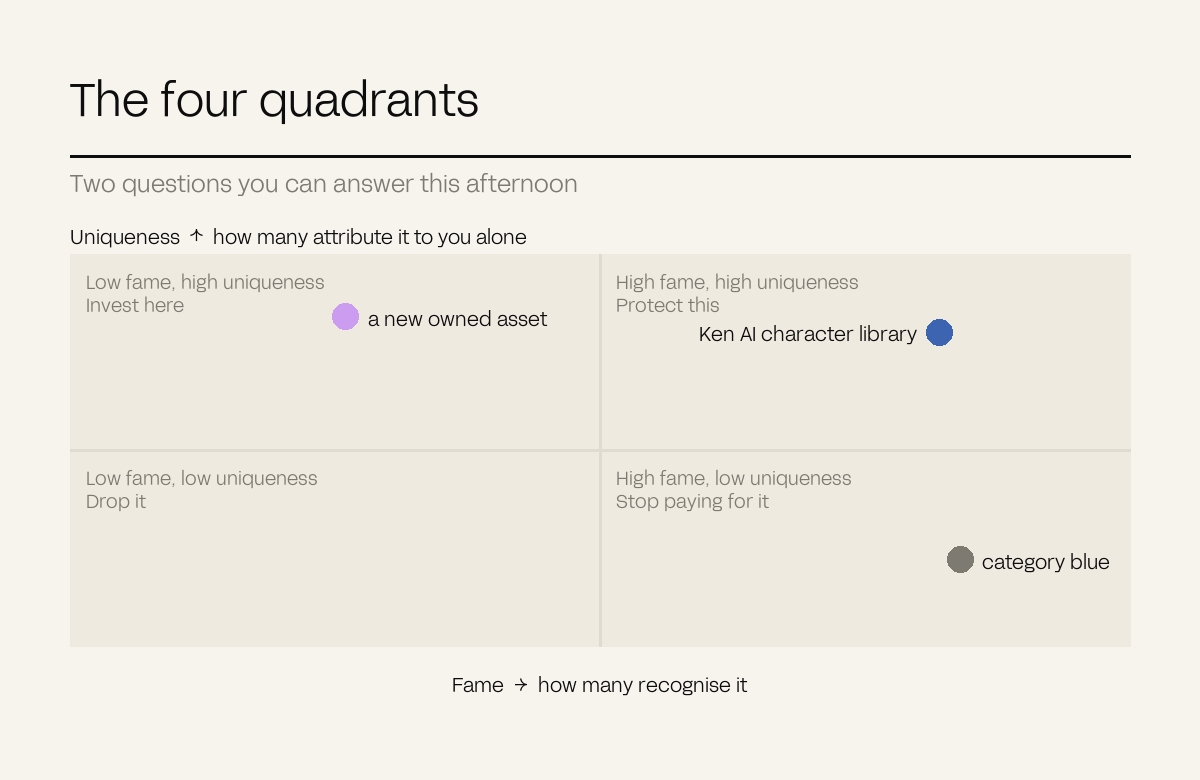
A genuine asset. Do not modernise it, do not let a new creative director improve it. These are rare and they take years.
Something that is genuinely yours but that too few people know. This is the only quadrant where more spending reliably helps.
The category cue. Blue for enterprise software, green for anything sustainable, a stethoscope for healthcare. Recognised instantly, attributed to nobody. Most brands' most-used elements live here.
Neither known nor owned. Usually the accumulated result of years of small unrelated decisions.
Take your logo off ten recent pieces. Show them to twenty people in your market. Ask one question: whose is this?
Then take each element separately – the colour, the typeface, the illustration style, the layout system, the tone – and ask which of them, alone, produced a correct answer. That is your uniqueness read, and it is usually humbling.
Ken AI's custom character and icon library – 24 bespoke assets – is a deliberate play for the high-uniqueness quadrant in a field where every competitor uses the same abstract gradient technical language. Nobody else can use a character system built for one brand.
Ka Ka Wa's packaging does the same at shelf: every SKU from the 70% cacao bar to the 100% ceremonial-grade kilogram format was designed to tell the brand's story where no one is standing next to it to explain.
RT Edgar shows the fame side: a collateral system adopted by 87% of agents, which is what turns a design into an asset. An identity used by 30% of a network never accumulates recognition, however distinctive it is on the page.
Running this on ourselves produced an uncomfortable finding that had nothing to do with design quality. Our company name was misspelled in the copyright line on every page of our own website, and had been for an unknown period.
The general rule: uniqueness requires consistency before it requires creativity. Every variant spelling, every off-palette colour, every one-off layout divides recognition across versions instead of accumulating it into one. Audit the boilerplate – footers, bios, directory listings – before you audit the creative, because those are written once, proofread never, and repeated everywhere.

Definitions. Fame: share of a market recognising an element. Uniqueness: share of those who attribute it to one brand only.