


.png)
Let’s talk

Thank you! Your submission has been received!
Oops! Something went wrong while submitting the form.
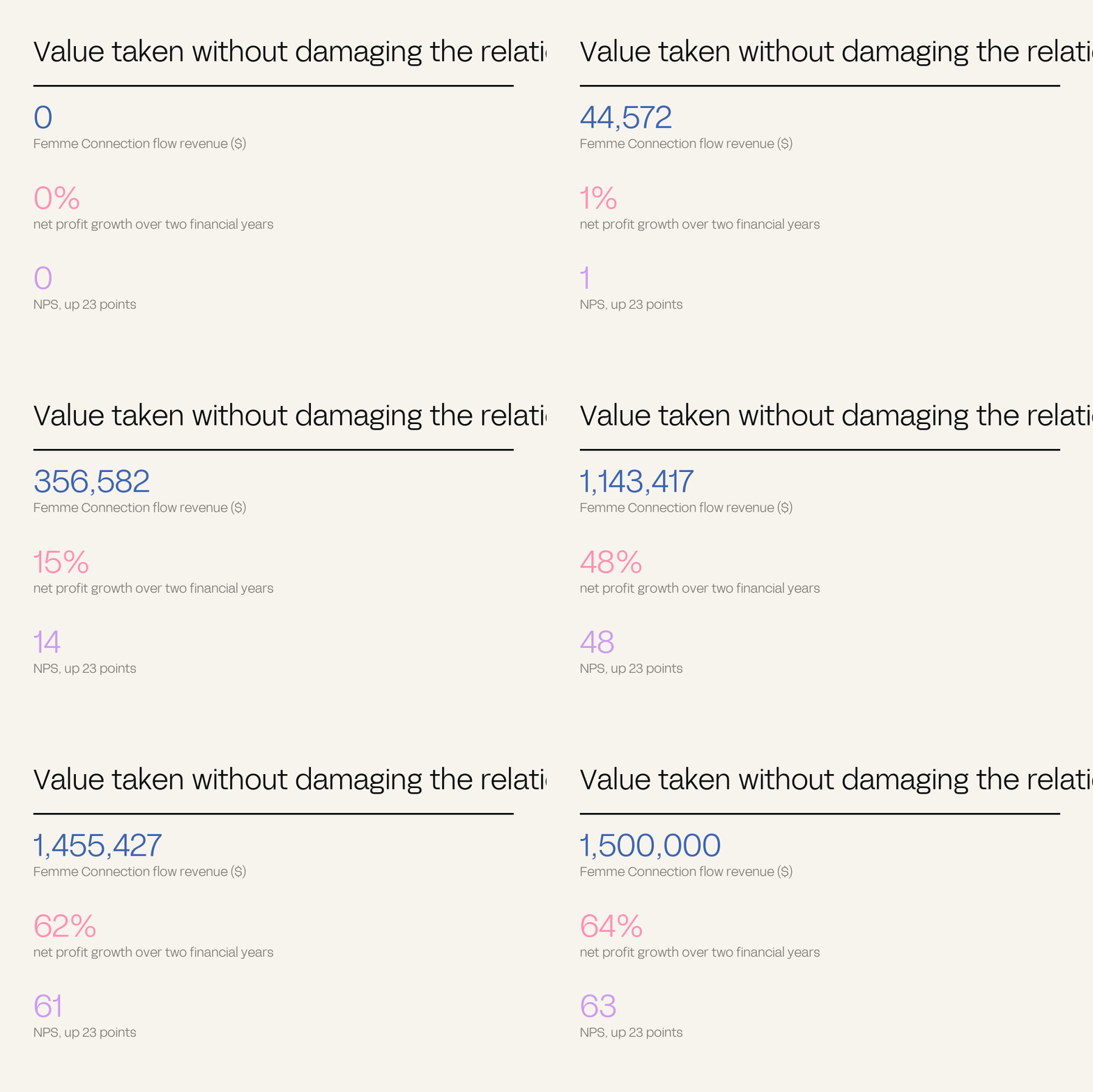
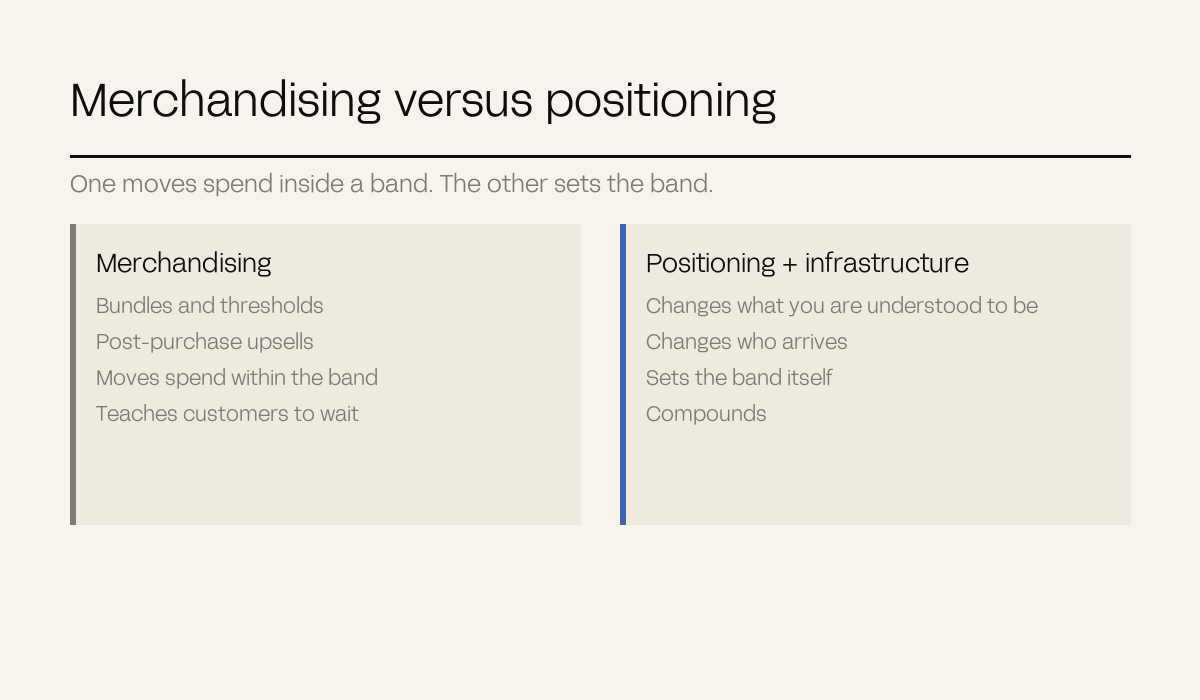
Merchandising tactics move spend inside a band the customer set before arriving; positioning sets the band. The larger and more durable gains come from being understood differently and then building the infrastructure that earns a second, third and fourth purchase. Femme Connection's email flows alone generated $1.5M in revenue from customers already acquired, while net profit rose 64%.
When customer value comes up, the conversation goes almost immediately to tactics: free shipping thresholds, bundles, post-purchase upsells, quantity breaks. All of them work a little. None of them explain why two brands selling comparable things end up with customers worth twice as much on one side as the other.
Threshold and bundle mechanics move a customer who has already decided what kind of purchase this is. They shift spend within a band the customer set before they arrived, and that band was set by what they understood the brand to be.
They also carry a cost. Discount-shaped mechanics teach customers to wait, and a brand that always has an offer running has quietly repriced itself downward while its list price stays the same.
Merchandising moves a customer within the band they arrived with. Positioning sets the band, and infrastructure decides how long they stay inside it.
– The Antimony position
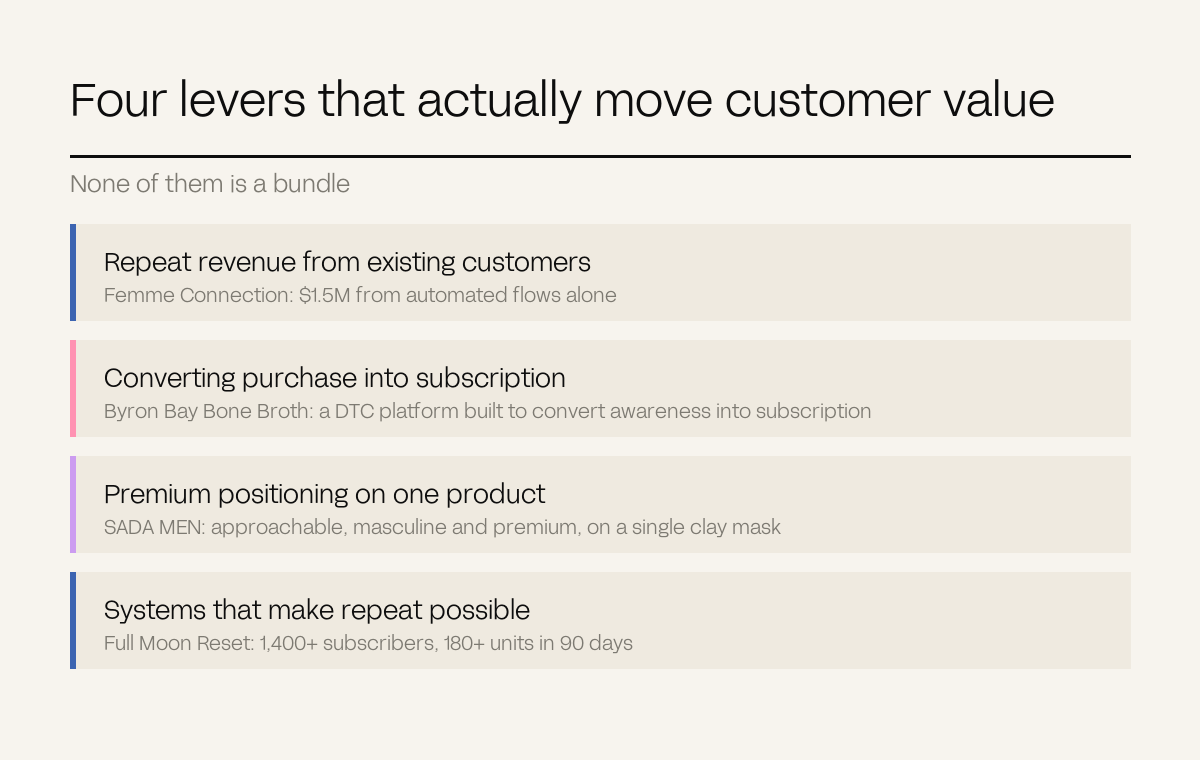
Femme Connection is the clearest evidence we have, because the number is isolated. The Klaviyo email program alone – automated flows sent to people who had already bought – generated $1.5M in flow revenue by 2025.
That is revenue from customers already acquired, earned by messaging them well rather than by finding more of them. And it did not come at the expense of the brand: over the same period net profit rose 64% across two financial years, NPS climbed 23 points to 63, and the brand earned 3,956 five-star ratings. Value extracted badly shows up as falling sentiment. This is what it looks like when the relationship is the asset.
Byron Bay Bone Broth had twelve years of wholesale credibility and no relationship with the person actually eating the product. The direct-to-consumer platform was built specifically to convert awareness into subscription – a membership program, an ambassador engine and a structured UGC pipeline forming a self-reinforcing loop.
A one-off purchase and a subscription are the same transaction with a different frame around it. Which one a customer chooses is decided by whether the brand made continuing feel obvious, and that is a design and positioning question long before it is a pricing one.
SADA MEN launched one Australian-made, native-ingredient clay mask that had to feel approachable, masculine and premium at once – in a category where the global men's grooming market was projected to exceed $115 billion but Australian skincare penetration remained low.
The brand had to earn permission before it could earn revenue, and it did that on one product rather than a range. Holding a premium position is far easier across one object you can explain completely than across five you can only gesture at.
Full Moon Reset is the smallest of the four and the most instructive about sequence. Website, CRM, community channels and an event marketing framework replaced manual distribution – turning loyal followers into a repeatable, compounding commercial engine.
In the first quarter post-launch the brand drove 4,600+ website sessions, sold 180+ product units within 90 days, and built an email database of 1,400+ subscribers. That list is the asset. Without it, every future sale has to be bought again.
Whether the customer understands what kind of purchase this is. Whether continuing is obvious or effortful. Whether you own a channel to reach the people who already bought. And whether your sentiment measures are moving in the same direction as your revenue – because if revenue is rising while satisfaction falls, you are not increasing customer value, you are borrowing against it.
If customer value is the problem, look at positioning and infrastructure before merchandising. Bundles and thresholds are worth running, but they optimise within a ceiling the brand set – and moving that ceiling is a different and much larger piece of work.
Definitions. Flow revenue: revenue attributed to automated email sequences rather than campaigns. NPS: net promoter score. UGC: user-generated content.