


.png)
Let’s talk

Thank you! Your submission has been received!
Oops! Something went wrong while submitting the form.
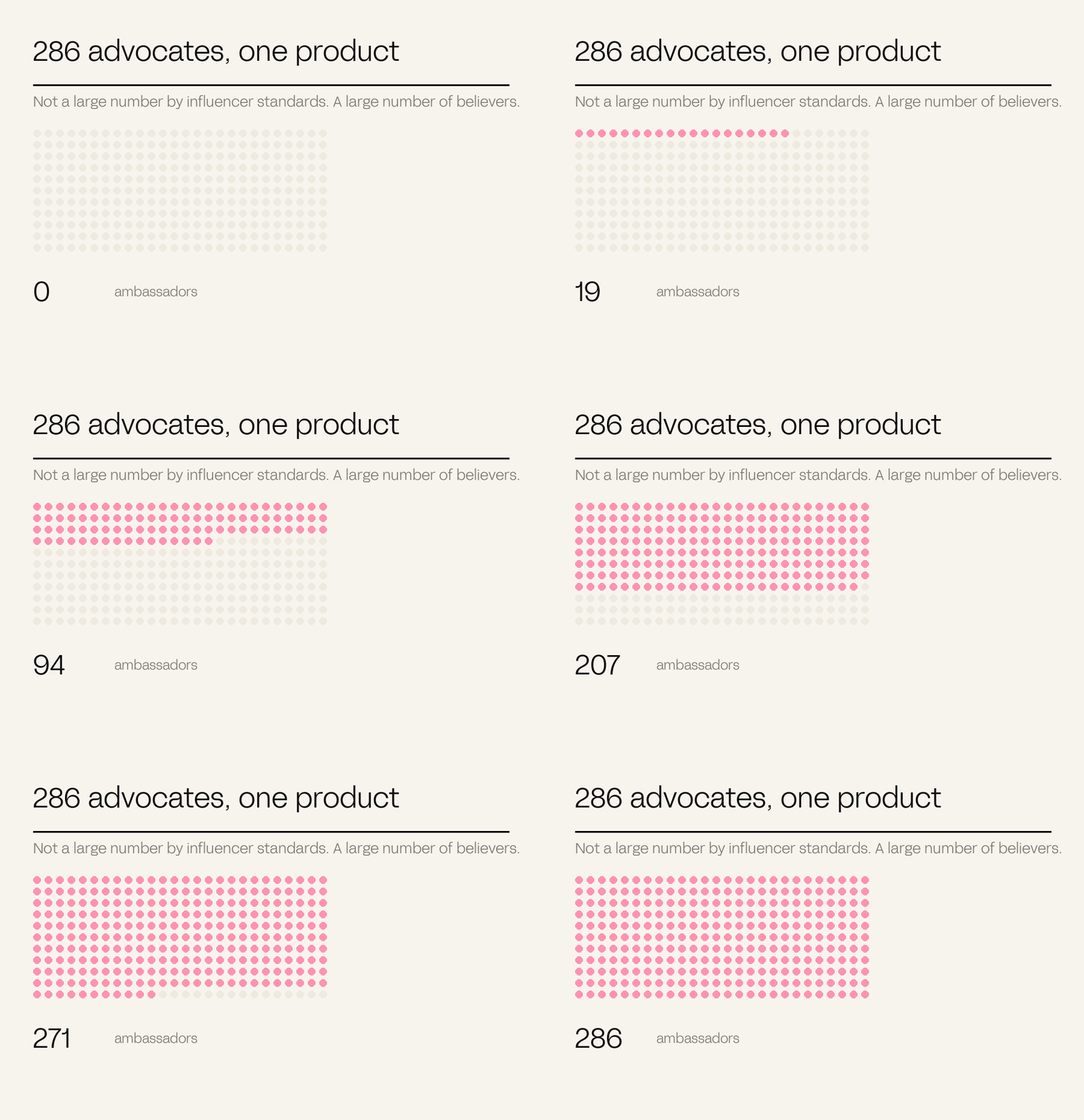
Ambassador programs fail when they recruit reach instead of belief – an audience paid to mention you produces content nobody trusts, including the ambassador. Programs that sell recruit existing customers, give them something worth explaining, and never make the payment the reason. SADA MEN's 286-strong program became the brand's selling engine on a single product.
Ambassador programs have a bad reputation among founders who have run one, and the reason is almost always the same: they recruited the wrong people, for the wrong reason, to do the wrong thing.
It goes like this. Find people with followings. Offer a discount code and a commission. Send free product. Wait.
What arrives is content produced by someone with no particular belief in the product, addressed to an audience who can tell, tracked through a code that mostly captures purchases that would have happened anyway. The programme runs at an apparent profit and contributes nothing, because it measured the wrong thing.
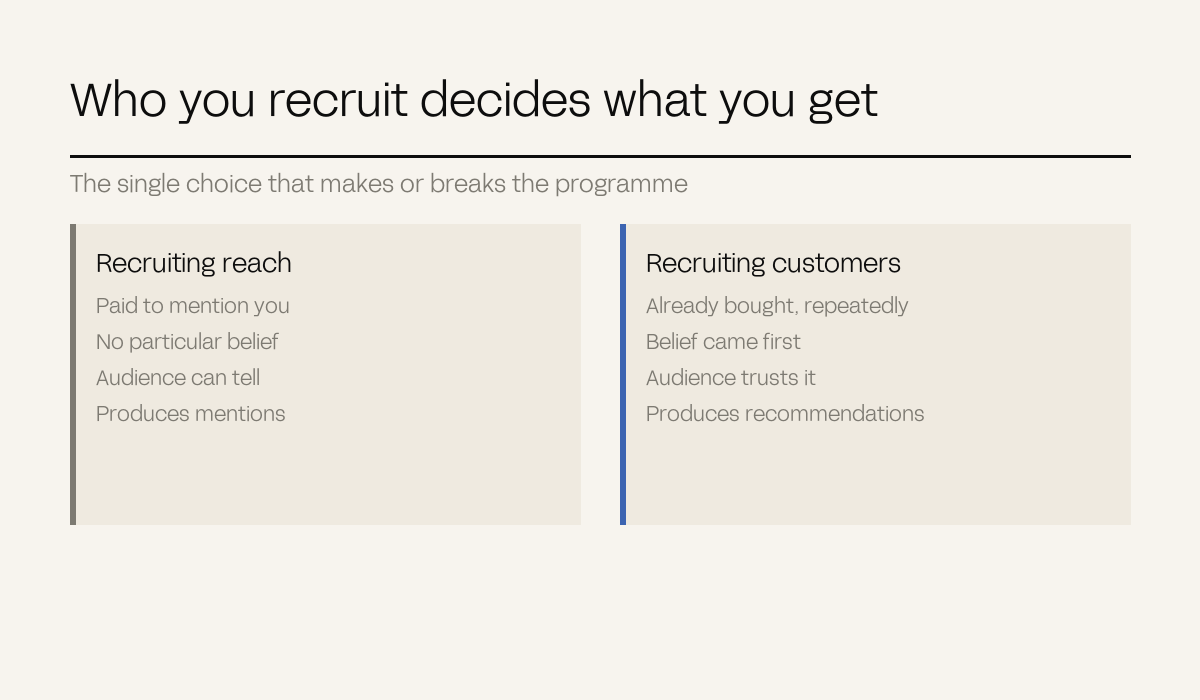
Recruiting reach gets you mentions. Recruiting customers gets you recommendations. Only one of those sells.
– The Antimony position
The qualifying attribute is that they already bought it, repeatedly, before you asked them anything. A customer with 400 followers who genuinely uses the product outperforms an account with 40,000 who was sent a box, because the recommendation is real and the audience knows the difference.
This is where a narrow product range pays off again. An ambassador with one product to talk about becomes fluent in it. An ambassador with a catalogue becomes a billboard.
Compensation should acknowledge effort without becoming the motivation, because the moment the audience reads the recommendation as paid, it converts into advertising and loses the only advantage it had. Early access, genuine input into what you make next, and visible recognition frequently outperform a higher commission rate.
SADA MEN was entering a category where men were not yet convinced the product was for them. Advertising can create awareness in that situation but it cannot easily create permission – that has to come from someone like the buyer, saying it plainly.
The programme was built around a single hero clay mask and grew to 286 ambassadors, and it became the engine of the brand rather than a channel alongside it. One product, one clear story, and a community that believed in it doing the selling. Read the case study.
The scale is worth noting. 286 is not a large number by influencer-marketing standards and that is precisely the point – it is a large number of genuine advocates, which is a different and much scarcer thing.
Ka Ka Wa acquired 6,500+ community members and customers across all channels within 24 months, with revenue up 120% in year two. The community and the commerce were built as one system rather than one being used to feed the other.
honahlee reached 6,500+ community members and 102,000 website visitors inside twelve months, with 3× platform growth year on year, in a category where trust is the scarce commodity and reach is easy.
Both numbers describe belief rather than impressions, which is why they translated into revenue.
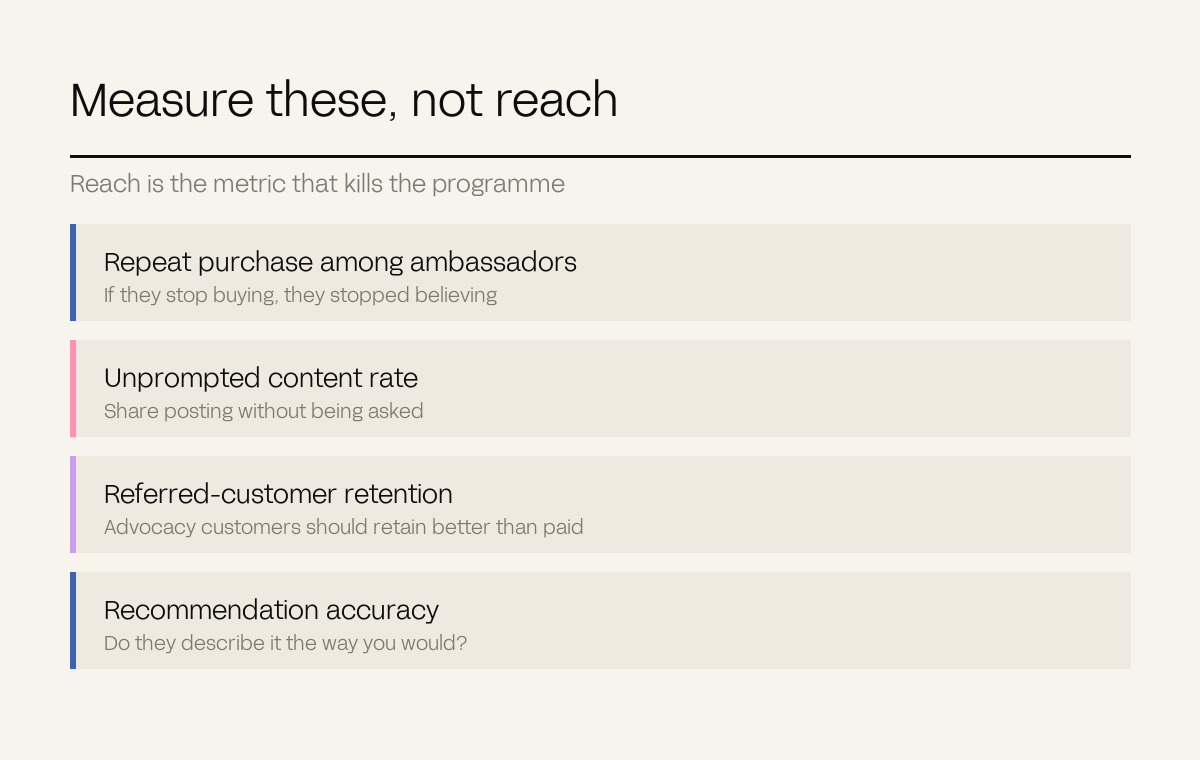
An ambassador programme is a brand asset, not a performance channel, and measuring it as a performance channel is what kills it. The return arrives as customers who trust you before they arrive – which shows up in retention and margin rather than in a discount code report.
Definitions. Ambassador: a customer who advocates publicly, usually with some formal relationship to the brand.