

.png)
Let’s talk

Thank you! Your submission has been received!
Oops! Something went wrong while submitting the form.
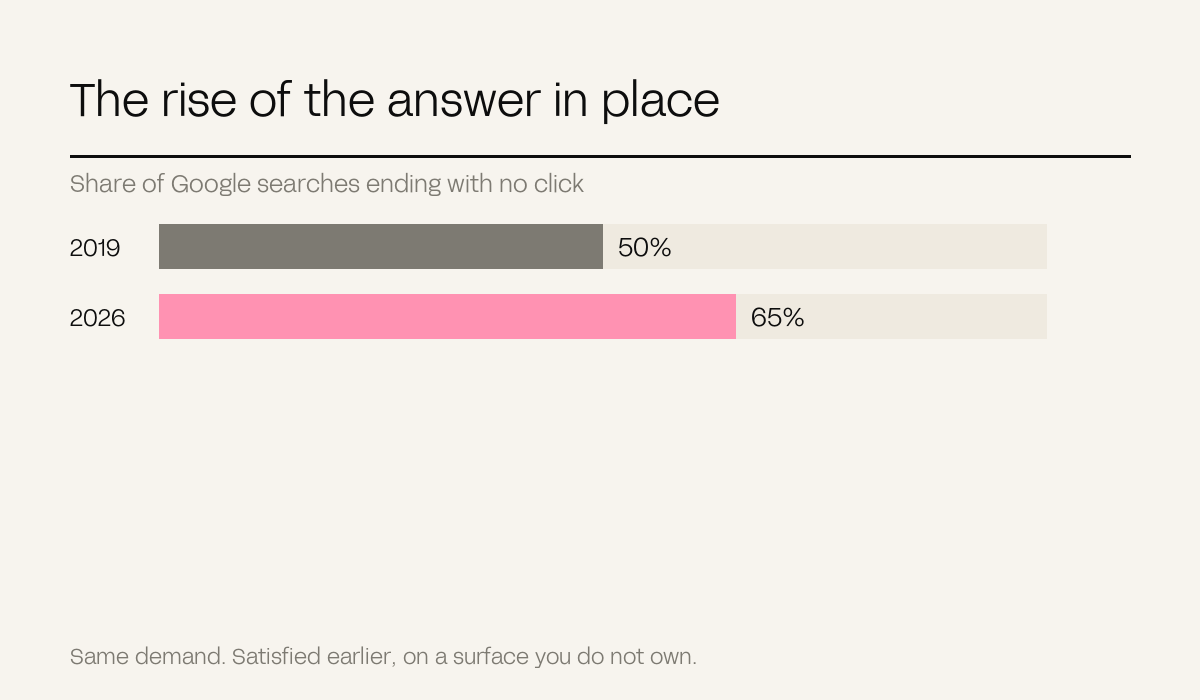
Around 64.8% of Google searches now end without anyone visiting a website, up from 50% in 2019. The strategic response is not to fight for the shrinking share of clicks but to treat the result surface itself as the placement – being the answer, and being named while being it. Visibility and traffic have become different metrics, and only one of them still tracks demand.
The single most disorienting statistic in marketing right now is that most searches no longer produce a visit. Not fewer visits. No visit at all.
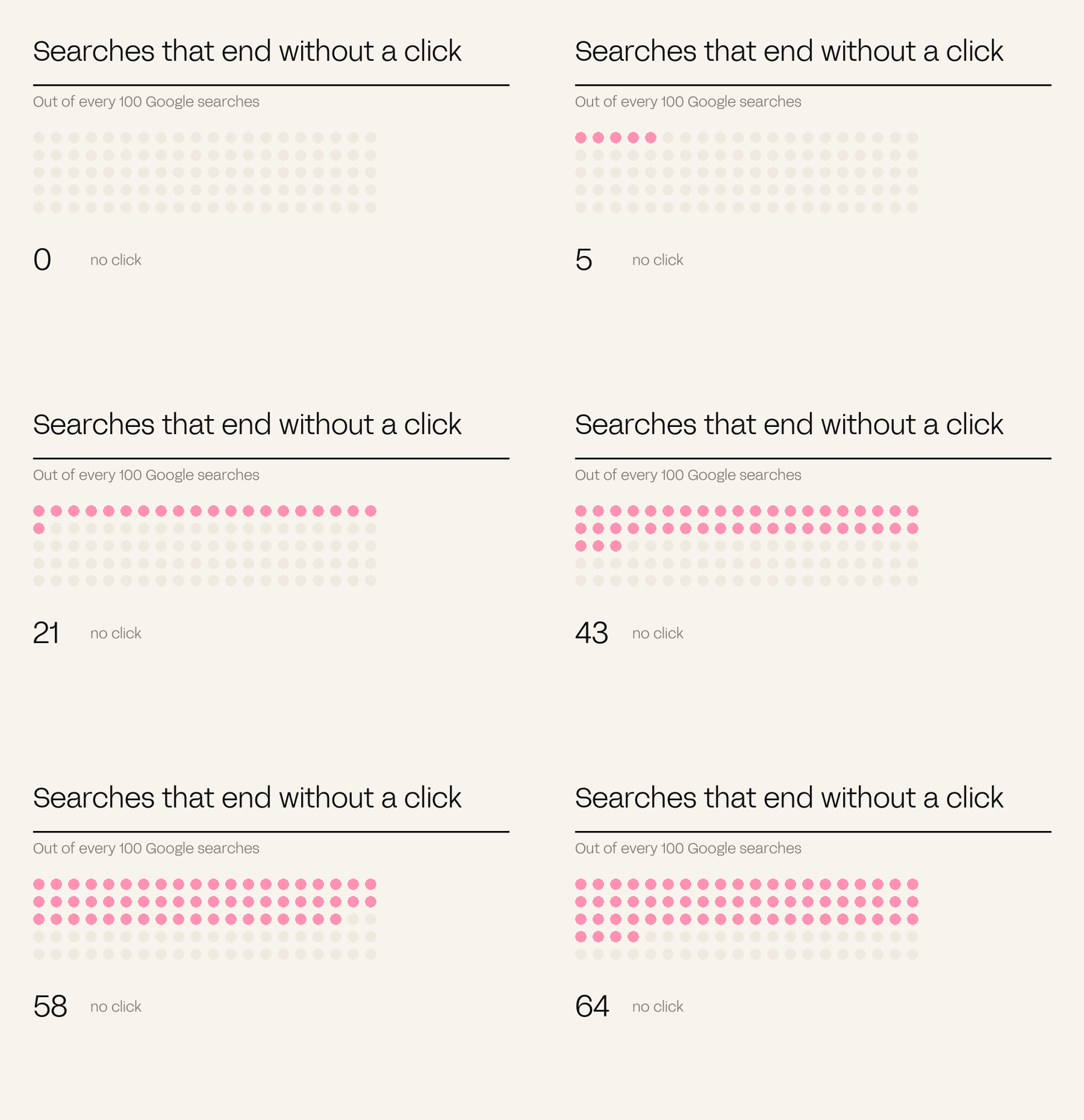
Roughly 64.8% of Google searches end without a click, up from about 50% in 2019. The answer appears in an AI Overview or a featured panel, the searcher reads it, and the session ends.
For anyone whose reporting equates organic traffic with organic performance, this reads as decline. It usually is not. It is the same demand, satisfied earlier, on a surface you do not own.
If the result is where the answer happens, then the result is the placement – and traffic stopped being the measure of whether you won it.
– The Antimony position
Two brands can have identical visibility and completely different traffic. The one whose queries get answered in-surface loses sessions while losing nothing commercially. The one whose queries require a visit keeps its numbers and looks healthier.
Judged on sessions alone, the first brand's content strategy looks like it is failing. It may be working perfectly. This is the measurement trap of the moment, and it causes people to defund content that is doing its job.
Zero-click means the answer is given by someone. If it is not from your material it is from a competitor's, or from an aggregator's summary of your category. Being the source of the answer is the placement, whether or not it produces a session.
This is the part brands neglect. An answer can use your framing, your figures and your structure without ever saying your name. Attribution is not automatic – it correlates with specificity and clear provenance. A claim tied to a named organisation with a date and a source is far more likely to be credited than a free-floating assertion.
Roughly a third of searches still produce a visit, and they are now a self-selecting group: people whose need was not satisfied by a summary. That is a more valuable visitor than the average of 2019. Design for depth – the case study, the calculator, the actual numbers – because the shallow query has already been handled without you.
Put the first and third together and the direction is unambiguous. The surface where the decision gets shaped is increasingly one you cannot instrument with a session counter.
Our own articles were written to be read start to finish, with the argument arriving late. Good for a reader who commits. Useless for a surface that lifts three sentences.
Two changes made the difference. Every article now leads with a plain summary of its answer – the thing a panel would quote – before the argument develops. And every claim now carries a named source, a date and a link to the underlying case study, so the material is attributable.
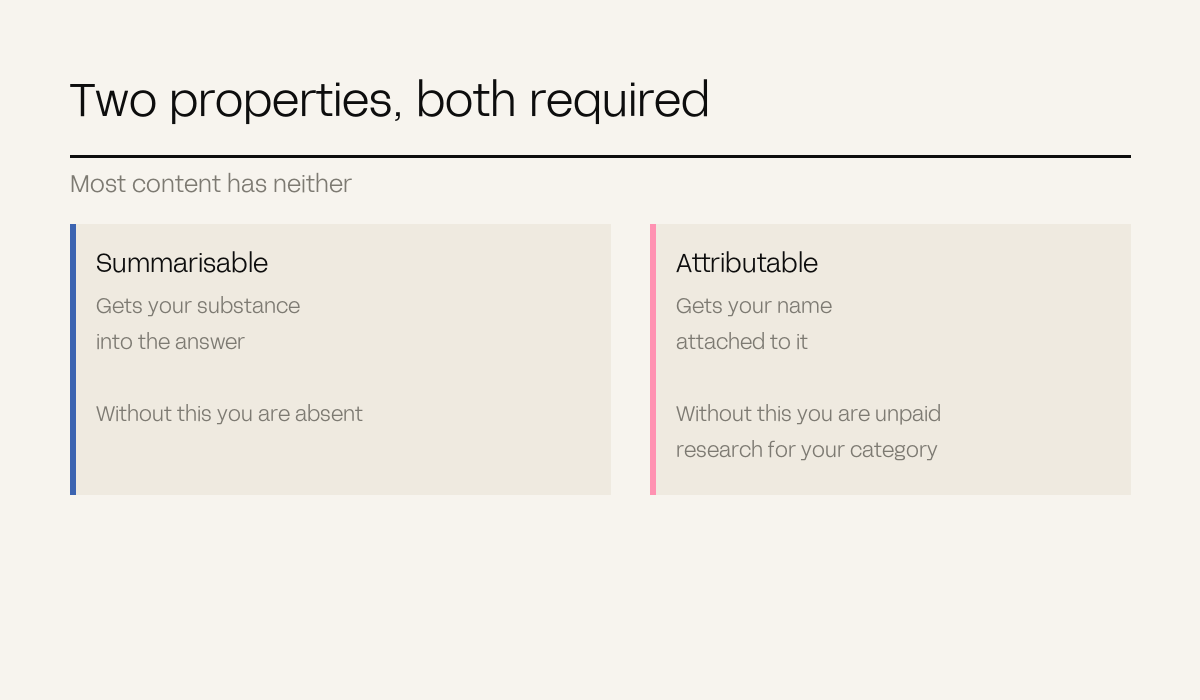
The general rule: summarisable and attributable are two separate properties, and most content has neither. Being summarisable gets your substance into the answer. Being attributable gets your name attached to it. A brand that is only the first is doing unpaid research for its category.
The attribution work is mostly linking claims to evidence you already own. When we write that a landing page can convert at 75%, it now points at Taiharuru Cove, where 6,938 visits became 209 qualified leads at $16.20 each. The figure stops being an assertion and becomes a citation with somewhere to go.
Definitions. Zero-click search: a search resolved without visiting any website. AI Overview: Google's generated summary at the top of results.