


.png)
Let’s talk

Thank you! Your submission has been received!
Oops! Something went wrong while submitting the form.
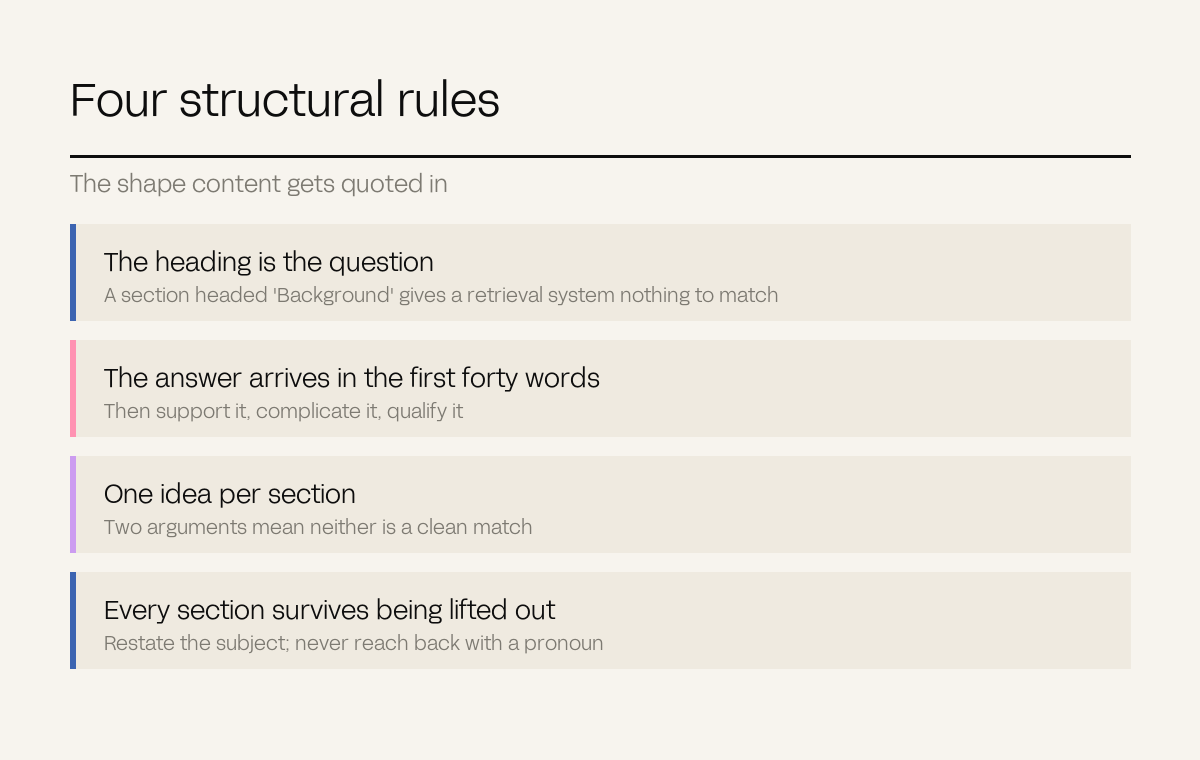
Content that gets quoted by AI systems shares a structure: the question as the heading, the answer in the first forty words, one idea per section, and every section self-contained enough to survive being lifted out. These are the same properties that make a page scannable for a human in a hurry, which is why the constraint is less painful than it sounds.
There is a specific shape that content gets quoted in. It is not a style or a tone, and it has nothing to do with quality in the literary sense. It is structural, it is learnable, and most business writing does the opposite of it.
A retrieval system matches a query against passages. A section headed "Background" gives it nothing to match. A section headed "What does a rebrand actually cost?" gives it the query itself.
Write headings as questions people type or claims people would quote. Labels – Overview, Context, Our Approach – are dead weight on both readers and machines.
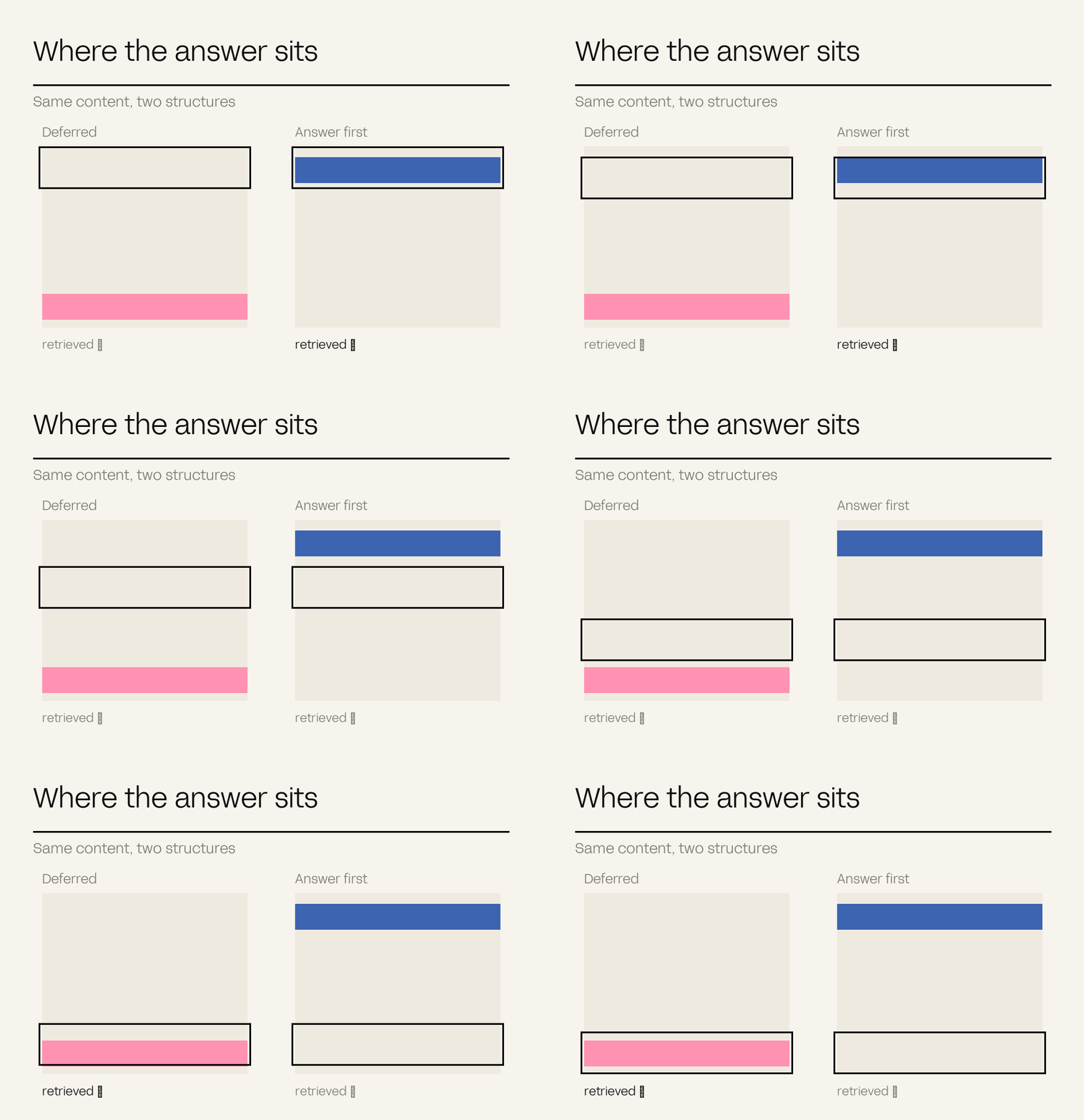
The classic structure holds the answer back to earn it. That builds tension for a reader who committed and produces a passage that, retrieved alone, is a conclusion with no premises.
Lead with the claim. Then support it, complicate it, qualify it. The reader who wants the argument still gets it; the one who wanted the answer already has it.
Two arguments in one passage means neither is a clean match for anything. The chunk loses to a competitor's that makes exactly one point clearly.
Restate the subject rather than reaching back with a pronoun. "This approach works because…" is unintelligible on its own; "Behavioural triggers work because…" is quotable. It reads slightly more repetitive in sequence. Publish it anyway.
You are no longer writing an article. You are writing a set of passages, each of which has to survive alone.
– The Antimony position
The objection is that this produces flat, formulaic prose. Sometimes it does. But the honest observation is that most business writing defers its answer out of habit rather than craft – the slow build is imitating journalism rather than serving a reader who came with a question.
Where the long form genuinely is the work – a manifesto, a case study, something someone chose to read whole – write it whole and accept it will be cited less. That is a legitimate trade in the other direction, made deliberately.
Those three together describe a world where being quotable and being ranked have separated, and where most people never arrive at your page at all.
Our journal was written to be read start to finish, with the argument arriving late – good for a committed reader, useless for a surface that lifts three sentences.
Every article now opens with a plain statement of its answer before the argument develops, and every claim carries a named source and a link to the evidence behind it.
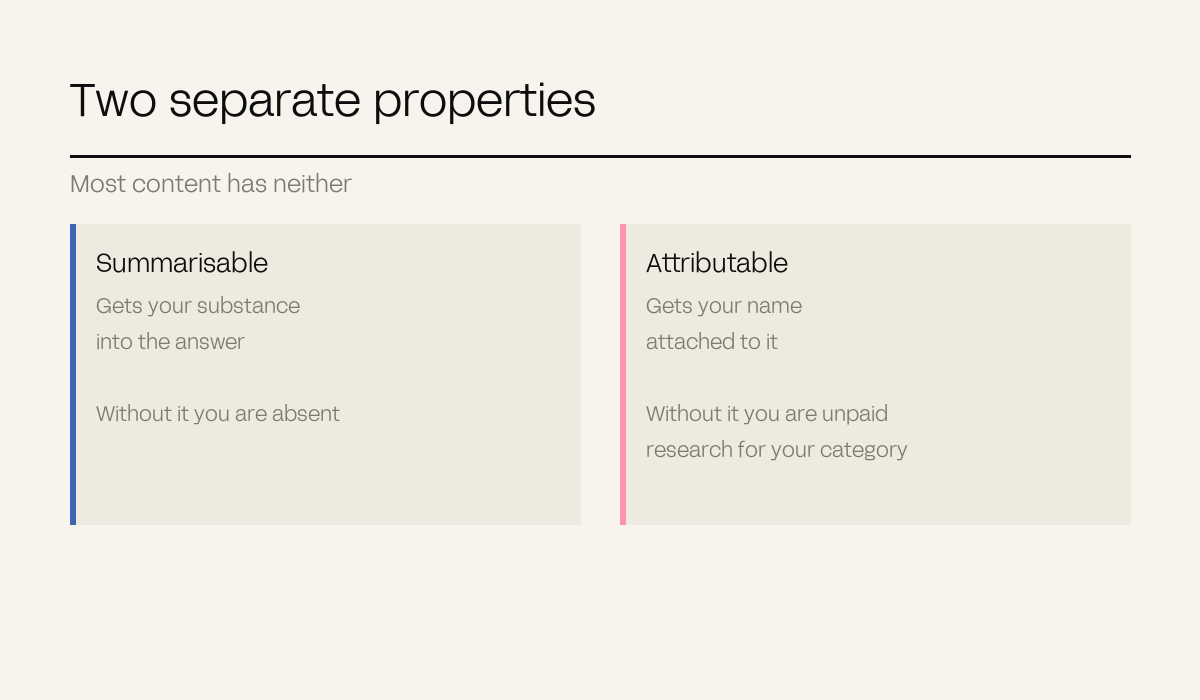
The general rule: summarisable and attributable are two separate properties and most content has neither. Being summarisable gets your substance into the answer; being attributable gets your name attached to it. A brand that is only the first is doing unpaid research for its category.
The attribution half is mostly linking claims to evidence you already own. When we say a landing page can convert at 75%, it now points at Taiharuru Cove, where 6,938 visits became 209 qualified leads at $16.20 each.
Definitions. Chunk: a passage a page is split into for retrieval. Extraction: lifting a passage to answer a query.