


Let’s talk

Thank you! Your submission has been received!
Oops! Something went wrong while submitting the form.

Roughly 32% of shoppers already use AI for shopping advice and 6 in 10 are comfortable doing so. This makes AI visibility a distribution problem rather than a marketing one: a brand an assistant cannot confidently describe is simply absent from those recommendations, regardless of how well it ranks or how much it spends.
There is a version of this shift that marketing teams keep filing under future concern. The number says it is a present one.
32% of Australian shoppers are already using AI for shopping advice, and 6 in 10 are comfortable using it.
The second figure is the leading indicator. Comfort precedes use, so the group asking assistants what to buy is likely to grow toward the group willing to.
If the assistant cannot describe you, you are not losing the comparison. You are not in it.
– The Antimony position
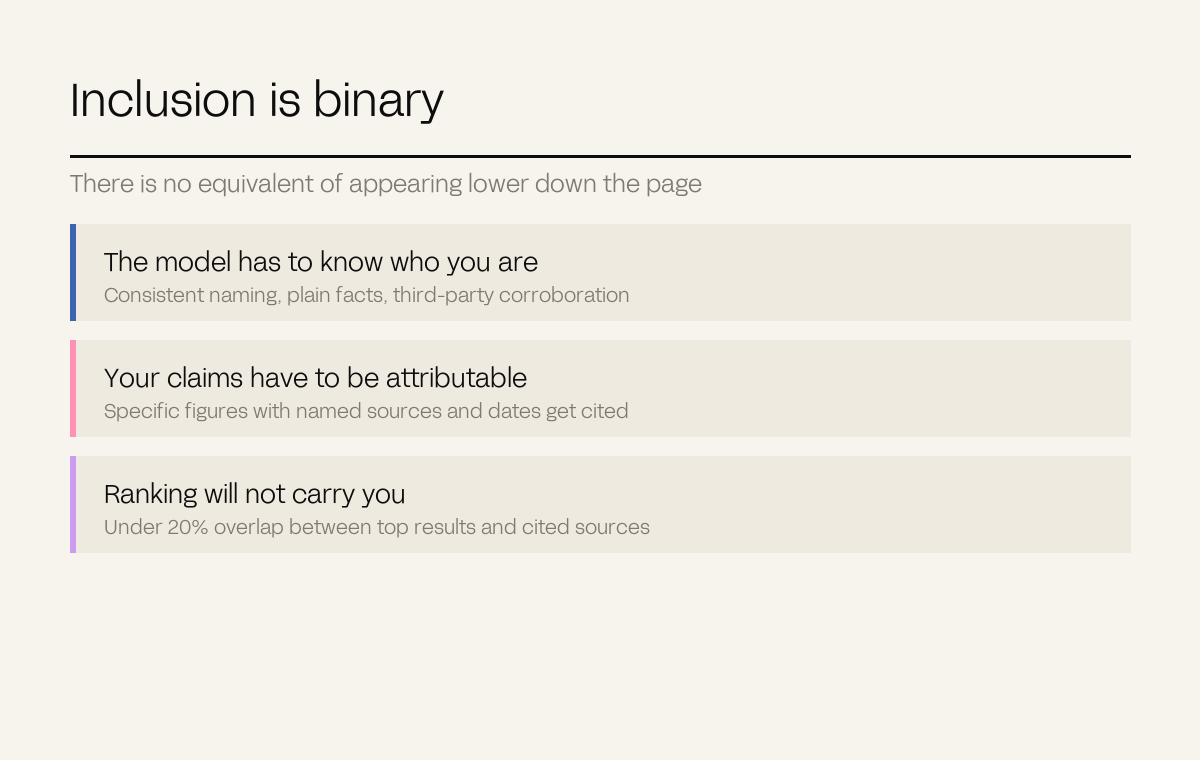
A shopper asking for the best option in your category receives a short list. Being on it is binary. There is no equivalent of appearing lower down the page, no impression, no partial credit.
That makes it structurally more like retail distribution than advertising: you are either stocked in that consideration set or you are not, and no amount of spending elsewhere compensates.
Recommendation requires confident identification. Consistent naming, plainly stated organisational facts, and corroboration from third-party sources are what produce that confidence – the full argument is in The Entity Problem.
Specific figures tied to named sources with dates get cited. Vague category language gets absorbed into a summary that credits nobody.
The overlap between Google's top results and AI-cited sources has fallen from around 70% to under 20%, and 28.3% of ChatGPT's most-cited pages have no Google organic visibility at all. A strong SEO position is not a proxy for being recommended.
Ask ChatGPT, Gemini and Perplexity what the best options are in your category, in the words a customer would use. Then ask them to describe your company specifically.
Record three things: whether you appear unprompted, whether the description is accurate, and who does appear if you do not. The third is often the most useful competitive intelligence available, because it tells you which brands the models consider legible.
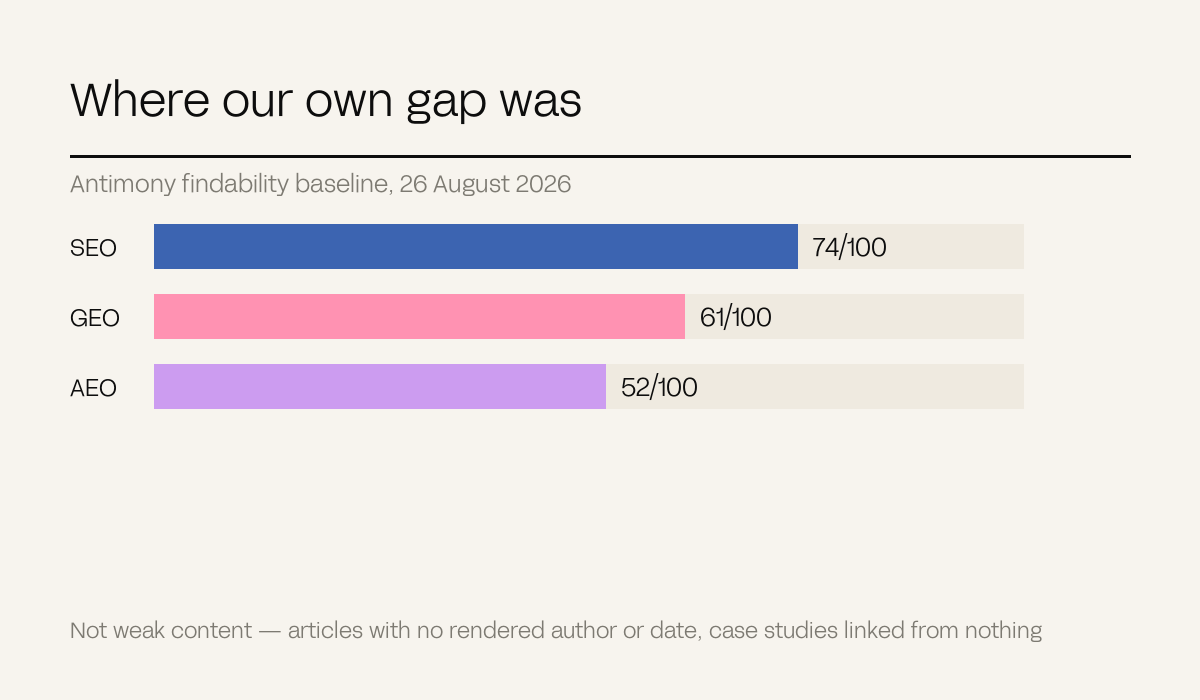
We ran this on ourselves and scored SEO 74, GEO 61, AEO 52. The SEO number was comfortable; the answer-engine number was barely half marks.
The cause was not weak content. Our journal articles rendered no author or publish date despite the CMS holding both, our case studies were linked from nothing, and our own company name was misspelled in the site-wide copyright line.
The general rule: most AI visibility problems are legibility problems in material you have already published. Before commissioning content for the assistant era, make what exists state its facts plainly, attribute its claims, and link to its evidence. That is a template change, not a programme.
Definitions. Consideration set: the shortlist a buyer chooses from. AEO: answer engine optimisation.