


.png)
Let’s talk

Thank you! Your submission has been received!
Oops! Something went wrong while submitting the form.
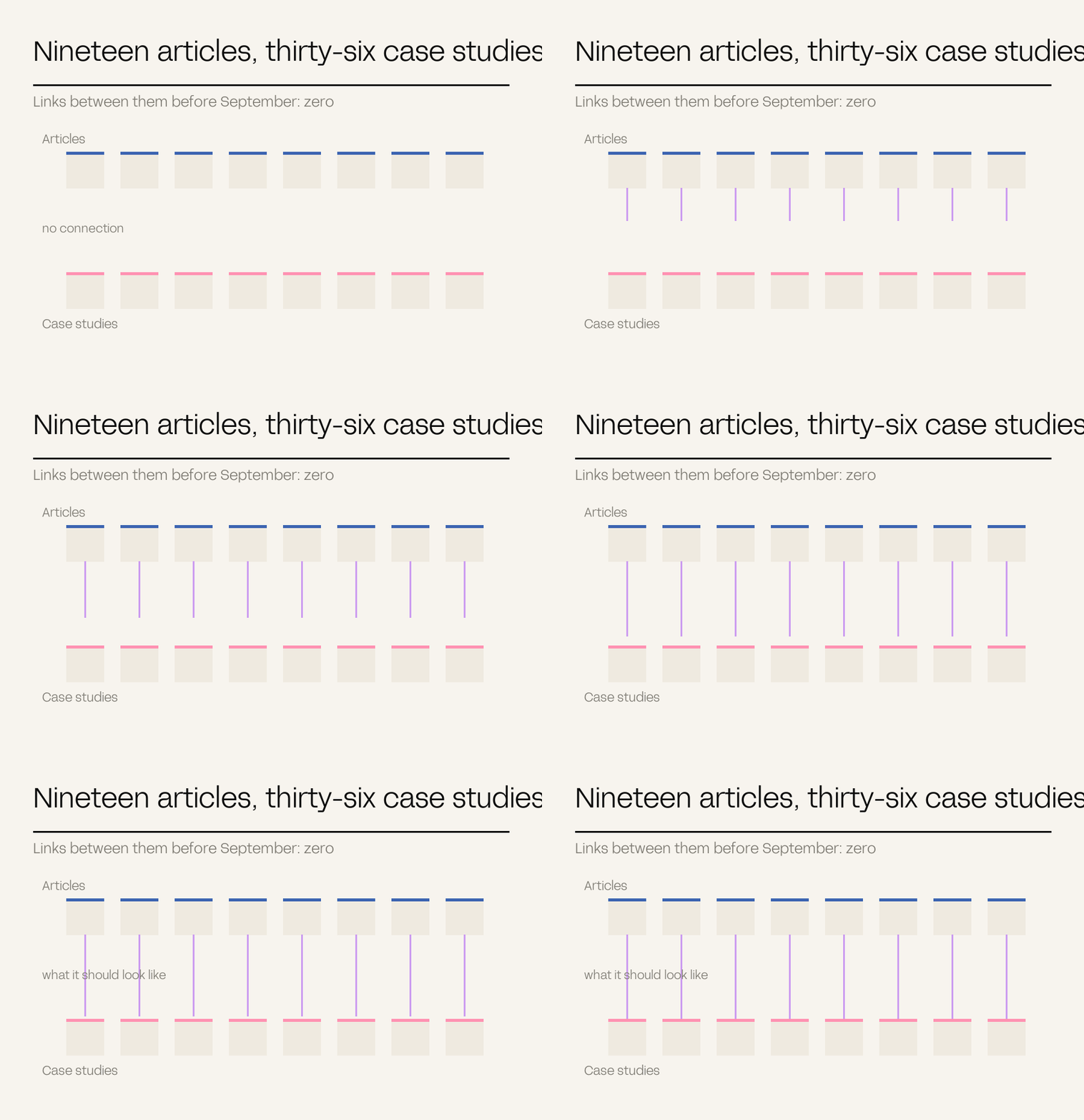
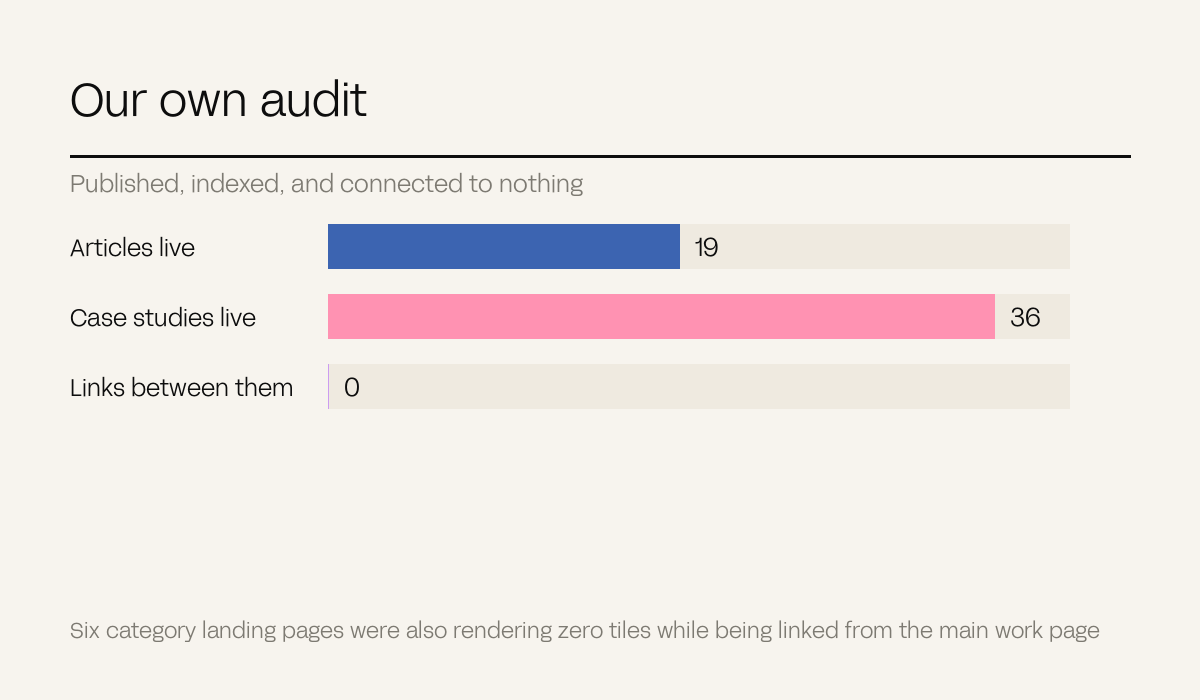
Most content libraries have a structural hole: the pages carrying the real evidence – case studies, results, proof – are never linked from the pages making the arguments. We audited our own journal and found zero links to any case study across all nineteen live articles, despite 36 case studies with named clients and real figures.
Here is an audit worth running this afternoon. Take your last twenty articles and count the links from them to your case studies, results pages or product documentation. For a lot of sites the answer is zero, and it was zero for us.
Nineteen live journal articles. Thirty-six published case studies with named clients and quantified results. Zero links between them.
Every article argued from first principles while the evidence sat one click away, unreferenced. Not buried – published, indexed, and simply disconnected from everything that made the argument it proves.
The most expensive content problem is rarely missing content. It is published content that nothing points at.
– The Antimony position
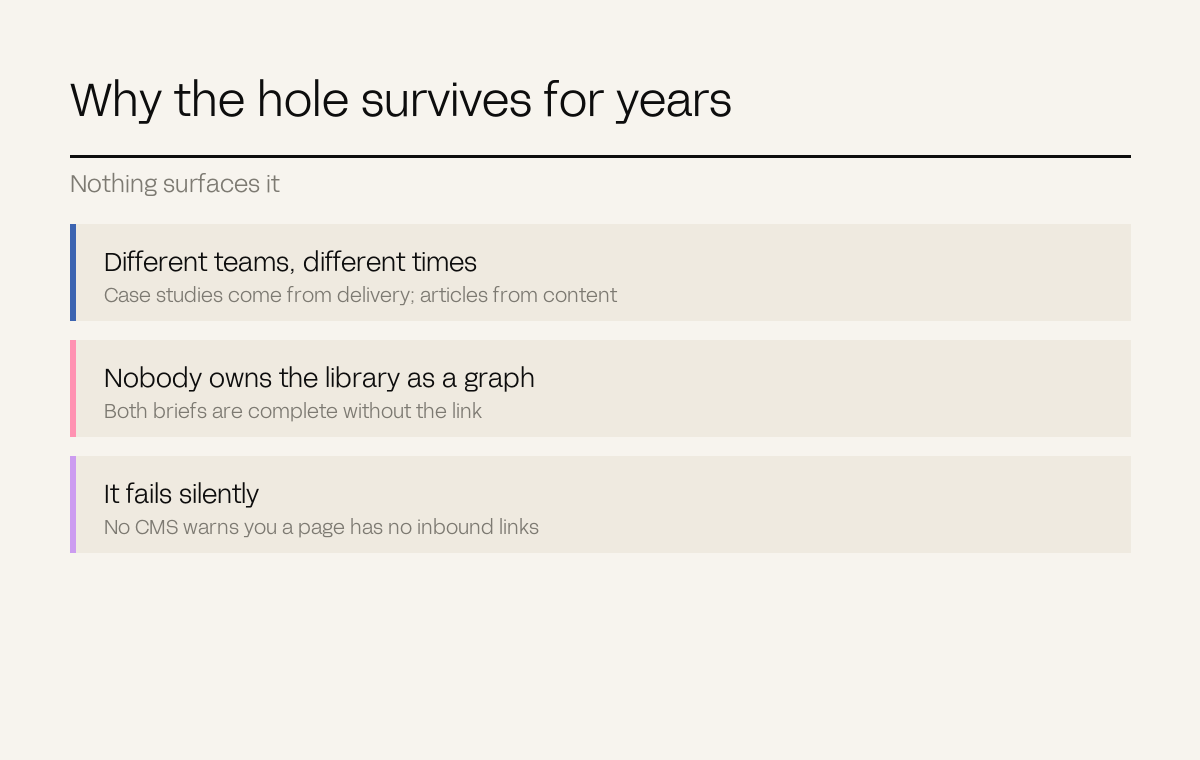
Different people, different times, different systems. Case studies are made by the team that did the work; articles are made by whoever owns content. Neither has linking to the other in their brief, and no single person is looking at the library as a graph.
It also survives because nothing surfaces it. No CMS warns you that a page has no inbound links. It fails silently for years.
Named clients, real figures, dates, specifics – exactly the material AI systems prefer to quote. An unlinked case study is a strong page with weak standing.
A claim with a link to its evidence is attributable. The same claim floating free is category knowledge that anyone can repeat without crediting you.
Internal links are the clearest statement you can make about relative importance. A page nothing links to reads as a page you do not think is important.
Fixing the links exposed a worse problem. Our /work page had category filter buttons – All, Fashion, Property, Retail, Technology – that were links to category pages rather than on-page filters. Those category pages rendered zero case study tiles. Clicking a filter took you to a blank page.
Meanwhile the filtering library was wired to the wrong element entirely, which is why on-page filtering never worked and the buttons became links in the first place.
The general rule: broken internal architecture usually presents as a content problem. Somebody concludes the case studies are not converting, when in fact one of the two routes to reach them was a dead end. Before commissioning content, walk your own site as a stranger would and click the things a stranger would click.
Take your ten strongest evidence pages and list the claim each one proves. Then take your twenty most-read articles and find where those claims already appear in the text. The links write themselves, because you are connecting an assertion you already made to proof you already published.
Resist adding a "related content" module instead. Contextual links inside the argument carry meaning; a grid of thumbnails at the foot of the page carries almost none.
Definitions. Internal link: a link from one page on your domain to another. Orphan page: a page with no inbound internal links.