


.png)
Let’s talk

Thank you! Your submission has been received!
Oops! Something went wrong while submitting the form.
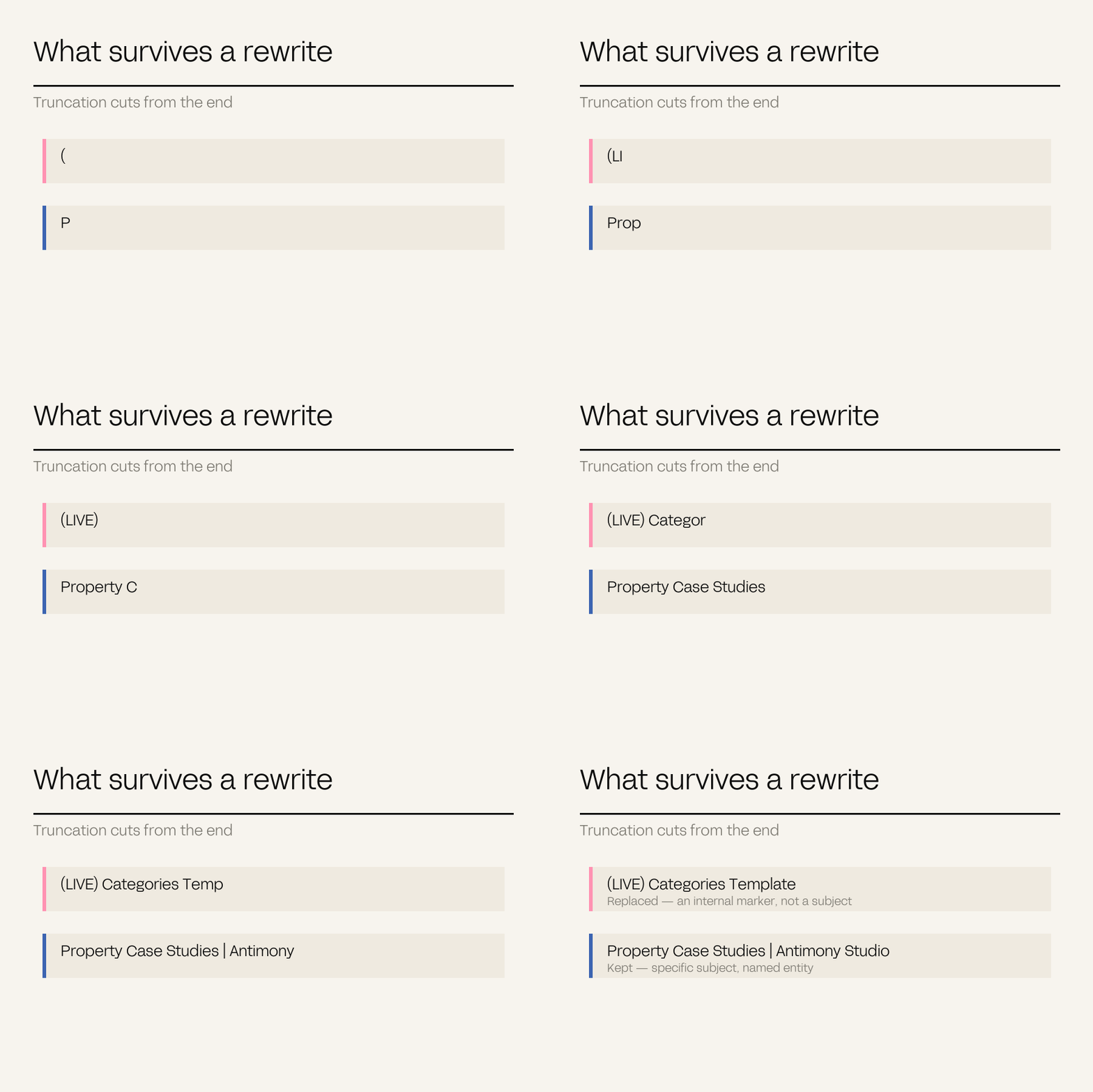
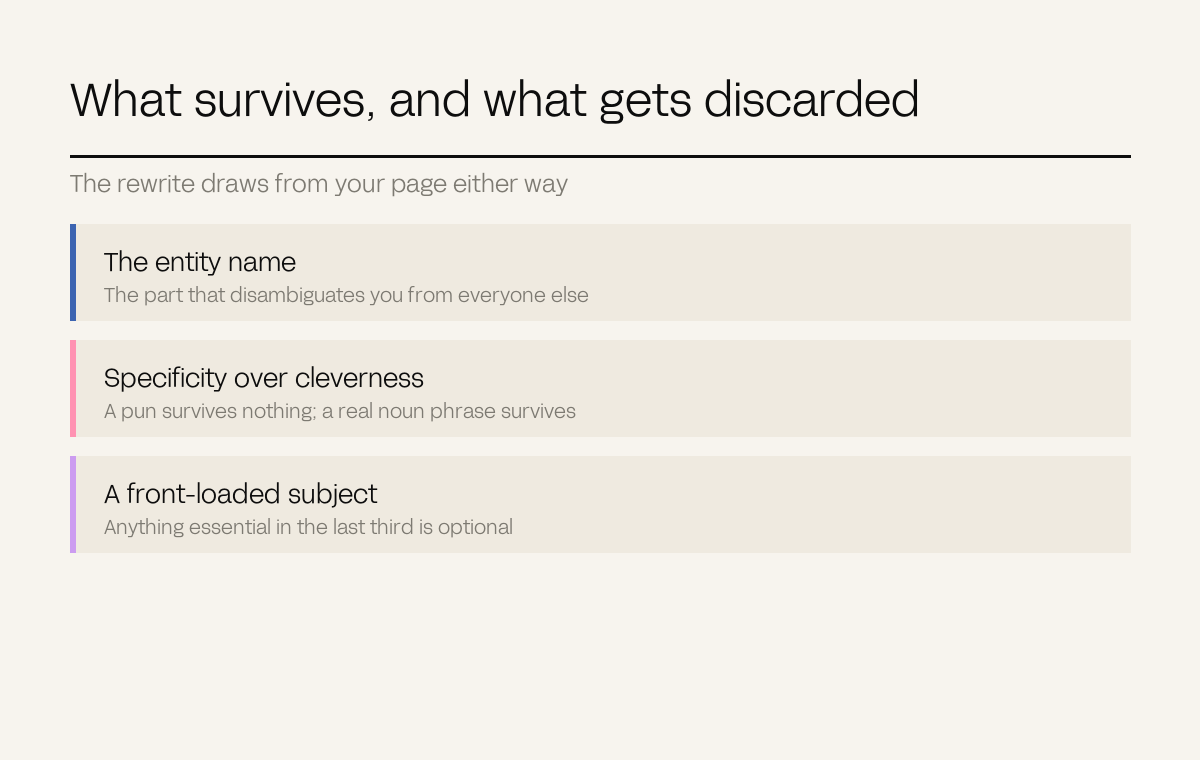
Google rewrites title tags when it judges them unhelpful, and AI summaries re-describe pages entirely. What survives both is a title that names the entity and states the specific subject. Clever, vague or templated titles get replaced. And a bad title can persist in search results long after you fix it, because reindexing lags.
You do not fully control how your page is titled in a search result any more, and you never control how it is described in a generated answer. Both are rewritten from your content when the original is judged unhelpful.
Google replaces a title tag when it thinks a better one exists on the page – typically when the tag is templated boilerplate, keyword-stuffed, far too long, or fails to describe what the page actually contains. An AI summary goes further: it describes the page in its own words entirely.
In both cases the rewrite is drawn from your page. So the practical question is not how to prevent it, but what the rewriter has to work with.
You cannot stop the rewrite. You can decide what it has to draw from.
– The Antimony position
A title naming the organisation gives the rewriter something it will usually keep, because it is the part that disambiguates. A title that could belong to any company in your category is the easiest thing to discard.
A pun survives nothing. A specific noun phrase – the actual subject, the actual number, the actual place – survives, because it is the load-bearing information.
Truncation cuts from the end. Anything essential in the last third of a long title is optional as far as the result is concerned.
Our six category landing pages shipped with an internal build marker leaking into the title tag, so pages were publicly titled with a bracketed (LIVE) instead of their subject. Every category page in the sitemap advertised itself as a work-in-progress.
Fixing them was fast – they now read "Property Case Studies | Antimony Studio" with real meta descriptions. What was not fast was the correction reaching search results. Days after the fix, Google was still showing the old titles, because reindexing runs on its own schedule.
The general rule: title errors have a long tail. The cost is not the mistake, it is the lag between fixing it and the fix being visible – which is why titles deserve checking on publication rather than at the next audit. Check what is actually rendered on the live page, not what your CMS field says, since a template can inject anything between the two.
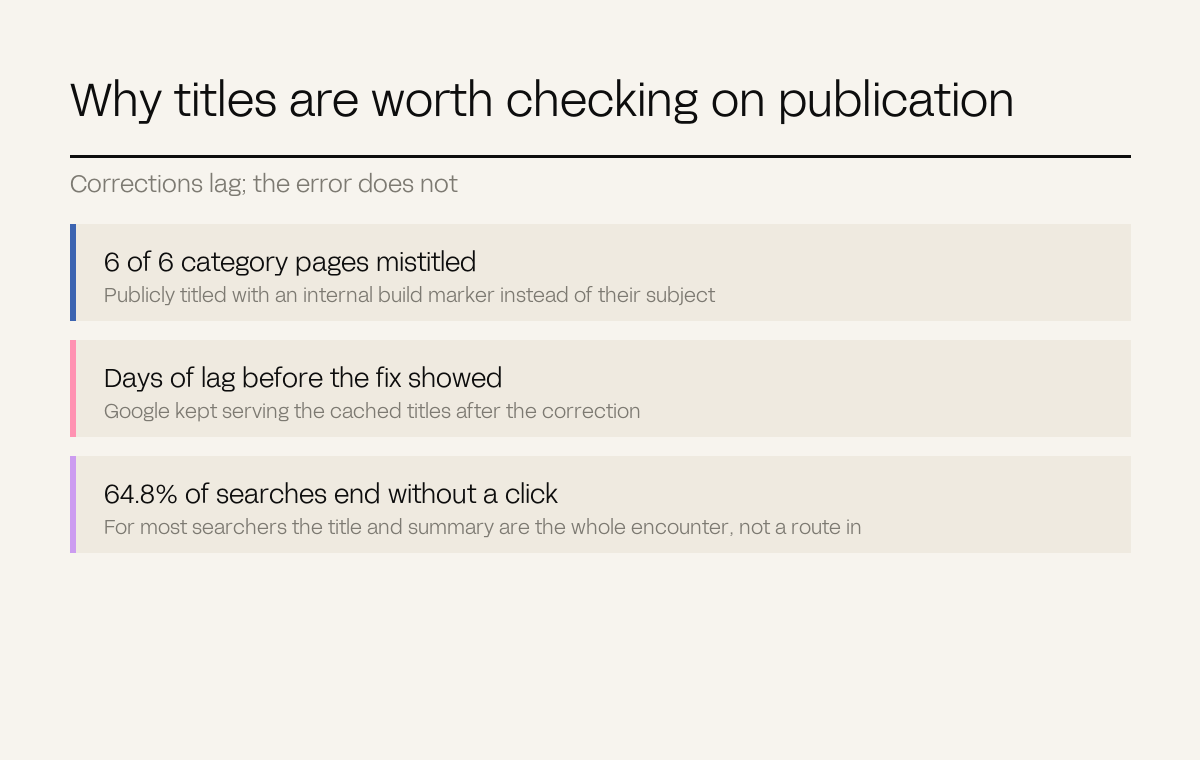
That last figure is the argument for taking titles seriously. For roughly two thirds of searches, the title and its summary are not a route to your page – they are the entire encounter.
Name the specific subject in the first few words. Include the entity. Keep it short enough that nothing essential can be truncated. Skip the wordplay, and skip the templated suffix that appears identically on every page – it is the first thing a rewriter throws away.
Definitions. Title tag: the HTML element defining a page's title. Reindexing: the process by which a search engine refreshes its stored copy.