


.png)
Let’s talk

Thank you! Your submission has been received!
Oops! Something went wrong while submitting the form.
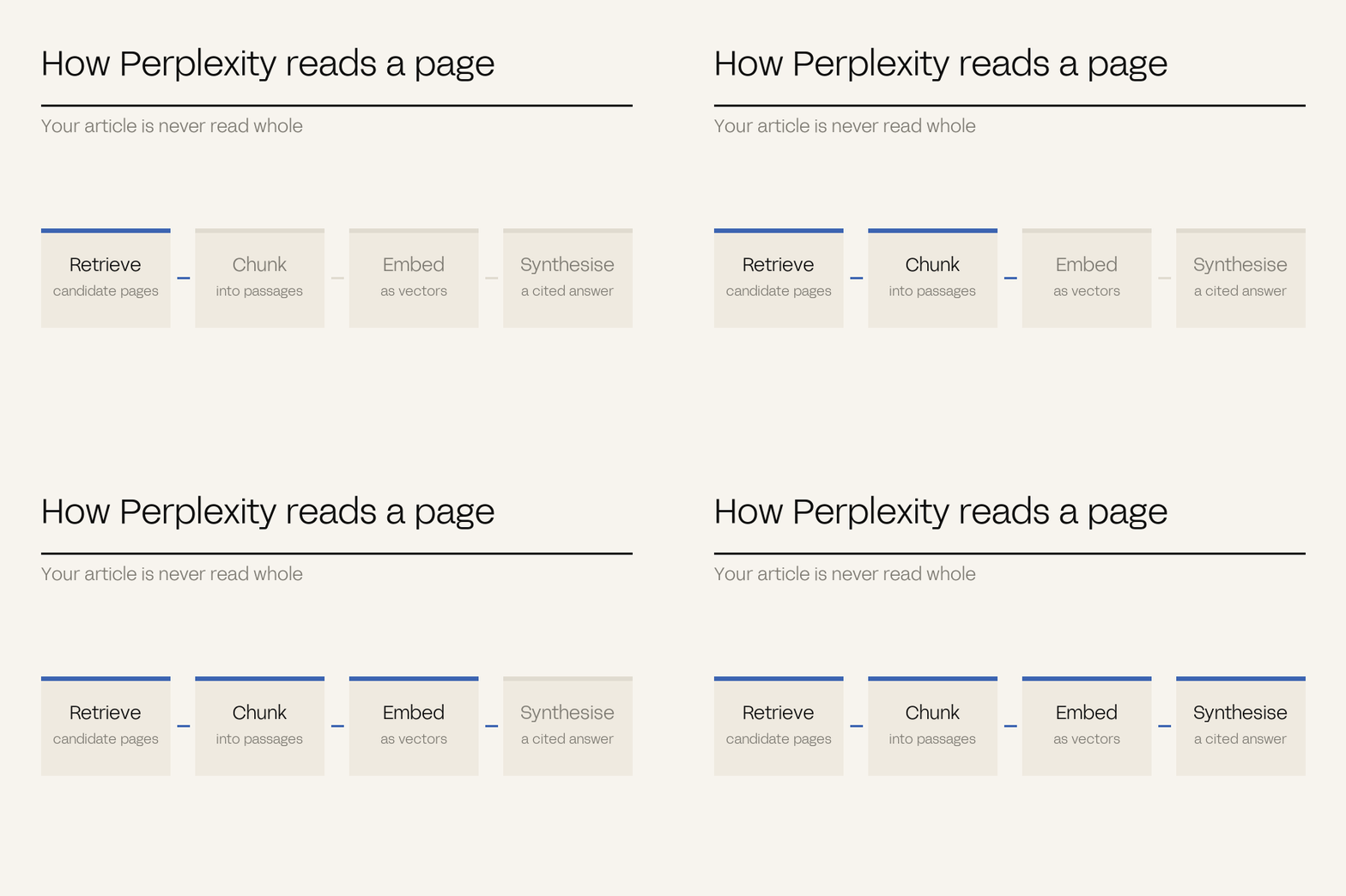
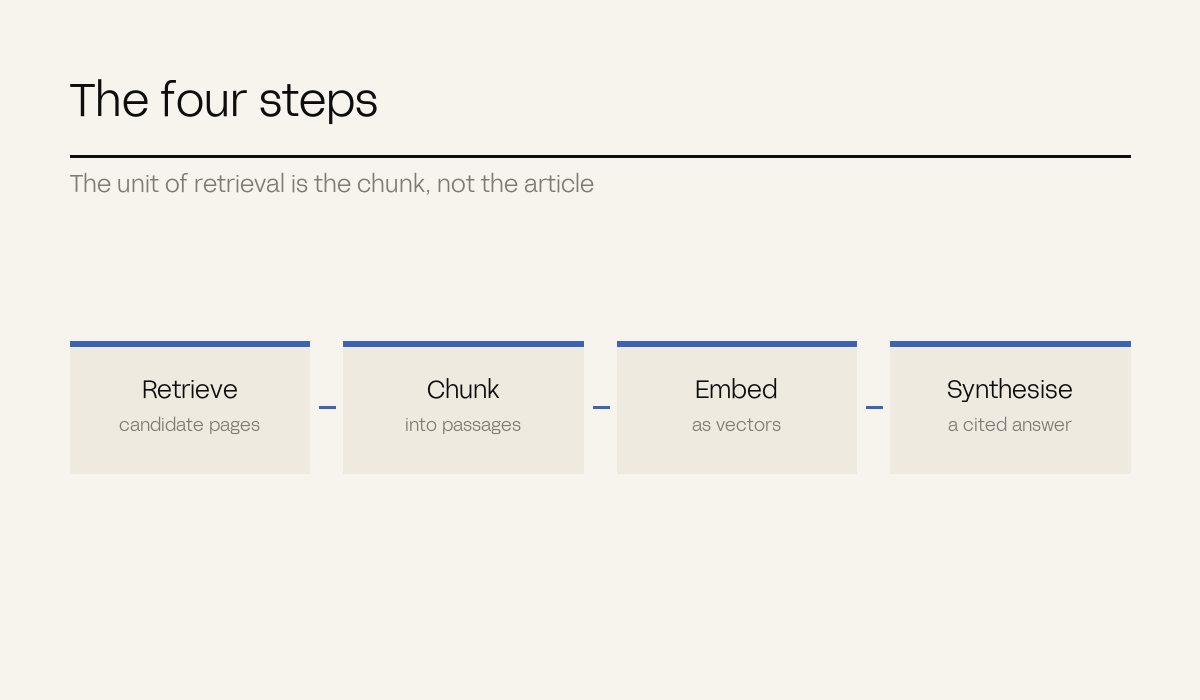
Perplexity uses retrieval-augmented generation: it retrieves candidate pages, splits them into chunks, converts those to vectors, and synthesises a cited answer from the pieces it selects. Your page is never read as a whole. The practical consequence is that every section must make sense on its own, because a section is the unit that gets quoted – not the article.
If you want your content cited by an AI search engine, it helps enormously to know what actually happens to it. The mechanism is not mysterious, and once you know it the writing rules become obvious.
Perplexity runs on retrieval-augmented generation. Four steps:
Notice what is absent. At no point is your article read from top to bottom as an argument. The unit of retrieval is the chunk. Your page is a container that gets dismantled.
You are not writing an article any more. You are writing a set of passages that each have to survive alone.
– The Antimony position
A good deal of conventional content craft, as it turns out.
The classic structure – context, tension, build, reveal – puts the answer in a chunk that only makes sense after the ones before it. Retrieved alone, that chunk is a conclusion with no premises. It will not be selected, and if it is, it will not be understood.
"This approach works because…" is fine when read in order. Retrieved on its own it is unintelligible: which approach? A chunk that begins with an unresolved reference is a chunk that cannot be quoted. Name the thing again, even when it feels repetitive to a linear reader.
A table of results three sections below the client it belongs to is orphaned data. "243% in year one" is uncitable without knowing who and what. Keep the figure and its subject inside the same passage.
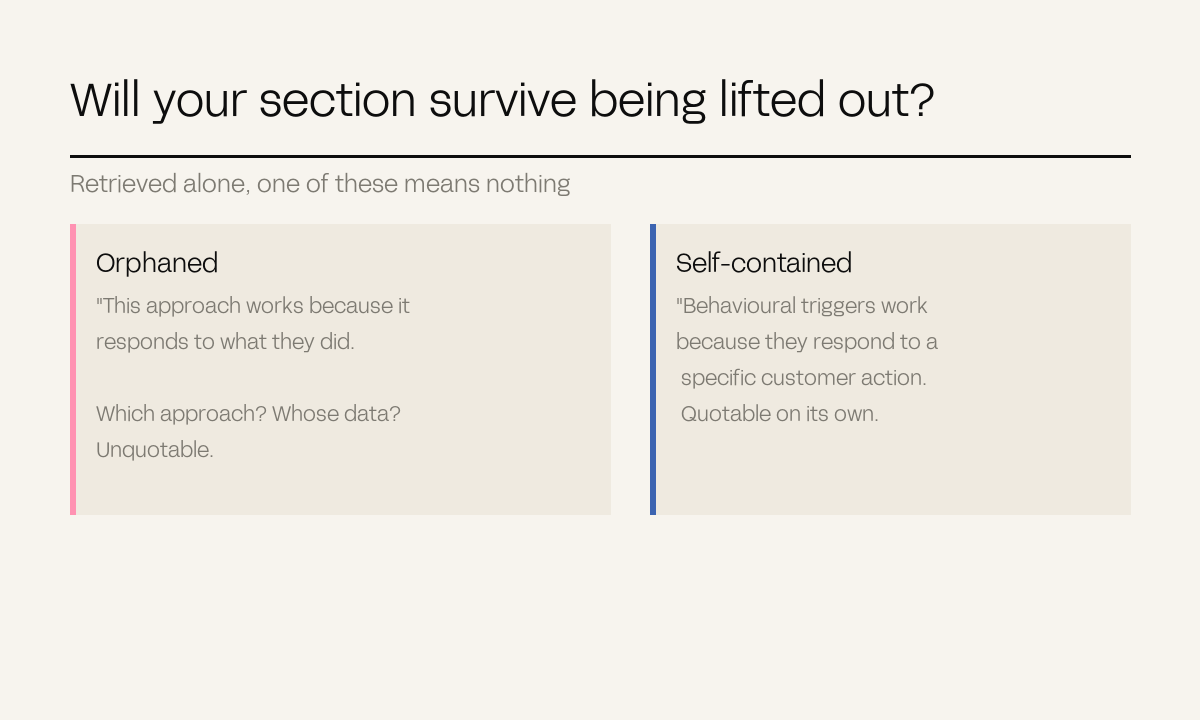
Write in self-contained sections. Each one restates its subject, makes one point, and carries whatever evidence that point needs. A reader going straight through will notice slightly more repetition than they are used to; they will not mind, and the trade is worth it.
Put the answer first within each section. Lead with the claim, then support it. Both a skimming human and a retrieval system reward the same shape.
Use headings that are questions or claims, not labels. "Why behaviour beats the calendar" gives a chunk its context in its own first line. "Background" gives it nothing.
Keep one idea per section. Two arguments in one passage means neither is a clean match for a query, and the chunk loses to a competitor that only makes one point.
Those figures describe a system selecting passages on their merits rather than inheriting a ranking. Which is good news for anyone willing to write for it: the barrier is craft, not domain authority.
Writing this way is a genuine constraint on style. Deferred reveals, running arguments and long builds are real tools and this mechanism penalises all of them.
We are not going to pretend the cost is imaginary. The slow build, the argument that earns its conclusion, the paragraph that lands only because of the three before it – these are real instruments, and this mechanism is deaf to all of them. A piece written to survive chunking is a slightly flatter read than the same piece written for someone with ten minutes and no hurry. Anyone telling you the constraint is pure upside is selling something.
We accept it anyway, for two reasons. Most business writing defers its answer out of habit rather than craft, so for the majority of pages the discipline costs nothing real and exposes sections that were never carrying a point. And the alternative is writing beautifully for an audience that increasingly meets you as three retrieved sentences, or not at all.
Where the long form genuinely is the work – a case study, a manifesto, something meant to be read whole by someone who chose to – write it whole and accept that it will be cited less. That is a legitimate trade in the other direction, and worth making on purpose rather than by accident.
Definitions. RAG: retrieval-augmented generation. Chunk: a passage a page is split into for retrieval. Embedding: a numeric vector representing meaning, used to match passages to a query.