


.png)
Let’s talk

Thank you! Your submission has been received!
Oops! Something went wrong while submitting the form.
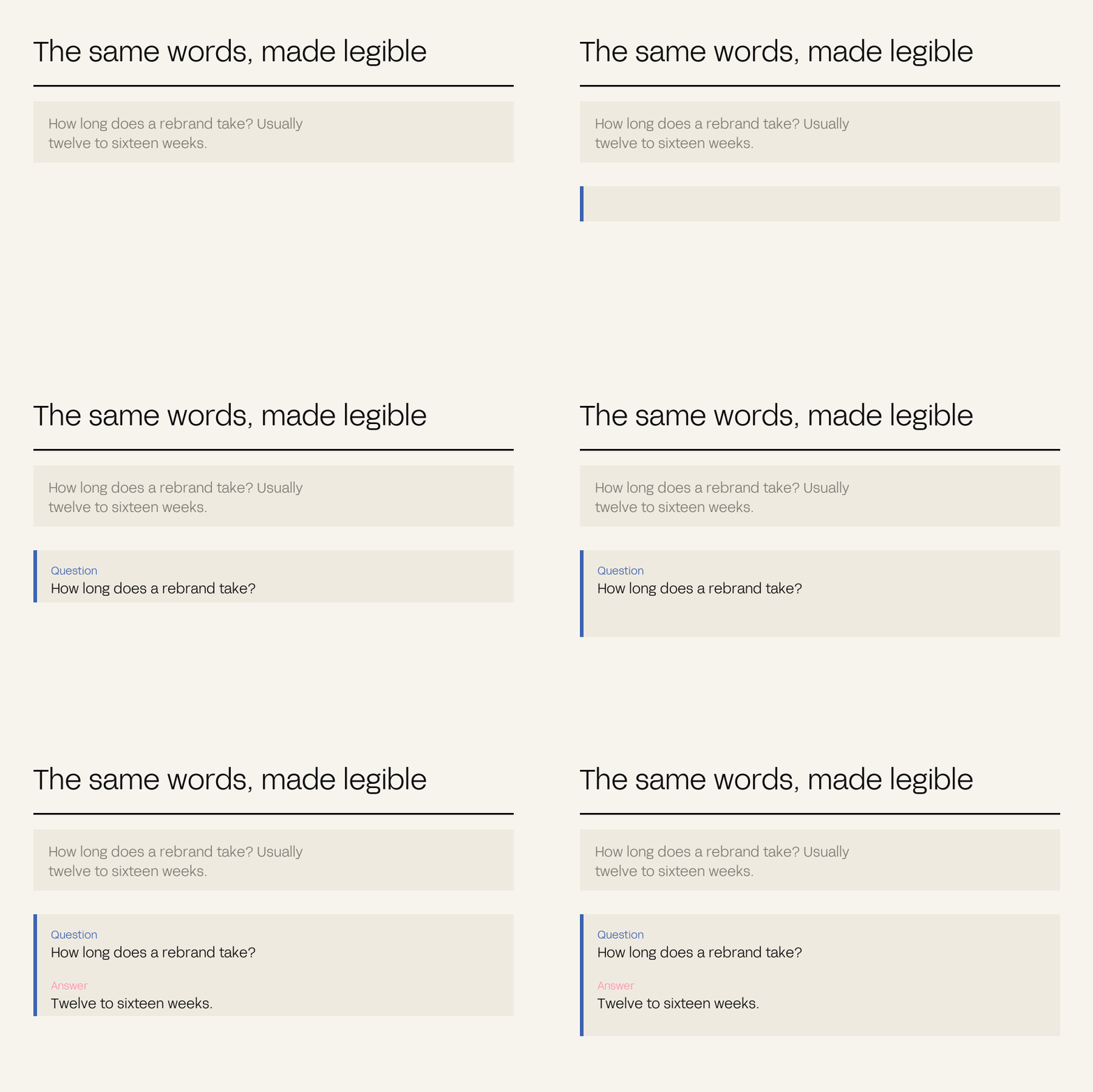
Schema markup has changed jobs. Google used it to decorate a result; AI systems use it to understand what a page asserts and to attribute it confidently. A study of 1,000 Google AI Overviews found schema-marked pages cited more often than unstructured equivalents even after controlling for domain authority. Implement in order: Organization, then Article with author and date, then FAQPage.
Most marketers filed schema markup under technical SEO some years ago, implemented a little of it for rich snippets, and stopped thinking about it. It has since become one of the highest-leverage things you can do, for an entirely different reason.
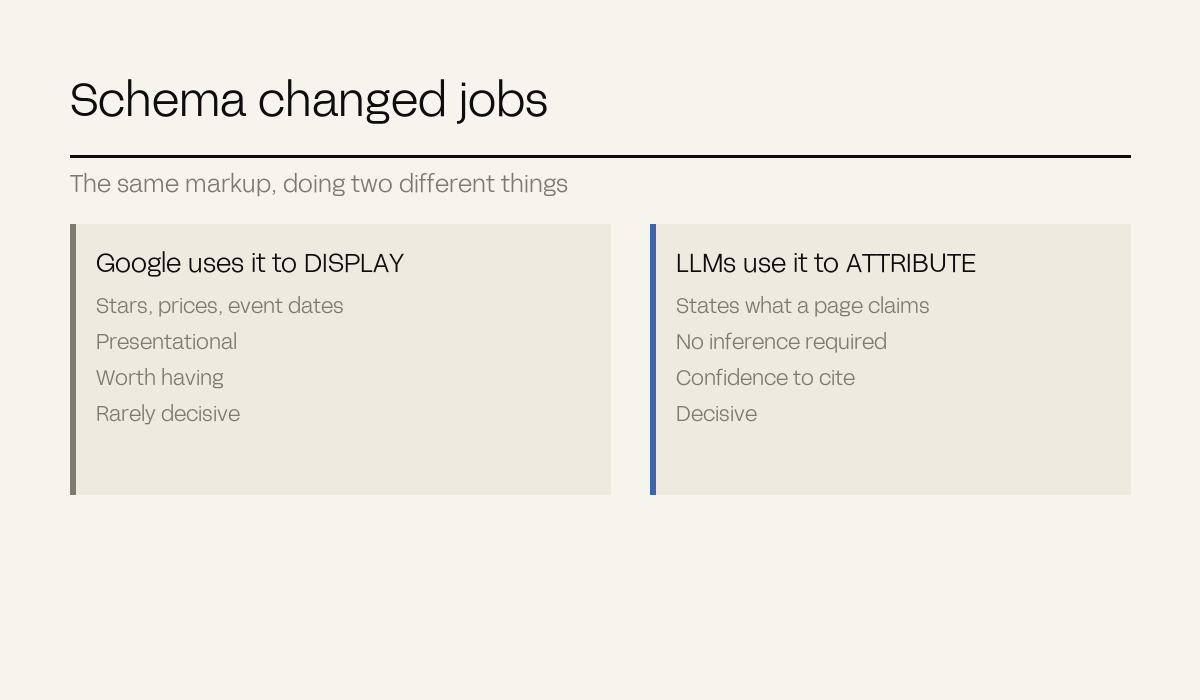
The distinction is worth stating exactly, because everything follows from it. Google uses structured data to display information. Language models use it to understand and attribute information.
For Google, schema was presentational – stars in a result, a price, an event date. Worth having, rarely decisive. For a retrieval system assembling an answer, schema is something else: an explicit, machine-readable statement of what a page claims, in a form that requires no inference. The model does not have to work out that a passage is answering a question. You have told it.
Confidence is what gets you cited. Structured data is the cheapest confidence you can give a machine.
– The Antimony position
We have deliberately left the eye-catching number out of this article. Several vendors in the AI-visibility tooling market publish very large citation-lift percentages for FAQ markup, and those figures arrive without stated methodology, sample size or control group. The AI Overviews study is a smaller claim and a far better-evidenced one. It is the one worth acting on.
Because it matches the shape of the task. An AI system is answering a question. FAQPage schema hands it a question paired with an answer, explicitly labelled as such, already self-contained.
Everything a retrieval system has to infer from ordinary prose – is this a question, is this the answer, where does the answer end – is stated outright. When the model then attributes the claim, it can do so with the confidence that produces a citation rather than an unattributed paraphrase.
ChatGPT and Perplexity have been observed treating structured data largely as text on the page rather than parsing it as a separate layer. That sounds like it undermines the case. It does not – it changes the instruction. Your schema answers must be genuinely good prose, because they may be read as prose. Terse keyword-stuffed schema answers, which sometimes worked for rich snippets, are actively counterproductive here.
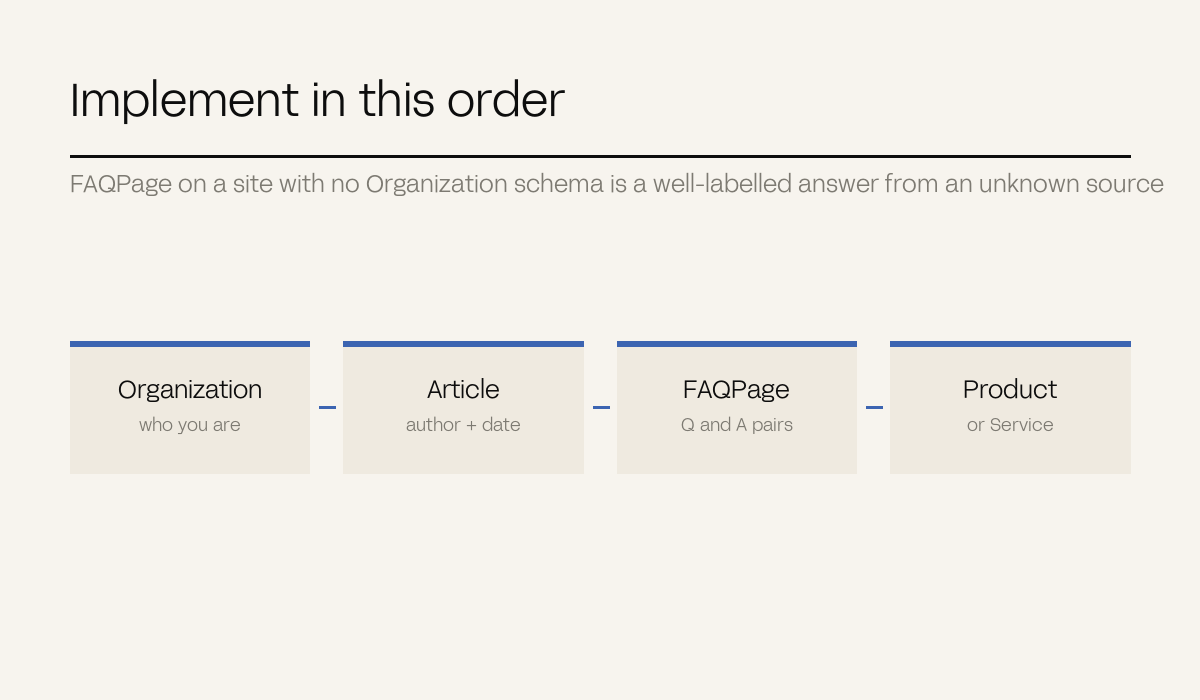
Start with Organization – who you are, where, what you do, with consistent naming everywhere. This is the entity foundation everything else attaches to. Then Article on every editorial page, carrying author and publish date, because provenance affects whether a model trusts a claim enough to quote it. Then FAQPage on the pages answering real questions. Then Product or Service where you have them.
Skip nothing in that order. FAQPage on a site with no Organization schema is a well-labelled answer from a source the model cannot identify.
We had Organization schema and nothing else. Our journal articles shipped without datePublished or author, because the fields existed in the CMS and were never rendered into the page – the data was there, invisible to everything reading it.
We fixed it in the order above: a real byline and dateline rendered on every article, which then fed the Article schema automatically. It cost an afternoon.
The general rule: the gap is almost never missing data. It is data the page holds and never states. Before you build anything, audit what your CMS already knows that your rendered HTML does not say out loud – author, date, category, price, location, review count. Rendering it is usually a template change, not a project.
The same principle runs through our client work. RT Edgar had the market authority and no system to express it consistently; making it legible across the network lifted organic property enquiries 41%. Legibility, not new substance, is the common fix.
Definitions. Schema markup: structured data describing a page's content in a machine-readable vocabulary. FAQPage: the schema type pairing questions with answers.